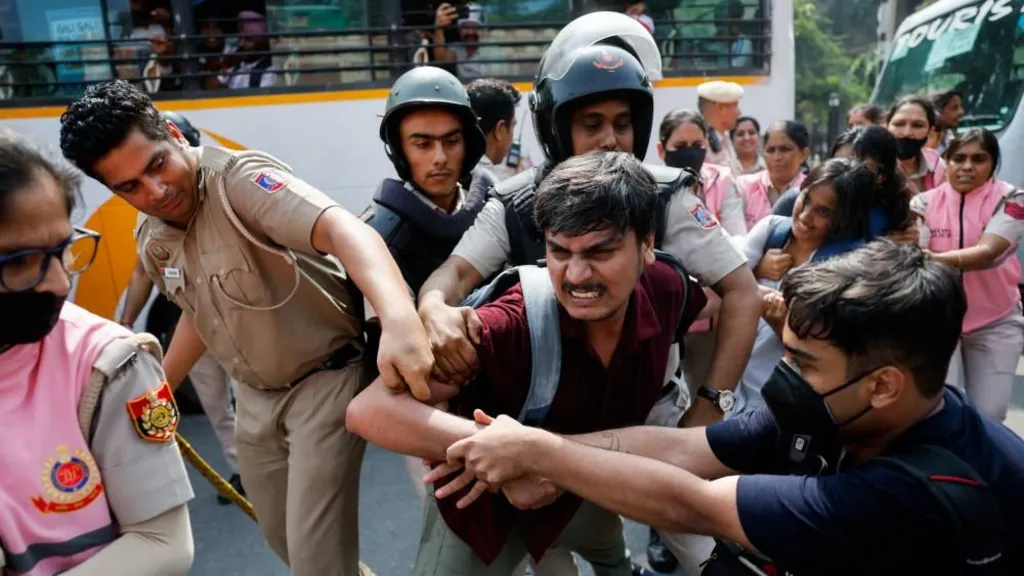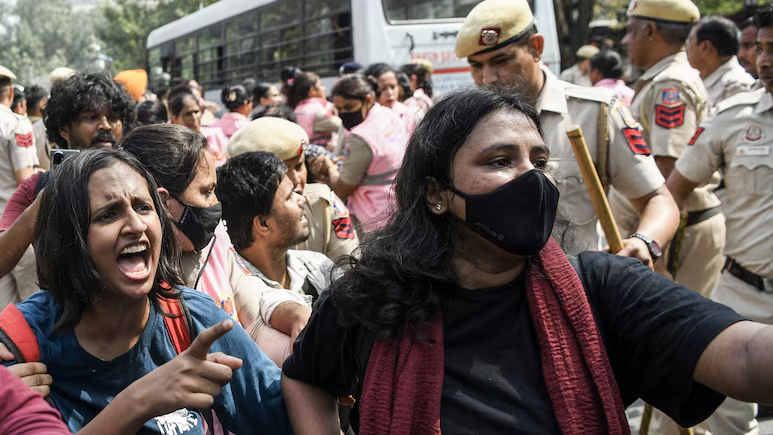

Women protesters have emerged as an important part of India’s growing Cockroach Janta Party movement, a youth-led campaign that has challenged the government over concerns surrounding examinations, education and employment. The movement, which initially gained attention through online satire and humour, has developed into a wider protest campaign involving young people across different parts of the country.
The Guardian recently highlighted the experiences of women involved in the protests, focusing on activists and organisers who have chosen to publicly challenge issues they believe are affecting young Indians. The protesters come from different backgrounds, including students and activists, but share concerns about accountability, opportunity and what they describe as failures within important public institutions.
The Cockroach Janta Party, commonly referred to as the CJP, is not a conventional political party in the traditional sense. It began as an online movement and used the image of the cockroach as a symbol of persistence and resistance. Supporters have used humour, memes, masks and unconventional slogans to express dissatisfaction with the political establishment.
The movement’s unusual name is part of its strategy. Supporters have suggested that young people may be treated as insignificant by those in power, but, like cockroaches, they can survive difficult circumstances and continue to organise. The movement’s first major public demonstrations attracted thousands of young people and quickly turned the online campaign into a visible street protest.
Women participating in the movement have brought their own experiences and concerns into the protests. Their involvement has helped broaden the campaign beyond a single education-related issue, while also demonstrating the willingness of young women to participate directly in political and social activism.
The protests have largely been driven by anger over examination-related problems, including alleged question-paper leaks, cancellations and other irregularities. Education has become a particularly sensitive issue for young Indians because competitive examinations can determine access to universities, professional careers and government employment.
The movement gained significant momentum during nationwide student demonstrations. Protesters demanded accountability from the government and called for action over problems affecting the examination system. The demonstrations eventually created enough political pressure to contribute to the resignation of Education Minister Dharmendra Pradhan in July, according to reporting by The Guardian.
The resignation was seen by supporters as an important victory, but the movement did not disappear immediately. Instead, disagreements developed over what protesters said were government commitments concerning students who had participated in demonstrations.
The Cockroach Janta Party subsequently accused authorities of failing to honour assurances that protesters would not face punitive action. The movement said students had been detained or harassed in several states and warned that protests could resume.
The protests have also become part of a broader debate about the relationship between India’s young population and its political institutions. Many of the demonstrators are members of Generation Z or young millennials who communicate primarily through social media and are comfortable using internet culture to express political opinions.
This has produced a style of protest that differs considerably from traditional political demonstrations. Instead of relying only on speeches, banners and established political organisations, CJP supporters have used memes, satire and viral content to attract attention.
The movement’s use of humour has also allowed protesters to criticise political leaders and mainstream television media in ways that are designed to spread rapidly online. Earlier reporting by The Guardian described how Cockroach movement protesters used memes, mockery and collective action to challenge what they regarded as failures in mainstream coverage of issues affecting young people.
Women involved in the movement have had to navigate the additional challenges that can accompany public political activism. Speaking publicly about political and social issues can expose activists to criticism, online abuse and pressure, particularly when they challenge established political narratives.
The Guardian’s latest report profiles women who have nevertheless chosen to remain involved, portraying them as part of a broader generation that is increasingly unwilling to remain silent about issues they believe will affect their future.
The movement’s rise has also been linked to wider concerns about employment. For many young Indians, examination irregularities are connected to a much larger problem: the intense competition for limited educational and employment opportunities.
A failed or cancelled examination can have consequences that extend far beyond one test. Students may spend years preparing for competitive examinations, often investing significant amounts of money and time. When examinations are disrupted, delayed or affected by alleged leaks, students can feel that their efforts and opportunities have been unfairly undermined.
These frustrations have helped create a wider constituency for the movement. Although the immediate protests focused heavily on education, supporters have also raised concerns about jobs, government accountability and political decision-making.
The movement’s political significance became clearer when the Bharatiya Janata Party suffered a notable electoral setback in a Bihar byelection in a constituency it had held for decades. The result was not proof that the Cockroach movement alone caused the defeat, but opposition leaders presented it as evidence that the wider student protests could be beginning to affect political sentiment.
The CJP’s relationship with conventional politics remains complicated. Its supporters have attempted to position the movement as a grassroots expression of public frustration rather than simply an extension of an established political party.
At the same time, its protests have inevitably become part of India’s wider political debate. Opposition parties have sought to highlight the demonstrations as evidence of dissatisfaction with the government, while supporters of the ruling establishment have questioned the movement’s motives and political affiliations.
The use of the word “party” in the movement’s name can therefore be misleading if interpreted as meaning a conventional electoral organisation. Its identity has largely been built around protest, online mobilisation and political satire rather than the established structures associated with India’s recognised political parties.
Another important aspect of the movement has been its ability to bring online communities into physical protests. The CJP initially developed through social media, but supporters eventually moved onto the streets, organising demonstrations in Delhi and other cities.
Jantar Mantar in New Delhi became one of the important locations associated with the protests. The historic protest site has hosted demonstrations on numerous political and social issues over the years. CJP protesters gathered there while raising concerns about examinations, education and government accountability.
The movement has also faced confrontation with authorities. Reports have described arrests and detentions of protesters in several states, contributing to further tension between organisers and the government. The CJP has argued that such actions contradict assurances made to students after the resignation of the education minister.
The participation of women is significant because it demonstrates that the movement is not limited to a narrow group of male student activists. Women have taken visible roles as protesters, organisers and campaigners, bringing their own perspectives to discussions about education, employment and political accountability.
For many of these women, participation is also connected to the broader question of what kind of society young Indians will inherit. Their concerns extend beyond immediate examination problems to questions about fairness, opportunity and whether young citizens feel adequately represented in political decision-making.
However, the movement’s future remains uncertain. Sustaining a large protest campaign is considerably more difficult than creating a viral online movement. Organisers must maintain public support, coordinate demonstrations, respond to government action and prevent internal disagreements from weakening the campaign.
There are also questions about whether the movement can translate street mobilisation into lasting political influence. Protest movements can generate significant public attention without necessarily becoming electoral forces. The CJP’s long-term impact will therefore depend on whether it can maintain its grassroots support and articulate clear demands beyond individual government resignations.
For now, however, the Cockroach Janta Party has demonstrated the power of youth-led political mobilisation in an increasingly digital India. Its use of humour and internet culture has allowed young protesters to communicate with audiences that may not respond to traditional political messaging.
The prominent involvement of women adds another dimension to that story. Their participation reflects a broader willingness among young Indian women to engage openly with political issues and challenge institutions they believe have failed them.
The movement’s rise also illustrates how quickly an online joke can develop into a serious political campaign when it connects with existing public frustration. What began with a deliberately unconventional identity has become a national protest movement capable of putting education, examination integrity and youth concerns at the centre of political discussion.
Whether the Cockroach Janta Party ultimately becomes a lasting political force or remains primarily a protest movement is still unclear. But its emergence has already demonstrated that India’s younger generation has new tools for organising, communicating and challenging political power.
For the women taking part, the protests represent more than a viral trend. They are an opportunity to make their voices heard on issues that directly affect their education, careers and future. As the movement continues to evolve, their participation is likely to remain an important part of the wider story of youth activism in India.