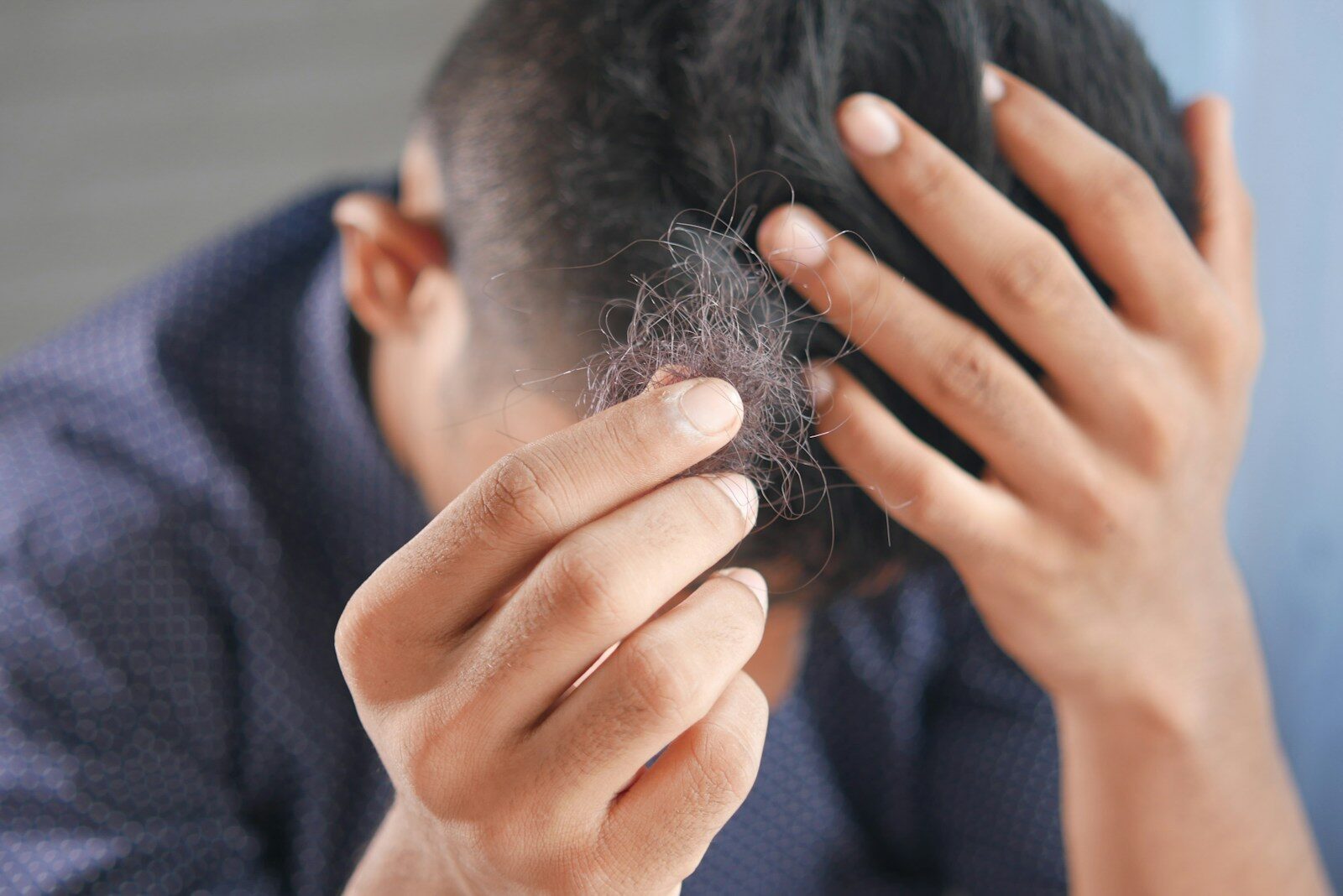
Finding more hair than usual on your pillow, clothes, comb, or shower floor can be worrying.
At first, you may think it is just normal shedding. Then you notice that your ponytail feels thinner, your part looks wider, or your hairline seems different in the mirror.
That is when the questions usually begin.
Why is my hair falling out?
Is my hair fall normal?
Can stress cause hair loss?
Am I deficient in vitamins?
Could my diet be responsible?
Is hair loss genetic?
Will my hair grow back?
Should I start using minoxidil?
These are some of the most common questions surrounding hair loss, but there is one important thing to understand from the beginning: hair loss is not one single condition.
Hair can fall out because of genetics, hormonal changes, stress, illness, nutritional problems, medications, scalp conditions, physical damage, or several factors occurring at the same time.
The American Academy of Dermatology describes hereditary hair loss as the most common cause worldwide, while also noting that childbirth, illness, stress, tight hairstyles, hair-care practices, autoimmune conditions, and other factors can contribute to hair loss.
That is why simply buying the latest “anti-hair-fall” shampoo may not solve the problem.
The better approach is to understand what type of hair loss you are experiencing and why it is happening.
Let’s look at the most common causes.
First, how much hair fall is normal?
Before assuming something is wrong, remember that everyone naturally loses hair.
The AAD says that losing around 50 to 100 hairs per day can be normal because old hairs are continuously shed while new hairs grow.
You may notice more hair on some days and less on others.
For example, if you do not wash your hair for several days, you might see a larger amount of loose hair when you finally shower.
That does not necessarily mean you suddenly developed a hair-loss disorder.
The more important warning signs are changes such as:
- A noticeably receding hairline
- A widening part
- Visible scalp
- A thinner ponytail
- Bald or patchy areas
- A sudden increase in shedding
- Hair breaking much more easily
- Continued thinning over several months
If you see these changes, it is worth investigating rather than simply counting hairs.
1. Hereditary hair loss
One of the most common reasons people gradually lose hair is genetics.
This is commonly called androgenetic alopecia, or hereditary hair loss.
It affects both men and women.
In men, it often appears as a receding hairline, thinning at the temples, or thinning around the crown.
In women, the pattern is often different. Overall thinning or a widening part may be more noticeable than a receding hairline.
The underlying issue involves genetically susceptible hair follicles gradually becoming smaller.
As follicles shrink, the hairs they produce can become finer and shorter.
This process can happen slowly, which is why many people do not notice it immediately.
You may look at an old photograph from three or four years ago and suddenly realize that your hair was considerably thicker.
That is one reason taking occasional photographs can be useful.
If you suspect hereditary hair loss, early professional evaluation is worthwhile because treatment tends to be more useful when started before substantial hair loss occurs. The AAD specifically notes that early treatment can improve outcomes.
2. Stress-related hair shedding
Yes, stress can contribute to hair loss.
But there is an important detail that many people misunderstand.
You might experience a major stressful event today and not notice significant shedding tomorrow.
Hair follicles follow a growth cycle, so stress-related shedding can appear later.
A common form is telogen effluvium, where a larger-than-usual number of hairs enter the resting phase and eventually shed.
Stress can be emotional, but it can also be physical.
Examples include:
- Major illness
- Surgery
- Significant weight loss
- Severe nutritional restriction
- Childbirth
- High fever
- Major emotional trauma
- Poor sleep combined with other physical stressors
Recent Cleveland Clinic guidance also notes that stress-related hair loss can occur after physical stressors such as rapid weight loss, illness, surgery, nutritional deficiencies, and poor sleep.
The confusing part is the delay.
You may blame today’s stress for today’s hair fall when the trigger may actually have happened several months earlier.
So when investigating sudden shedding, think backward.
Ask yourself:
What changed in my life a few months ago?
That question can sometimes provide an important clue.
3. Hair loss after illness or fever
Have you ever noticed significant hair shedding after recovering from an illness?
You are not imagining it.
A significant illness can place considerable physical stress on the body.
Some people then experience excessive hair shedding a few months later.
The AAD lists illness, high fever, and surgery among events that can be followed by increased shedding.
This type of shedding can be frightening because the original illness may already be forgotten.
You feel healthy again, but suddenly your shower drain seems full of hair.
In some cases, the shedding is temporary.
If the underlying trigger resolves, the hair-growth cycle may gradually return toward normal.
However, persistent or severe shedding should still be evaluated, especially if you notice visible thinning.
4. Postpartum hair loss
Postpartum hair loss is one of the most searched hair-related concerns among new mothers.
And there is a good reason.
During pregnancy, hormonal changes can alter the normal hair-growth cycle.
Many women notice that their hair looks unusually thick during pregnancy.
After childbirth, hormone levels change again, and hairs that remained in the growth phase during pregnancy can enter the shedding phase.
This can produce surprisingly heavy shedding.
Johns Hopkins Medicine describes postpartum hair loss as common and temporary, with hair generally returning toward its normal growth cycle within about 6 to 12 months.
The AAD similarly notes that postpartum shedding commonly peaks around four months after delivery, with many women regaining normal fullness by their child’s first birthday.
So if you recently had a baby and suddenly see lots of hair in your brush, do not automatically assume that you are permanently losing your hair.
However, if significant shedding continues beyond the expected recovery period or your hair does not regain fullness, it is worth speaking with a dermatologist.
Other factors, such as iron deficiency or thyroid problems, can sometimes contribute.
5. Rapid weight loss
This is an increasingly important hair-loss question.
People often focus on the number on the weighing scale but forget that the body also responds to rapid nutritional and metabolic changes.
Significant weight loss can sometimes trigger excessive hair shedding.
This is particularly relevant when someone dramatically reduces calories or protein.
The body needs adequate energy and nutrients for normal biological processes, including hair production.
If someone suddenly eats far less than before, loses weight rapidly, or follows a highly restrictive diet, hair growth may be affected.
This does not mean healthy weight loss automatically causes baldness.
The concern is more about rapid or nutritionally inadequate weight loss.
If you are intentionally losing weight and notice significant shedding, review your diet with a qualified healthcare professional rather than immediately blaming a particular food or medication.
6. Nutritional deficiencies
Hair follicles require nutrients to function normally.
If your diet does not provide enough essential nutrients, hair problems can occur.
Possible nutritional contributors include inadequate protein and certain vitamin or mineral deficiencies.
Iron deficiency is one example that healthcare professionals may consider, particularly when other symptoms or risk factors are present.
But this is where many people make a mistake.
They notice hair fall and immediately buy a multivitamin.
That may not be the right solution.
If you are not deficient, taking large doses of supplements does not necessarily produce better hair.
The Cleveland Clinic lists nutritional deficiencies, including inadequate iron or protein, among possible causes of hair loss.
If you suspect a deficiency, discuss your symptoms and diet with a healthcare professional.
Testing may be appropriate depending on your individual situation.
7. Thyroid problems
Your thyroid plays an important role in many body functions.
Thyroid disorders can also be associated with hair changes.
Some people notice increased shedding or thinning along with other symptoms such as unusual fatigue, changes in body weight, temperature sensitivity, or changes in menstrual patterns.
However, hair loss by itself does not prove that you have a thyroid problem.
If you have persistent shedding together with other unexplained symptoms, your healthcare professional can determine whether thyroid testing is appropriate.
The key lesson is simple:
Do not diagnose yourself from hair fall alone.
Hair loss is a symptom with many possible explanations.
8. Hormonal changes
Hormones can influence the hair-growth cycle.
Pregnancy and the postpartum period are obvious examples.
Menopause can also coincide with changes in hair density and texture.
Other hormonal changes may contribute depending on the individual.
This is one reason women experiencing significant hair thinning should not simply assume that they need a hair-growth serum.
The cause could involve hormones, genetics, nutrition, stress, scalp disease, medication, or a combination of factors.
A proper evaluation can help separate these possibilities.
9. Tight hairstyles
Your hairstyle can affect your hair.
If you regularly wear styles that pull tightly on the roots, the repeated tension can damage hair follicles.
This condition is known as traction alopecia.
Examples of potentially problematic styles include very tight ponytails, buns, braids, extensions, and other styles that consistently pull on the scalp.
The AAD identifies tight hairstyles as a potential cause of hair loss.
A simple warning sign is discomfort.
If your hairstyle hurts your scalp, causes headaches, or creates noticeable pulling around your hairline, it may be too tight.
Changing your styling habits early can help reduce ongoing traction.
10. Excessive heat and chemical treatments
Hair straighteners, curling irons, blow dryers, bleaching, coloring, relaxing, perming, and other chemical or heat treatments can weaken the hair shaft.
This is not always the same as hair loss from the follicle.
Sometimes the problem is breakage.
You may notice shorter pieces of hair, split ends, frizz, or uneven lengths.
If the hair breaks repeatedly, overall density can appear lower.
The AAD notes that chemical processing and damaging hair-care practices can contribute to hair damage and, in some circumstances, hair loss.
This does not mean you can never color or style your hair.
It means moderation and proper technique matter.
Avoid excessive heat.
Do not repeatedly process already-damaged hair.
And handle wet hair gently because it can be more vulnerable to mechanical damage.
11. Scalp infections and scalp conditions
Not all hair loss begins with the hair follicle itself.
Some scalp conditions can contribute to hair loss.
For example, scalp ringworm, also known as tinea capitis, can cause hair loss.
The AAD notes that untreated scalp ringworm can potentially lead to hair loss.
Other scalp problems may cause symptoms such as:
- Itching
- Redness
- Scaling
- Pain
- Crusting
- Pus
- Tenderness
If hair loss occurs together with significant scalp symptoms, do not simply treat it as ordinary hair fall.
A dermatologist can examine the scalp and determine whether infection, inflammation, or another condition is present.
12. Alopecia areata
Alopecia areata is different from ordinary shedding.
It is an autoimmune condition in which the immune system attacks hair follicles.
One classic sign is a sudden smooth patch of hair loss.
It can affect the scalp and sometimes other areas such as the eyebrows or eyelashes.
Because the cause and treatment differ from hereditary hair loss, recognizing the pattern is important.
If you suddenly develop a round bald patch, do not wait months hoping that a shampoo will fix it.
Get it evaluated.
13. Certain medications
Some medications can contribute to hair shedding or hair loss.
This does not mean you should stop taking a prescribed medicine because you noticed hair fall.
That can be dangerous.
Instead, tell your healthcare professional about the change.
They can review your medication history and determine whether a particular medicine could be involved.
The Cleveland Clinic lists certain medications among possible contributors to hair loss.
The same principle applies to supplements.
If you recently started a new medication or supplement and subsequently noticed significant hair changes, mention the timing during your medical consultation.
14. Age-related thinning
Hair naturally changes with age.
Individual hairs may become finer.
Growth may become slower.
The density of hair can decrease.
And genetic hair loss may become more noticeable.
This is particularly relevant because people sometimes expect their hair to remain exactly the same throughout adulthood.
It usually does not.
However, “I’m getting older” should not automatically explain every case of rapid hair loss.
If thinning is sudden or unusually severe, another factor may be involved.
15. Hair breakage mistaken for hair loss
This is an underrated problem.
Not every strand you find is coming out from the root.
Some hairs are breaking somewhere along the shaft.
You can often suspect breakage when you see:
- Many short broken hairs
- Split ends
- Uneven lengths
- Increased frizz
- Dry or brittle texture
- Damage after bleaching or heat styling
The solution is different from treating follicle-related hair loss.
You need to reduce mechanical and chemical damage.
Use gentler styling practices.
Avoid excessive heat.
Condition appropriately.
Be careful when detangling.
And give heavily processed hair time to recover.
How can you tell whether your hair is shedding or actually thinning?
This is one of the most useful questions to ask.
Shedding means hairs are coming out in greater quantities than usual.
Hair loss can involve progressive thinning, follicle miniaturization, bald patches, or other changes.
They can occur together, but they are not necessarily the same thing.
For example, telogen effluvium can cause dramatic shedding while the follicles remain capable of producing new hair.
Hereditary hair loss, on the other hand, involves gradual follicle miniaturization.
That difference matters because treatment and expectations can be completely different.
Why does my hair fall out more when I shower?
Many people become frightened when they see a large amount of hair in the shower.
But showering itself is not necessarily causing the problem.
Loose hairs that were already ready to shed may become visible during washing.
If you wash every few days, several days’ worth of shedding can appear at once.
That can make the amount look dramatic.
Instead of judging your hair health based on one shower, pay attention to the broader trend.
Is shedding consistently higher than before?
Is your hair becoming visibly thinner?
Is your part widening?
Are you developing bald patches?
These observations are more useful.
Does shampoo cause hair fall?
Ordinary shampooing does not usually cause follicle-related hair loss.
However, harsh products and aggressive handling can contribute to hair shaft damage and breakage.
If a shampoo makes your scalp extremely irritated, itchy, or uncomfortable, consider changing products and seeking advice if symptoms persist.
Do not assume that a shampoo marketed as “anti-hair fall” can treat every form of hair loss.
A shampoo cleans your scalp.
A medical hair-loss condition may require an entirely different approach.
Is oiling good for hair fall?
Hair oiling is common in many cultures and can be part of a personal hair-care routine.
Oils may help with lubrication, dryness, and the appearance or feel of the hair.
But it is important to distinguish hair conditioning from treating hair loss.
If your follicles are becoming progressively smaller because of hereditary hair loss, applying oil does not necessarily address the underlying biological process.
Likewise, if your hair is shedding because of illness, nutritional deficiency, or hormonal changes, oil cannot correct the underlying trigger.
Use oil if it works well for your hair and scalp, but do not treat it as a universal medical treatment.
Can onion juice stop hair fall?
Onion juice is frequently discussed online as a natural hair-growth remedy.
You may find dramatic before-and-after claims on social media.
But social-media anecdotes are not the same thing as high-quality clinical evidence.
If you have significant hair loss, it is better to identify the cause than rely entirely on viral remedies.
Natural remedies can also irritate the scalp in some people.
A burning or irritated scalp is not a sign that a treatment is “working.”
Is rosemary oil effective for hair growth?
Rosemary oil has become popular because of interest in natural hair-care approaches.
Some evidence has generated interest in rosemary-based approaches, but it should not be presented as a guaranteed cure for every form of hair loss.
If you are experiencing significant thinning, especially hereditary hair loss, speak with a healthcare professional about evidence-based options.
The bigger mistake would be spending months experimenting with oils while progressive hair loss continues untreated.
Are hair-growth supplements worth taking?
Sometimes supplements are useful.
But not everyone needs them.
If your diet is already adequate, adding multiple high-dose supplements may provide little benefit and can sometimes create problems.
The best approach is to determine whether there is a nutritional issue first.
If a deficiency is identified, correcting it makes sense.
If there is no deficiency, your hair loss may have another cause.
This is another reason why a personalized evaluation is better than buying the most heavily advertised supplement.
Does minoxidil work?
Minoxidil is one of the better-known medical treatments for certain forms of hair loss.
The AAD notes that minoxidil can stimulate hair growth and help prevent further hair loss in some cases, particularly early hair loss.
But there are important expectations to understand.
It is not an instant solution.
The AAD notes that visible results can take around six to twelve months, and continued use is generally needed to maintain the benefit.
Also, minoxidil is not appropriate for every cause of hair loss.
If you have unexplained sudden shedding or patchy loss, getting a diagnosis first is sensible.
What happens if you stop minoxidil?
This is an important question that many people overlook.
Minoxidil does not permanently “cure” the underlying tendency toward certain forms of hair loss.
The AAD explains that if someone stops using it, the benefits are gradually lost.
That means you should think about it as an ongoing treatment rather than a short-term cosmetic product.
If you are considering it, discuss whether it is appropriate for your type of hair loss and how long you should use it.
Can hair loss be reversed?
Sometimes.
The answer depends entirely on the cause.
Temporary excessive shedding may resolve after the underlying trigger disappears.
For example, hair shedding following childbirth, illness, or another major stressor may gradually improve as the body returns to its normal cycle.
Hereditary hair loss is different.
Without treatment, it generally progresses.
Some treatments can slow the process and promote regrowth in appropriate candidates.
Certain autoimmune or scarring forms of hair loss may require specialized medical management.
So instead of asking whether “hair loss” is reversible, ask:
What type of hair loss do I have?
That question gets you much closer to a useful answer.
When should you see a dermatologist?
You do not need to panic every time you lose hair.
But certain patterns deserve professional attention.
Consider seeing a dermatologist if:
- Your hair is suddenly shedding much more than usual.
- You develop a bald patch.
- Your hairline is rapidly changing.
- Your part continues widening.
- Your scalp is painful or inflamed.
- You have significant itching or scaling.
- You lose eyebrow or eyelash hair.
- Your hair continues thinning for months.
- Hair loss occurs with other unexplained symptoms.
- You are unsure whether you have shedding or progressive hair loss.
The AAD emphasizes that identifying the true cause is important because treatment effectiveness depends heavily on the underlying condition.
What happens during a hair-loss evaluation?
A dermatologist will generally want to understand your story.
That can include questions about:
- When the hair loss started
- Whether it was sudden or gradual
- Your family history
- Recent illness
- Stress
- Weight changes
- Diet
- Pregnancy or hormonal changes
- Medications
- Hair-care habits
- Scalp symptoms
They may examine your scalp and hair closely.
Depending on what they find, additional testing may be appropriate.
This is much more useful than walking into a store and buying five different products at random.
What should you eat if you have hair fall?
There is no single miracle food for hair.
Instead, focus on an overall balanced diet.
Adequate protein is particularly important because hair is made primarily from a protein called keratin.
Depending on your dietary pattern, useful protein sources can include:
- Eggs
- Fish
- Chicken
- Dairy products
- Lentils
- Beans
- Soy
- Nuts
- Seeds
Include a variety of vegetables, fruits, whole grains, and other nutrient-rich foods.
If you are following a restrictive diet, losing weight rapidly, or struggling to meet nutritional needs, consider discussing your diet with a qualified professional.
Can drinking more water stop hair loss?
Staying adequately hydrated is important for general health.
But drinking extra water beyond your body’s needs is not a proven cure for hereditary hair loss or other medical forms of hair loss.
If you are dehydrated, correcting dehydration is sensible.
But if your hair is progressively thinning, the solution is unlikely to be simply drinking more water.
Again, the cause matters.
Does cutting hair make it grow faster?
No.
Cutting the ends does not change the biological growth rate of the hair follicle.
Hair grows from the follicle in the scalp, not from the ends.
Regular trims can make hair look healthier by removing split or damaged ends.
But cutting your hair shorter does not cause the follicle to produce hair faster.
Does shaving the head make hair thicker?
No.
Shaving changes the appearance of the hair because the newly growing hair has a blunt tip.
That can make it look darker or thicker temporarily.
But shaving does not increase the number of follicles or change the underlying genetic tendency toward hair loss.
If shaving makes you feel more comfortable with your appearance, that is completely fine.
Just do not expect it to cure hair loss.
Can wearing a cap cause hair loss?
Ordinary cap or hat use does not automatically cause baldness.
The bigger concerns are things such as excessive traction, poor scalp hygiene when a scalp condition is present, or wearing something that causes significant irritation.
There is a common myth that hats “stop the scalp from breathing.”
Hair follicles do not obtain oxygen from the air in the way that myth suggests.
So you do not need to avoid hats simply because you are worried about hereditary hair loss.
Can dandruff make hair fall?
Dandruff and scalp irritation can make the scalp uncomfortable and encourage scratching.
If scratching is aggressive, it can damage the hair shaft.
Persistent scalp inflammation or an underlying scalp disorder should be addressed appropriately.
If you have chronic dandruff that does not improve with routine care, or if you have redness, pain, thick scaling, or significant hair loss, consult a healthcare professional.
What is the biggest mistake people make when treating hair fall?
The biggest mistake is often waiting too long while trying random remedies.
Imagine someone notices progressive thinning.
They spend three months trying oil.
Then they switch shampoos.
Then they buy supplements.
Then they start a homemade treatment.
Another six months pass.
Meanwhile, the actual cause has never been identified.
This approach can be especially problematic with progressive forms of hair loss.
The better strategy is:
Notice the pattern → identify possible causes → seek appropriate evaluation → choose treatment → monitor progress.
That is much more rational than chasing every viral hair-growth trend.
A simple hair-loss self-check
If you are currently experiencing hair fall, ask yourself these questions.
Did the shedding start suddenly or gradually?
Sudden shedding can point toward a recent trigger, while gradual thinning may suggest a progressive condition.
Did something significant happen several months earlier?
Think illness, fever, surgery, childbirth, stress, or rapid weight loss.
Is the hair falling evenly or in patches?
Patchy loss deserves closer attention.
Is your hairline changing?
A receding hairline can be a clue toward hereditary hair loss.
Is your part getting wider?
A widening part can indicate thinning.
Is the hair coming from the root or breaking?
Short broken hairs suggest a different problem from hairs shedding from the scalp.
Do you have scalp symptoms?
Itching, pain, redness, scaling, and sores may indicate a scalp condition.
Has anyone in your family experienced similar thinning?
Family history can provide an important clue.
These questions cannot replace a diagnosis, but they can help you describe your problem more clearly.
How to protect your hair every day
You do not need an expensive 10-step routine.
Start with the basics.
Wash your scalp appropriately for your hair type and scalp condition.
Use conditioner to reduce friction and improve manageability.
Avoid unnecessarily high heat.
Do not repeatedly wear hairstyles that pull tightly.
Be gentle while brushing and detangling.
Avoid excessive chemical processing.
Eat a balanced diet.
Avoid crash diets.
Do not take high-dose supplements without a reason.
And pay attention to changes in your hair density over time.
Healthy hair care is often more about avoiding repeated damage than finding a magical product.
Final thoughts
If your hair is falling out, the most important thing to remember is that hair loss is a symptom, not a single disease.
Genetics may be responsible.
Stress may be responsible.
A recent illness may be responsible.
Pregnancy or hormonal changes may play a role.
Rapid weight loss or nutritional deficiencies may contribute.
Hair-care practices can cause damage.
Certain medications or medical conditions may be involved.
Sometimes several factors occur together.
That is why the most useful question is not simply:
“What is the best hair-fall product?”
It is:
“What is causing my hair loss?”
Once you understand the cause, you can make a much better decision about treatment.
For temporary shedding, patience and addressing the trigger may be enough.
For nutritional problems, correcting the deficiency may help.
For damaging hair practices, changing your routine can reduce further damage.
For hereditary hair loss, evidence-based treatments may help slow progression and preserve or regrow some hair.
And for unusual, sudden, patchy, or persistent hair loss, professional evaluation is the safest route.
Do not let social media convince you that one oil, one vitamin, or one shampoo can solve every hair problem.
Your hair deserves something better than guesswork.
It deserves the right diagnosis, realistic expectations, consistent care, and evidence-based treatment when treatment is needed.
Frequently Asked Questions About Hair Loss
Why is my hair falling out all of a sudden?
Sudden increased shedding can happen after illness, fever, surgery, childbirth, major stress, rapid weight loss, nutritional problems, or other physical stressors. The trigger may occur months before you actually notice the shedding.
How many hairs should I lose each day?
Around 50 to 100 hairs per day can be normal. More important than counting every strand is noticing whether your usual shedding pattern has changed or whether you are developing visible thinning.
Can stress really cause hair loss?
Yes. Significant emotional or physical stress can trigger excessive shedding, often with a delay.
Can hair loss from stress grow back?
In many cases, stress-related excessive shedding is temporary. Once the trigger is resolved, the hair cycle can gradually normalize.
Why does hair fall out after pregnancy?
Hormonal changes after childbirth can cause many hairs to enter the shedding phase around the same time. Postpartum hair shedding is usually temporary.
Can losing weight cause hair loss?
Yes, particularly rapid or significant weight loss accompanied by inadequate nutrition can trigger excessive shedding.
Does a lack of protein cause hair loss?
Inadequate protein intake can contribute to hair problems. A balanced diet containing sufficient protein is important for normal hair growth.
Is hereditary hair loss permanent?
Hereditary hair loss tends to be progressive without treatment. However, several treatments can help some people slow progression and maintain or improve hair density.
Does shampoo stop hair loss?
Shampoo can support scalp hygiene and hair condition, but it cannot treat every cause of hair loss. The appropriate treatment depends on the underlying problem.
Does oiling stop hair fall?
Oils may help condition hair and reduce dryness or friction, but they are not a universal treatment for follicle-related hair loss.
Is biotin good for hair?
Biotin is important for normal body function, but taking extra biotin does not automatically stop hair loss. Supplementation is most useful when there is a genuine need.
Does minoxidil work?
Minoxidil can help certain types of hair loss, particularly some forms of pattern hair loss. It requires consistent use and takes time to produce visible results.
What happens if I stop minoxidil?
The benefits can gradually disappear after stopping treatment because minoxidil does not permanently remove the underlying tendency toward hair loss.
Can tight hairstyles cause bald spots?
Repeated tension from tight hairstyles can cause traction alopecia and potentially damage follicles.
Can hair loss be a sign of thyroid problems?
Thyroid disorders can be associated with hair changes, although hair loss alone does not prove that you have a thyroid disorder.
Should I see a dermatologist for hair loss?
You should consider professional evaluation if hair loss is sudden, severe, patchy, rapidly progressing, associated with scalp symptoms, or continuing for an extended period.
What is the best treatment for hair loss?
There is no single treatment that works for every person. The best treatment depends on the specific cause, which is why diagnosis is the first step.
Can hair grow back naturally?
Some types of temporary shedding can resolve naturally. Other types, especially progressive hereditary hair loss, may require treatment.
Is hair fall always a sign of disease?
No. Normal shedding and temporary excessive shedding can occur without a serious disease. However, persistent or unusual hair loss should be investigated.
How long does it take for hair to grow back?
Hair grows slowly, so meaningful improvement generally takes months rather than days. The timeline depends on the cause and treatment.
Medical Disclaimer
This article is intended for general educational and informational purposes and is not a substitute for medical diagnosis or treatment. Hair loss can have many causes, and the appropriate evaluation or treatment depends on the individual. If you experience sudden, severe, patchy, painful, or rapidly progressive hair loss, consult a qualified dermatologist or healthcare professional.