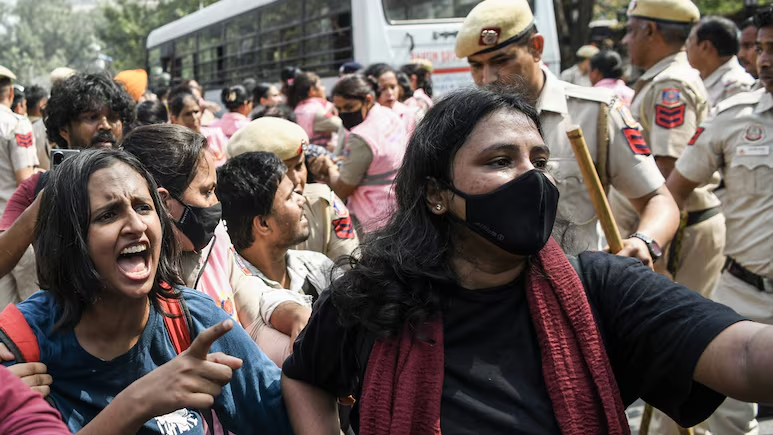
Panchayat workers in the erstwhile Khammam district staged relay protests outside Mandal Parishad offices on Tuesday, August 18, demanding that the state government fulfil its promises regarding their employment and wages. The protests were organised following a call given by the state committee of the Panchayat Workers Union affiliated with CITU.
The workers’ main demand is that panchayat employees should be made permanent in accordance with the assurances mentioned in the government’s election manifesto. They are also demanding a minimum monthly wage of ₹26,000, arguing that their work and responsibilities at the village level should be recognised through better employment conditions.
The relay protests were conducted at Mandal Parishad offices across the erstwhile Khammam district. Workers participated in the demonstrations while raising demands related to job security, wages and the implementation of government commitments.
According to the workers’ union, the demand for permanent employment is one of the central issues behind the ongoing agitation. Panchayat employees perform essential duties connected with the functioning and upkeep of rural local bodies, and the union has been pressing the government to provide them with more secure employment conditions.
The workers have also sought a revision of the existing system governing their duties. Union leaders demanded that Government Order 51 be amended and that the multipurpose system currently followed in gram panchayats be scrapped.
Under the multipurpose arrangement, workers may be expected to perform different kinds of duties within village panchayat administration and maintenance. The union has argued that the system needs to be changed and that workers should receive clearer employment responsibilities and appropriate compensation.
Another major demand raised during the protests concerns the payment of salaries. The workers have called for their wages to be deposited directly into their bank accounts through a green-channel system. According to the union, such a mechanism could help ensure that payments reach workers more efficiently and reduce delays in receiving wages.
The demand for a ₹26,000 minimum wage has become a central part of the workers’ campaign. The protesters are seeking an improvement in their income while also calling for greater job security.
The demonstrations come amid continuing discussions over the working conditions of employees associated with local rural bodies. Panchayats play an important role in delivering basic civic services at the village level, making the availability of a functioning workforce essential for day-to-day operations.
Workers involved in these activities can be responsible for a range of duties associated with village administration and public services. Their union has therefore argued that their contribution should be recognised through permanent employment and improved wages.
The relay protest format allows workers to continue their agitation while different groups participate on different days. It is also a way for unions to draw attention to their demands at local administrative offices without necessarily organising a single large demonstration.
The CITU-affiliated Panchayat Workers Union has used the latest programme to reiterate its demands before local authorities. The union’s state committee had called for the protests across the region, leading workers to gather outside Mandal Parishad offices.
The protests also reflect a broader concern among workers over employment security. Temporary or non-permanent workers often face uncertainty regarding their long-term employment and income. The demand for permanent status is therefore closely connected to their request for stable wages and better working conditions.
The workers’ insistence on implementing promises mentioned in the manifesto also places the issue within the political commitments made during elections. They are seeking action from the government based on those assurances and have intensified their campaign to press for implementation.
At the local level, panchayats are responsible for several functions that directly affect rural communities. Regular sanitation, maintenance and other village-level activities depend on workers being available to perform assigned duties. Any prolonged uncertainty surrounding the workforce can therefore become an administrative concern for local bodies.
The union’s demand to eliminate the multipurpose system is linked to this question of work responsibilities. Leaders have argued that workers should not be burdened with an arrangement that combines multiple duties without corresponding improvements in employment conditions.
The demand for direct salary payments is another important aspect of the campaign. Workers want their wages to reach their accounts through a system that they believe will make payments more predictable and transparent.
The issue of wage delays has frequently been a concern in discussions involving local-body workers. Regular payment is particularly important for employees who depend primarily on their monthly income to meet household expenses.
The ₹26,000 wage demand represents the workers’ stated expectation rather than an announcement that the government has approved such a salary. As of the latest report, the protesters were demanding that the government take action on their requests.
No government decision accepting the workers’ demands was reported in the source covering Tuesday’s protests. The immediate development was the beginning of relay demonstrations across the erstwhile Khammam district.
The protests could put additional pressure on the state government to engage with representatives of the workers. If discussions take place, issues including permanent employment, wage levels, the multipurpose system and the mechanism for salary payments are likely to remain central.
For the workers, the agitation is focused on improving their employment conditions and ensuring that their demands receive attention from the authorities. The union’s decision to organise demonstrations at Mandal Parishad offices also places the issue directly before the local administrative system.
Khammam has a significant rural population, and gram panchayats remain an important part of local governance. The functioning of these institutions affects everyday services and administration in villages throughout the district.
The workers’ demands consequently have implications beyond their individual employment conditions. A stable and adequately supported workforce can contribute to the regular functioning of village-level services, while disputes over employment and wages can create additional challenges for local administrations.
The demand for permanent status is particularly significant because it concerns the workers’ long-term relationship with the panchayat system. The union wants the government to move beyond temporary arrangements and provide workers with a more secure employment structure.
The protesters have also linked their campaign to the government’s manifesto commitments. By referring to the promises made during the election process, the union is seeking accountability over assurances that it believes should now be implemented.
The wage demand is equally central. Workers are asking for a minimum salary of ₹26,000, which they believe would provide better financial security and recognise the responsibilities associated with their work.
The demand for direct payment through a green channel reflects another aspect of the campaign: ensuring that workers receive their salaries without unnecessary administrative delays. The union has specifically called for wages to be credited to workers’ bank accounts through this mechanism.
The call to amend Government Order 51 also indicates that the protesters want changes at the policy level rather than only temporary relief. Their demands include restructuring the way panchayat workers are engaged and assigned duties.
The relay protests therefore bring together several connected issues: permanent employment, minimum wages, changes to the multipurpose work system and timely salary payments.
The demonstrations across the erstwhile Khammam district show that the issue has support among workers in different mandals. Rather than limiting the protest to one location, the union has organised workers outside multiple Mandal Parishad offices.
The continuation of the relay programme will depend on the response from the state government and local authorities. If the government initiates discussions, the workers may seek concrete assurances regarding their demands.
For now, however, the workers remain focused on their campaign. The protests are intended to draw attention to what the union considers longstanding employment and wage concerns.
The issue also highlights the importance of local government employees in rural administration. Gram panchayats are the closest formal level of governance for many villagers, and workers associated with these institutions contribute to the delivery and maintenance of basic services.
Ensuring that such workers have stable employment and timely wages can therefore have a direct bearing on the functioning of rural local bodies. The workers’ union has used this argument while seeking stronger employment protections.
The latest protests are part of an organised campaign rather than an isolated demonstration. The CITU state committee’s call has brought workers together across the region, giving the issue a wider organisational platform.
The state government’s response will now be closely watched by the protesting workers. Their demands involve both financial and administrative decisions, meaning that any resolution could require policy changes as well as discussions with the concerned departments.
Until such a decision is announced, the ₹26,000 minimum wage and permanent employment demands remain the central issues around which the workers’ campaign is being conducted.
The relay protests in the Khammam region have thus brought renewed attention to the employment conditions of panchayat workers in Telangana. Their demands focus on permanent status, higher minimum wages, changes to the multipurpose work system and direct salary payments.
As the agitation continues, the key question will be whether the government responds with negotiations or announces measures addressing the workers’ concerns. For the protesters, the immediate objective remains clear: they want the promises made to panchayat employees to be implemented and are seeking a minimum monthly wage of ₹26,000 along with greater employment security.