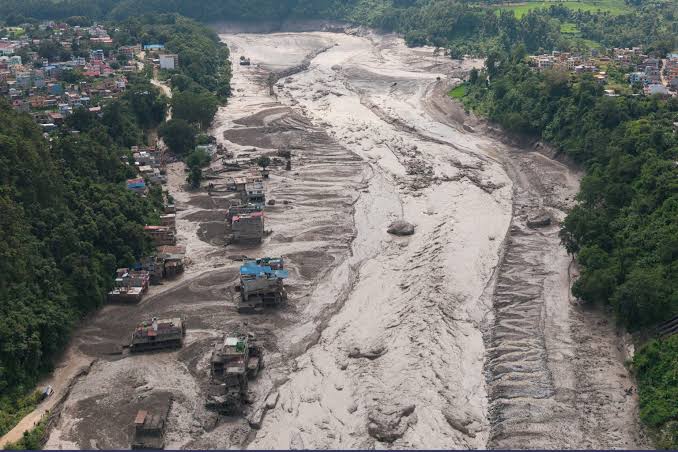
Nepal has launched a diplomatic push for Nepal climate compensation after devastating floods killed more than 1,100 people and left thousands missing across parts of the Himalayan nation. The disaster, which struck on August 26, caused widespread destruction in the Bhotekoshi river basin, affecting districts including Rasuwa, Nuwakot and Dhading. Nepal has identified China, India and the United States among major greenhouse gas emitters and is seeking financial assistance for the damage caused by the disaster.
The demand for Nepal climate compensation comes as the country struggles with a large-scale rescue and recovery operation. Nepal’s Foreign Minister Shisir Khanal has argued that assistance should not be viewed simply as charity, but as part of a wider discussion about climate justice and responsibility. The government has formally approached the UN-backed Fund for Responding to Loss and Damage for urgent financial assistance following the catastrophe.
The floods were reportedly triggered after a massive collapse involving rock and ice near the Nepal-China border sent water and debris through the Bhotekoshi river system. The resulting destruction affected homes, roads, bridges and hydropower infrastructure. As of September 2, Nepal Police figures cited by Indian media reported 1,127 deaths and 4,858 people still missing, while security forces had rescued thousands of people from affected areas.
Nepal’s argument for Nepal climate compensation is closely connected to the country’s relatively small contribution to global greenhouse gas emissions. Officials have said that Nepal contributes only a negligible share of global emissions while facing serious consequences from changing conditions in the Himalayan region. These include glacier changes, unstable mountain slopes, floods and other hazards that can threaten communities and infrastructure.
Foreign Minister Shisir Khanal has said Nepal is shifting its diplomatic approach from seeking traditional aid toward seeking justice and compensation. The Nepal climate compensation demand is therefore being presented as part of a larger international conversation about how vulnerable countries can receive support when they face severe climate-related losses despite making relatively small contributions to global emissions.
The issue is particularly sensitive because India, China and the United States have different positions in the global climate debate. While China, the US and India are among the largest greenhouse gas emitters in absolute terms, their per-person emissions and historical contributions are different. India has consistently argued that climate responsibilities should consider historical emissions, per-capita emissions and the development needs of developing countries.
Nepal has also requested assistance through the Fund for Responding to Loss and Damage, an international mechanism established to support developing countries particularly vulnerable to climate change. The Nepal climate compensation proposal is therefore connected to an existing international framework rather than being presented solely as a series of direct compensation claims against individual countries.
The financial challenge facing Nepal is substantial. Finance Minister Swarnim Wagle has estimated that rebuilding after the floods could require around $4 billion to $5 billion, representing a significant burden for the country’s economy. The reconstruction will involve restoring roads, bridges, hydropower facilities and homes while also supporting displaced communities and affected livelihoods.
The disaster has also exposed the vulnerability of Himalayan infrastructure. Hydropower projects, roads and settlements are often located in narrow valleys where access to rivers and mountainous terrain is important for development. However, these same geographical conditions can expose communities and infrastructure to sudden floods, landslides and avalanches. The Nepal climate compensation discussion is consequently taking place alongside a broader debate about how Himalayan countries can prepare for increasingly complex environmental risks.
Scientists have cautioned against directly attributing this individual disaster entirely to climate change without detailed scientific investigation. Initial assessments have pointed toward a combination of geological and glacial factors, including a rock-and-ice avalanche. Experts have nevertheless warned that warming conditions can contribute to changes in glaciers and mountain environments, potentially increasing the risks associated with interconnected hazards.
The continuing rescue operation has made the situation even more urgent. Fresh rainfall has hampered efforts in several affected locations, while water and debris have entered hydropower tunnels where workers are feared to remain trapped. Nepalese security forces, technical experts and project workers are continuing search operations despite difficult conditions.
The government is also looking beyond immediate relief. Nepal needs resources not only for rescue operations but also for resettlement, infrastructure reconstruction and restoring livelihoods. The Nepal climate compensation demand reflects this longer-term requirement, as authorities seek financial and technical support to rebuild communities that have suffered extensive losses.
The issue could receive further international attention if Prime Minister Balendra ‘Balen’ Shah travels to New York for the United Nations General Assembly later this month. Reports indicate that Nepal is considering using the UN platform to highlight the flood disaster and its demand for greater climate justice.
For readers following developments related to the Nepal climate compensation demand, Himalayan disasters, international affairs and major global news, 50 News provides regular coverage of important national and international developments.
Nepal’s latest diplomatic campaign highlights the growing debate over how the costs of climate-related disasters should be shared. Vulnerable developing countries have increasingly argued that wealthier and higher-emitting nations should provide greater financial assistance for unavoidable losses and damages associated with climate change. The Nepal climate compensation demand adds a Himalayan perspective to that continuing international discussion.
For Nepal, however, the immediate priority remains saving lives and supporting communities affected by the floods. Search teams continue to look for missing people while authorities work to restore transportation links and provide essential supplies. The scale of destruction means that recovery will likely continue long after the immediate emergency ends.
The Nepal climate compensation campaign could now become an important part of Nepal’s international climate diplomacy. Whether the country receives the level of financial support it is seeking will depend on international discussions and the mechanisms available through global climate finance institutions. For now, Kathmandu is seeking urgent assistance while simultaneously calling for greater recognition of the disproportionate risks faced by Himalayan countries.
The devastating floods have brought together questions of disaster response, climate finance, infrastructure resilience and international responsibility. As Nepal continues its rescue and reconstruction efforts, the Nepal climate compensation demand is expected to remain an important issue in the country’s diplomatic agenda and in wider discussions about climate justice.