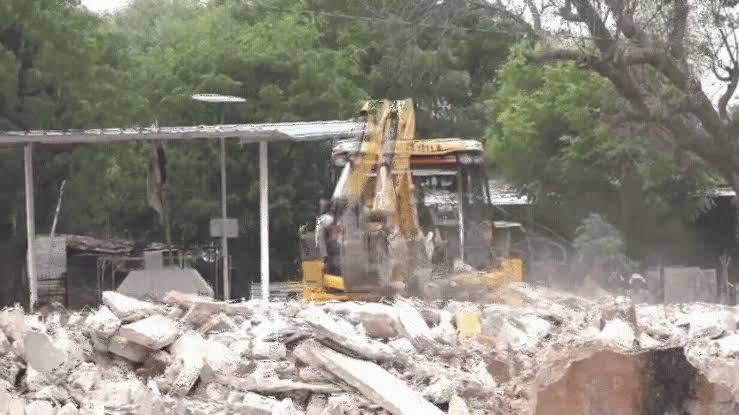
The Jaipur school demolition at a government primary school in Rampura-Kanwarpura village has brought renewed attention to the condition of public education infrastructure in Rajasthan. Authorities demolished the old school structure after it had previously been declared unsafe, paving the way for construction of a new building for students. The development follows growing public attention to the condition of the school and a recent controversy involving members of the Cockroach Janta Party (CJP) who visited the area as part of a campaign focused on government schools.
The Jaipur school demolition took place at the Government Primary School in Rampura-Kanwarpura, located in the Bagru Assembly constituency. The old structure had reportedly been found to be in poor condition and was declared unsafe following a technical assessment conducted in September 2025. Because of concerns about the safety of students and teachers, regular classes could no longer continue in the original building.
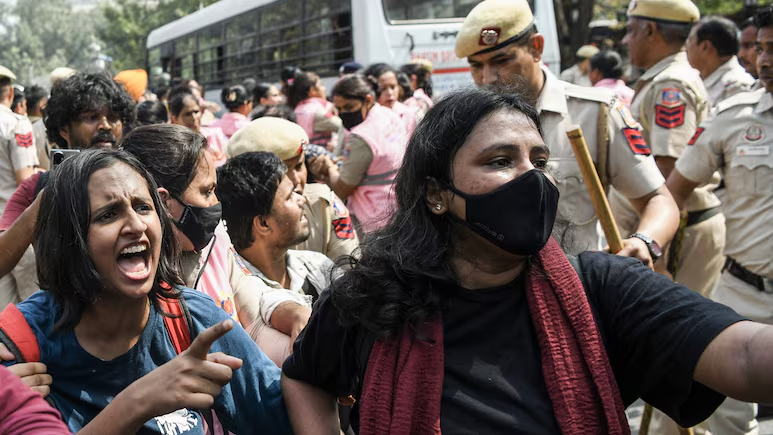
The condition of the school became a wider public issue after CJP workers visited the village on August 21 as part of the party’s “School Thik Karo” campaign. The campaign was aimed at highlighting the condition of government schools and drawing attention to infrastructure problems. The visit, however, resulted in a confrontation between the CJP members and local residents, adding a political dimension to an issue that had originally centred on the condition of the school building.
The Jaipur school demolition has now moved the situation into a new phase, with authorities preparing for construction of a replacement building. The new facility is expected to provide students with a safer and more permanent place to study instead of the temporary arrangements that had been used after the old structure was declared unsafe.
Reports indicate that ₹18 lakh has been sanctioned for construction of the new school building. Of this amount, ₹12 lakh has been allocated through the District Mineral Foundation Trust, while another ₹6 lakh has been sanctioned through the MLA fund. The financial allocation provides the foundation for replacing the demolished structure and improving the educational facilities available to children in the village.
The Jaipur school demolition is particularly important because the school serves young children at the primary level. Primary education requires a safe and stable learning environment where students can attend classes without concerns about the condition of the building. A school building that has been officially declared unsafe cannot provide that environment, making reconstruction an important requirement for the local community.
Before the demolition, students had reportedly been attending classes in temporary facilities. The arrangements included two rooms and a tin shed provided with assistance from villagers. Although these facilities allowed education to continue, they were not equivalent to a permanent school building designed for students and teachers.
The Jaipur school demolition therefore represents more than the removal of an old structure. It is the first physical step toward creating a new educational facility for the community. Once construction is completed, students are expected to have access to classrooms that are more suitable for regular teaching and learning.
The issue of school infrastructure has broader relevance across India, where government schools in rural and semi-urban areas can sometimes face challenges related to ageing buildings, maintenance, classrooms, sanitation, electricity and other basic facilities. When buildings become unsafe, authorities must balance the need to continue education with the responsibility of protecting students and staff.
The Jaipur school demolition demonstrates what can happen when an unsafe school building remains a public concern over an extended period. The original building was reportedly declared unsafe in 2025, but students continued their education through temporary arrangements. The latest action has now created an opportunity for the authorities to address the infrastructure problem more permanently.
The controversy involving CJP members brought additional attention to the school. The organisation’s “School Thik Karo” campaign focused on government school infrastructure, and the Rampura-Kanwarpura school became one of the locations visited during the campaign. The subsequent confrontation between CJP workers and local residents resulted in both sides filing police complaints.
The Jaipur school demolition should therefore be viewed separately from the allegations arising from the confrontation. While the political dispute attracted public attention, the underlying issue remains the condition of the school and the need for appropriate facilities for students. The decision to demolish the unsafe building and sanction funds for a replacement addresses that infrastructure requirement.
According to reports, CJP members alleged that they were attacked during their visit to the school. Local residents, however, reportedly made counter-allegations regarding the conduct of the visiting group. Police became involved after complaints were filed. These allegations form a separate matter from the administrative decision concerning the school building.
The Jaipur school demolition has also prompted discussion about the role of elected representatives and government departments in maintaining public educational infrastructure. The allocation of funds through the MLA fund and District Mineral Foundation Trust indicates coordination between different sources of public funding for the new building.
For the local community, the most important outcome is expected to be the construction of a school that can safely accommodate students. Parents generally expect government schools to provide basic infrastructure necessary for children’s education. A permanent building can also make it easier for teachers to conduct classes and for students to follow a regular academic routine.
The Jaipur school demolition could also encourage greater attention to other schools with ageing infrastructure. Technical assessments can help authorities identify buildings that require repairs, renovation or complete replacement. Acting on such assessments is important because delaying necessary work can increase risks and eventually make reconstruction more expensive.
A safe school environment includes more than just structurally sound classrooms. Students also need adequate ventilation, sanitation, drinking water, electricity and appropriate learning spaces. As the new building is planned, the local administration will have an opportunity to consider these requirements while developing the replacement facility.
The Jaipur school demolition has occurred after the building’s earlier classification as unsafe, which means the next stage will be especially important. The authorities will need to ensure that construction progresses according to approved plans and that the allocated funds are used effectively. Timely completion will be important for students who have already spent time studying in temporary arrangements.
The development also highlights the importance of communication between authorities and local communities. When a school building is declared unsafe, parents and students need clear information about why the decision has been made, where classes will be conducted temporarily and when a permanent solution is expected. Transparent communication can reduce uncertainty and prevent infrastructure concerns from becoming wider public disputes.
The Jaipur school demolition has received attention partly because of the involvement of a political organisation, but the issue itself has direct consequences for children and their families. Government school infrastructure should ideally remain focused on providing safe and effective education regardless of political disagreements surrounding it.
The “School Thik Karo” campaign by CJP has brought the condition of government schools into public discussion. While political campaigns can draw attention to infrastructure problems, long-term improvement ultimately depends on government departments, local representatives, engineers, school authorities and communities working together.
The Jaipur school demolition also illustrates how local infrastructure issues can quickly become subjects of wider public interest when political groups, residents and authorities become involved. What began as a concern about an unsafe school structure eventually resulted in public confrontation and media attention. The subsequent decision to construct a new building has shifted the focus back toward education.
For students, the completion of the new building will be more significant than the political controversy. A permanent school can provide greater stability and allow children to attend classes in an environment specifically designed for education. It can also give teachers better conditions for delivering lessons and conducting school activities.
The Jaipur school demolition could ultimately have a positive outcome if the new building is completed efficiently and equipped with the facilities required by the school. The sanctioned ₹18 lakh provides a defined financial allocation, but effective implementation will determine how quickly the community sees the benefits.
The situation also raises questions about how quickly unsafe government buildings are replaced after technical assessments. Identifying an unsafe building is only the first step. Authorities must then arrange alternative classrooms, allocate funds, approve construction plans and complete the replacement facility. Delays at any stage can prolong the period during which students depend on temporary arrangements.
The Jaipur school demolition has now removed the immediate problem of an unsafe structure being used as a school. The challenge is to ensure that the replacement process moves forward without unnecessary delays. Local officials and representatives will have an important role in monitoring construction and ensuring that the new facility meets required standards.
For parents, the availability of a safe school close to home is particularly important. Families in rural areas may have limited access to alternative educational institutions, meaning that the condition of the local government school can directly influence children’s ability to attend classes regularly. A new building can therefore contribute to educational continuity in the community.
The Jaipur school demolition also highlights the importance of investing in rural education infrastructure. Government schools serve a large number of children across the country, particularly in communities where private educational alternatives may not be easily accessible. Improving these schools can support attendance, learning conditions and community confidence in public education.
The role of local residents is also significant. In this case, villagers reportedly helped provide temporary spaces for students after the original building became unsafe. Such community involvement allowed classes to continue despite infrastructure challenges. The construction of a permanent facility can reduce the burden on residents and return the school to a more appropriate educational setting.
The Jaipur school demolition comes at a time when education infrastructure remains an important public policy issue. Governments at the state and national levels regularly announce schemes and funding programmes intended to improve schools, but the effectiveness of these initiatives ultimately depends on implementation at the local level.
For readers following developments related to the Jaipur school demolition, Rajasthan education, government schools and other public-interest stories, 50 News provides regular coverage of important developments across India. The platform covers education, Rajasthan, government-related news and other current affairs that can help readers stay informed about developments affecting local communities.
The new building will be expected to provide a more secure environment for the school’s students once construction is completed. However, maintaining the facility after construction will be equally important. Regular inspections and maintenance can help prevent the new building from reaching the condition that ultimately led to the demolition of the previous structure.
The Jaipur school demolition therefore provides a useful reminder that infrastructure maintenance should be treated as an ongoing responsibility rather than a one-time activity. Regular assessments can identify problems at an early stage, allowing authorities to carry out repairs before buildings deteriorate to the point where they become unsafe.
The controversy surrounding the school also demonstrates the importance of ensuring that public infrastructure concerns are addressed through appropriate administrative channels. Political campaigns can bring visibility to an issue, but decisions about safety assessments, demolition and construction need to be based on technical evaluations and government procedures.
The Jaipur school demolition is now expected to be followed by the construction of a new school building using the sanctioned funds. For the children of Rampura-Kanwarpura, this could mean a return to a proper school environment after a period of temporary arrangements.
The development also sends a message about the importance of responding to safety concerns in educational institutions. Once a building is officially classified as unsafe, continued use can expose students and staff to unnecessary risks. Providing alternative arrangements is essential in the short term, while reconstruction or major renovation provides the long-term solution.
The Jaipur school demolition has consequently become an important local education development, combining questions of school safety, government funding, political attention and community involvement. The demolition itself marks the conclusion of the old building’s use, while the sanctioned funds provide the basis for the next stage.
The success of the project will ultimately depend on the timely completion and quality of the new construction. Parents, teachers and residents will likely continue to watch the progress because the new facility is directly connected to the education of children in the area.
The Jaipur school demolition also demonstrates why accurate reporting and public attention can be important when dealing with local infrastructure issues. However, such reporting should remain focused on verified developments and avoid exaggerating allegations or political disputes that have not been established.
With the old unsafe structure now demolished and funds sanctioned for a replacement, the immediate focus is on building the new school. The Jaipur school demolition has cleared the site, but the broader goal is to provide students with a safe, functional and sustainable educational environment.
For the Rampura-Kanwarpura community, the new school building represents an opportunity to move beyond the temporary arrangements that followed the safety concerns. The Jaipur school demolition may therefore mark the beginning of a more positive phase for the school, provided construction proceeds as planned and the facility receives proper maintenance in the years ahead.
The development is ultimately about more than a building. A safe school provides children with a stable place to learn, teachers with an appropriate working environment and parents with greater confidence in their children’s education. The Jaipur school demolition, followed by the planned construction of a new facility, has the potential to deliver these benefits to the local community and address a long-standing infrastructure concern.