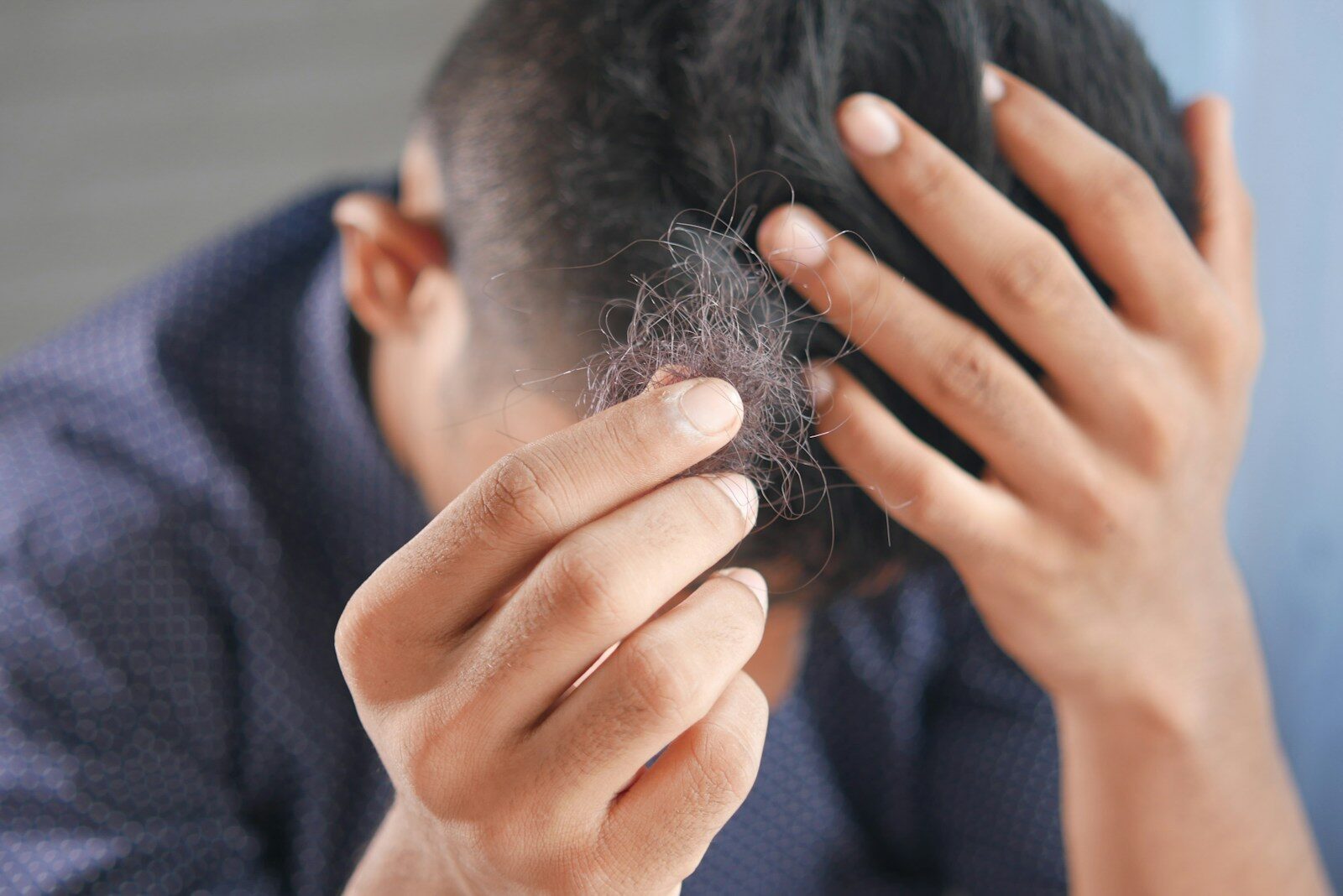
Hair fall can be frustrating for men, especially when you suddenly start seeing more hair on your pillow, comb, clothes, or shower floor. The first reaction is often to search for a natural remedy that can stop hair fall immediately at home.
But there is an important truth to understand before trying anything.
There is no natural home remedy that can guarantee immediate stoppage of true hair loss. Hair grows through a biological cycle, and the cause of the shedding determines what can actually help.
The good news is that there are several things you can do at home right now to reduce unnecessary hair damage, support healthier hair growth, and avoid making the problem worse.
If your hair fall is caused by temporary shedding, nutritional problems, excessive styling, scalp irritation, or lifestyle factors, addressing the underlying trigger can help.
If you have male pattern hair loss, however, natural remedies alone are unlikely to stop the genetic process.
The first step is to understand what kind of hair fall you are experiencing.
Losing some hair every day is normal.
Hair follicles naturally move through growth, resting, and shedding phases. This means you will always find some loose hairs around your home.
The problem is when your normal pattern changes.
If you suddenly notice much more hair than usual, your ponytail or overall density seems reduced, your hairline is changing, or your crown is becoming thinner, it is worth paying attention.
One of the most common causes of progressive hair loss in men is male pattern hair loss.
It can begin at a surprisingly young age.
Some men first notice their temples becoming thinner.
Others notice a receding hairline or thinning around the crown.
For some men, the changes happen slowly and may take years to become obvious.
Male pattern hair loss is strongly influenced by genetics and hormones.
This is why simply applying oil or changing shampoo usually cannot stop it.
Natural hair care can still protect the hair shaft and scalp, but it should not be confused with treating the underlying genetic process.
If your hair loss is sudden rather than gradual, the situation may be different.
A sudden increase in shedding can occur after illness, high fever, major stress, rapid weight loss, restrictive dieting, or other physical changes.
This type of temporary shedding is often associated with telogen effluvium.
The interesting part is that the shedding may not begin immediately after the trigger.
You may experience an illness and notice increased shedding weeks or months later.
You may lose weight rapidly and only later realize that your hair is falling more than usual.
This delayed response can make it difficult to identify the cause.
If your hair fall started after a stressful event, do not immediately assume that your shampoo or hair oil is responsible.
Think about what happened during the previous few months.
Were you sick?
Did you have a high fever?
Did you lose weight quickly?
Did you start a restrictive diet?
Did you experience major emotional stress?
Did your sleep become severely disrupted?
Did you start a new medication?
These details can be more important than the products currently sitting in your bathroom.
If you want to start taking care of your hair naturally at home, begin with nutrition.
Your hair needs adequate energy and nutrients to grow normally.
One of the most important nutrients is protein.
Hair is primarily made of keratin, which is a structural protein.
If you consistently eat too little protein, particularly while dieting or exercising intensely, your body may have difficulty supporting normal hair production.
Include protein-rich foods in your meals.
Eggs, milk, yogurt, fish, chicken, beans, lentils, soy, nuts, and seeds can all contribute protein depending on your dietary preferences.
You do not need to eat expensive foods or follow a complicated hair-growth diet.
The goal is simply to provide your body with adequate nutrition consistently.
Avoid crash diets if you are trying to lose weight.
Extreme calorie restriction can put significant stress on the body and may contribute to temporary increased shedding.
Losing weight gradually through a sustainable eating pattern is generally a better approach for your overall health and your hair.
If you are already losing weight rapidly, consider discussing your diet with a qualified healthcare professional.
Another important nutrient is iron.
Low iron stores can contribute to hair shedding in some people.
However, this does not mean that every man with hair fall should start taking iron tablets.
Iron supplements should generally be used when there is a medical reason to do so because excessive iron can be harmful.
If you suspect a nutritional deficiency, talk with a healthcare professional about whether testing is appropriate.
The same principle applies to vitamin D, vitamin B12, zinc, and other nutrients.
Taking supplements randomly is not a natural solution to hair fall.
In fact, excessive amounts of certain nutrients can cause health problems.
A balanced diet should be your starting point unless a healthcare professional recommends supplementation.
Biotin deserves special attention because it is frequently promoted as a hair-growth solution.
Severe biotin deficiency can affect hair, but deficiency is uncommon in many people.
Taking large doses of biotin when you are not deficient does not automatically make your hair grow faster.
High-dose biotin can also interfere with certain laboratory tests.
So before buying a large bottle of hair gummies, consider whether you actually need them.
Your scalp also deserves attention.
A healthy scalp provides a better environment for normal hair growth.
If your scalp is persistently itchy, red, painful, inflamed, or heavily flaky, do not simply assume that you need more hair oil.
You may have dandruff or another scalp condition that requires appropriate treatment.
Dandruff is common and can often be managed, but persistent scalp symptoms should not be ignored.
Scratching your scalp repeatedly can also increase irritation and mechanical damage.
Try to avoid using your fingernails aggressively on the scalp.
When washing your hair, use your fingertips gently.
You do not need to scrub as hard as possible to make the scalp clean.
Another important point is that shampooing does not normally cause male pattern hair loss.
Many men see hair in the shower and immediately think their shampoo is pulling out healthy hair.
Usually, the shower is simply where already-loose hairs become visible.
If you have not washed your hair for several days, several days’ worth of naturally shed hairs may come out during one wash.
That can make the amount appear much larger than it actually is.
You do not need to stop washing your hair because you are experiencing shedding.
Instead, choose a shampoo that suits your scalp and does not cause irritation.
There is no single shampoo schedule that works for every man.
If you have an oily scalp, you may need more frequent washing.
If your scalp is dry or sensitive, a gentler routine may be more comfortable.
The goal is a clean, comfortable scalp rather than following a strict internet rule.
Hair handling is also important.
Wet hair can be more vulnerable to mechanical damage, especially when it is already fragile.
Avoid aggressively rubbing your hair with a towel after washing.
Instead, gently squeeze out excess water and handle the hair carefully.
Rough towel drying can contribute to breakage.
Brushing should also be gentle.
Do not repeatedly pull through knots or aggressively brush the scalp.
If your hair is long enough to tangle, take time to detangle it carefully.
This will not stop genetic hair loss, but it can reduce unnecessary breakage.
Heat styling should also be limited.
Frequent use of straighteners, curling tools, and very hot blow dryers can damage the hair shaft.
The result may be dryness, split ends, and breakage.
Breakage can make your hair appear thinner even though the follicles are still producing hair.
If you regularly use heat, lower the temperature when possible and avoid unnecessary daily styling.
Chemical treatments can create similar problems.
Frequent bleaching, coloring, relaxing, or other harsh chemical processes can weaken the hair shaft.
If you are already concerned about thinning, reducing unnecessary chemical processing can help protect the hair you have.
Another simple natural strategy is to avoid hairstyles that constantly pull on the roots.
Tight ponytails, buns, braids, or other styles that create prolonged tension can contribute to traction-related hair loss.
If your hairstyle causes pain or a persistent pulling sensation, it is too tight.
Change the hairstyle and give the roots a break.
This is especially important around the hairline, where repeated tension can cause noticeable thinning.
Sleep is another factor worth taking seriously.
A few nights of poor sleep are not going to make a healthy man suddenly go bald.
However, consistently poor sleep can contribute to overall physical and psychological stress.
If you are dealing with increased shedding, try to establish a more regular sleep routine.
Your body needs adequate recovery, particularly after illness, intense exercise, or significant stress.
Stress management can also be useful.
Major emotional or physical stress can trigger temporary hair shedding in some people.
You cannot eliminate every stressful event from life.
Instead, focus on practical ways to manage it.
Regular exercise, walking, relaxation, hobbies, social connection, breathing exercises, and adequate rest can all be part of a healthier routine.
Exercise itself does not normally cause hair loss.
The problem can occur when intense exercise is combined with severe calorie restriction and inadequate recovery.
If you are training heavily while eating very little, your body may not receive enough energy and nutrients.
A balanced approach is better for both your health and your hair.
Hydration is also important for general health.
Drink enough fluids according to your needs, particularly during hot weather or physical activity.
However, drinking excessive amounts of water will not suddenly stop male pattern hair loss.
Hydration should be considered part of overall health rather than a miracle hair treatment.
One of the most popular home remedies for hair fall is onion juice.
You may have seen claims that applying onion juice to the scalp can regrow hair.
There is some limited research around onion-based topical treatment in specific forms of patchy hair loss, but this does not make onion juice a proven treatment for male pattern baldness.
It can also irritate the scalp in some people.
Do not assume that a kitchen ingredient can replace an appropriate diagnosis.
Garlic, lemon juice, essential oils, and other homemade mixtures are also widely promoted online.
Natural does not automatically mean safe or effective.
Lemon juice, for example, can irritate the skin.
Strong essential oils can also cause irritation or allergic reactions when used incorrectly.
If you choose to use any topical product, avoid applying irritating substances to an already inflamed scalp.
Another popular idea is scalp massage.
Gentle scalp massage can feel relaxing and may be enjoyable as part of your routine.
However, it should not be presented as a guaranteed cure for male pattern hair loss.
Avoid aggressively rubbing or pulling the hair during massage.
More pressure does not mean more growth.
The same applies to hair oiling.
Coconut oil, argan oil, almond oil, and other oils can make hair feel softer and reduce friction for some people.
They may be useful for hair conditioning.
But they do not reliably reverse the genetic process behind male pattern baldness.
If you enjoy oiling your hair and your scalp tolerates it, there is nothing inherently wrong with using an appropriate amount.
Just keep your expectations realistic.
Another common misconception is that cutting or shaving your hair will stop hair fall.
Hair grows from follicles underneath the scalp.
Cutting the visible hair does not change the follicle.
Shaving your head can make the hair appear thicker temporarily because newly cut hairs have blunt ends.
It does not increase the number of follicles or permanently change the growth rate.
If you want to cut your hair short because it is easier to manage, that is perfectly fine.
But do not expect the haircut itself to treat hair loss.
Caps and helmets are also often blamed for hair fall.
Normal use of a properly fitted cap or helmet does not generally cause male pattern baldness.
However, headwear should be comfortable and clean.
If something causes excessive pressure, friction, or discomfort, adjust the fit.
Another important factor is smoking.
Smoking can negatively affect overall health and circulation, and avoiding tobacco is beneficial for your general health.
However, quitting smoking should be viewed as a health decision rather than a guaranteed hair-regrowth treatment.
Alcohol should also be approached sensibly.
Excessive alcohol consumption can contribute to poor nutrition and other health problems.
A healthy lifestyle supports your overall wellbeing, which is also relevant to hair health.
If your hair fall is caused by a temporary trigger, correcting your lifestyle may help over time.
But if you have classic male pattern hair loss, lifestyle changes alone may not stop the progression.
This is where it becomes important to recognize the signs of genetic thinning.
Look at your temples.
Are they gradually moving backward?
Look at your crown.
Is the scalp becoming increasingly visible?
Look at your overall density.
Does the hair on top seem noticeably thinner than the sides?
Look at older photographs.
Has your hairline changed over the past year or two?
These changes can be more informative than the number of hairs in your shower drain.
Male pattern hair loss often progresses gradually.
You may not notice the change from one week to the next.
But comparing photographs several months apart can reveal a pattern.
Take photographs under similar lighting and from similar angles.
Do not compare a bright overhead photograph with one taken in soft natural light.
Wet hair can also make the scalp look more visible.
Try to evaluate your hair when it is dry and under consistent conditions.
If the hairline is progressively receding or the crown is becoming thinner, consider getting a professional evaluation.
A dermatologist can examine the scalp and determine whether the pattern is consistent with hereditary hair loss.
This can save you from spending months experimenting with home remedies that do not address the underlying cause.
Another important warning sign is sudden patchy hair loss.
If you develop a clearly defined bald spot, do not assume it is male pattern baldness.
Conditions such as alopecia areata can cause sudden patchy loss.
Other scalp disorders can also create localized thinning.
A dermatologist can determine the cause.
You should also seek professional advice if your scalp becomes painful, red, swollen, heavily scaly, or develops sores.
These symptoms may indicate a scalp condition requiring treatment.
Persistent unexplained shedding is another reason to seek evaluation.
If you have been shedding significantly more hair than usual for an extended period, do not continue trying random home remedies indefinitely.
The cause may be temporary, nutritional, hormonal, medication-related, or another medical condition.
A proper assessment can help identify the reason.
If you recently experienced a high fever, major illness, surgery, significant weight loss, or severe stress, mention it during the evaluation.
The timing may help identify telogen effluvium.
If you recently started a new medication, mention that as well.
Do not stop prescription medication on your own.
Your healthcare professional can determine whether the medication could be contributing to the problem and whether any changes are appropriate.
Another useful step is to review your diet honestly.
Ask yourself whether you are eating enough.
Have you recently cut out entire food groups?
Are you skipping meals?
Are you losing weight quickly?
Are you getting enough protein?
Are you relying heavily on processed foods?
These questions can reveal potential nutritional stress.
You do not need to follow an expensive “hair diet.”
You simply need adequate nutrition.
A variety of whole and minimally processed foods can provide protein, vitamins, minerals, and other nutrients.
If your diet is restrictive or you have difficulty eating adequately, seek individualized advice.
One thing you should not do is dramatically increase your protein intake beyond your body’s needs simply because you think it will make your hair grow faster.
More is not always better.
Adequate intake is the goal.
The same principle applies to supplements.
Taking large amounts of vitamins does not guarantee faster hair growth.
If a deficiency is identified, correcting it can be important.
Without a deficiency, additional supplementation may not provide the result you expect.
This is especially important because some supplements marketed for hair growth contain very high doses.
If you are taking multiple supplements, tell your healthcare professional about them.
Another question many men ask is whether hair fall can be stopped overnight.
Unfortunately, no.
There is no scientifically reliable home method that can instantly stop the biological hair cycle.
If a hair has already entered its shedding stage, applying an oil or homemade mask cannot simply force it back into the growth phase.
The realistic goal is to identify the cause and reduce ongoing triggers.
If the cause is temporary, shedding may gradually decrease as your body recovers.
If the cause is nutritional, improving nutrition may help.
If the cause is a scalp disorder, treating the scalp condition can help.
If the cause is hereditary pattern hair loss, evidence-based treatment may be needed.
This is why the word “immediately” can be misleading when discussing hair loss.
You can immediately start healthier habits.
You cannot necessarily produce immediate new hair.
Hair follicles need time.
Even effective treatments usually require patience.
Some men may benefit from minoxidil for certain types of hair loss.
It can help some people with pattern hair loss, but it is not appropriate for every cause.
Results generally take time to assess, and continued use is usually needed to maintain benefits.
If you are considering it, speak with a healthcare professional about whether it is appropriate for your situation.
Prescription treatments may also be options for certain men with hereditary hair loss.
These treatments can have important considerations and potential side effects.
They should be discussed with a qualified healthcare professional rather than copied from someone else’s routine.
A treatment that works for one man may not be suitable for another.
The earlier you understand the cause of progressive hair loss, the more informed your treatment decisions can be.
This does not mean every man with a slightly receding hairline needs medication.
Hairlines naturally vary.
Some men have a naturally higher or more mature hairline without developing significant progressive loss.
The important thing is whether the pattern continues to change.
Another mistake is judging your hair based on a single bad hair day.
Humidity, sweat, oil, styling products, lighting, and wetness can all affect how thick your hair looks.
Do not diagnose hair loss because your scalp looked more visible after a shower.
Look for consistent changes over time.
If your hair has become noticeably thinner across several months, that is more meaningful.
You can also ask someone you trust whether they have noticed a change, but professional evaluation is more reliable than opinions from friends.
If you have been experiencing hair fall, you may feel tempted to try every natural remedy you see online.
Resist that urge.
More products do not necessarily mean better results.
A complicated routine can irritate the scalp and make it difficult to identify what is helping.
A simple routine is often better.
Use a suitable shampoo.
Keep your scalp comfortable.
Handle your hair gently.
Avoid excessive heat.
Reduce chemical damage.
Avoid tight hairstyles.
Eat adequately.
Get enough rest.
Manage stress.
And investigate persistent hair loss.
If you want to use a natural oil for conditioning, choose one that your scalp tolerates and use it as a cosmetic hair-care product rather than expecting it to cure genetic baldness.
If you have dandruff or another scalp problem, treat that problem appropriately rather than simply adding more oil.
Your scalp condition matters.
Another useful habit is keeping your hands out of your hair.
Constantly touching, twisting, pulling, or checking the hair can increase mechanical damage.
If you are anxious about hair loss, repeated checking can also make the problem feel much worse psychologically.
Try to monitor your hair periodically rather than every hour.
Photographs taken every few weeks can provide a more objective view.
Hair loss can affect confidence, especially when it begins at a young age.
Feeling concerned does not mean you are being vain.
Your appearance is part of how you present yourself, and changes can affect self-esteem.
But do not allow fear to push you toward unsafe treatments.
Be skeptical of products promising guaranteed regrowth.
Be cautious with before-and-after photographs that do not explain treatment duration, lighting, styling, or other variables.
Be particularly cautious when a product claims that everyone can regrow a full head of hair naturally.
Hair loss has many causes.
There is no single remedy that works for everyone.
If you want the best chance of improving your hair, diagnosis should come before aggressive treatment.
One of the most useful things you can do today is examine your recent history.
Think about the last three to six months.
Has your weight changed?
Have you been sick?
Did you experience a fever?
Have you been under unusual stress?
Has your sleep changed?
Have you changed your diet?
Have you started a new medication?
Have you increased exercise significantly?
Have you changed your hairstyle?
Have you noticed scalp itching or inflammation?
These questions can provide important clues.
If there has been no obvious trigger and your hairline or crown is gradually thinning, genetics may be playing a significant role.
In that situation, natural habits can support your overall hair health but may not be enough to stop the progression.
That is when an evidence-based treatment discussion becomes worthwhile.
If your hair loss is temporary, you may not need aggressive treatment at all.
Sometimes the best approach is simply to address the trigger and allow the hair cycle to recover.
This is particularly true when increased shedding follows a major illness or stressful event.
But do not assume that every case will resolve automatically.
If the shedding continues or your density keeps decreasing, get evaluated.
Another important point is that healthy hair growth takes time.
Even after the cause has been corrected, new hair needs to grow through the scalp and become long enough to contribute to visible density.
This is why patience is essential.
You may notice less shedding before you notice more hair.
That can still be a positive sign.
If you are expecting dramatic changes in two weeks, you are likely to become disappointed.
Think in terms of months rather than days.
There is also no need to wash your hair less frequently simply because you are experiencing shedding.
Avoiding shampoo does not stop the underlying hair cycle.
Continue a washing routine that keeps your scalp clean and comfortable.
If your scalp is oily, regular washing may actually be useful.
If it is dry or sensitive, adjust your routine accordingly.
Your shampoo should serve your scalp, not an internet rule.
The same applies to cold-water or hot-water claims.
Extremely hot water can be uncomfortable and may dry or irritate the scalp, but changing water temperature alone will not reverse male pattern hair loss.
Comfortably warm water is a reasonable choice.
You also do not need to rinse your hair with unusual ingredients.
Simple is often better.
If you are experiencing hair fall, your immediate goal should be to stop unnecessary damage and identify the cause.
Do not expect a homemade remedy to instantly reverse a biological condition.
Natural care can be valuable, but it should be realistic.
For men, the most important distinction is between temporary shedding and progressive pattern hair loss.
Temporary shedding can follow illness, fever, stress, rapid weight loss, or nutritional problems.
Progressive thinning around the hairline and crown is more suggestive of male pattern hair loss.
Both can happen together.
A man with genetic hair loss can also experience temporary shedding after illness or dieting.
That combination can make the hair appear to worsen very quickly.
If that happens, treating only the temporary trigger may not completely address the underlying pattern.
Professional evaluation can clarify what is happening.
So, how can you stop hair fall immediately at home naturally?
You cannot guarantee immediate stoppage of true hair loss, but you can immediately start protecting your hair and improving the factors that support healthy growth.
Eat adequately, especially enough protein.
Avoid crash diets.
Get enough sleep.
Manage significant stress.
Keep the scalp clean and comfortable.
Avoid aggressive brushing and towel rubbing.
Reduce excessive heat and chemical treatments.
Avoid tight hairstyles.
Do not randomly take high-dose supplements.
And do not rely on harsh homemade remedies.
If your hairline is receding, your crown is thinning, you develop bald patches, or your shedding remains unusually high, consult a dermatologist.
The sooner you know what type of hair loss you have, the easier it becomes to choose the right approach.
Hair fall is not always something you can solve with an oil, shampoo, or kitchen remedy.
Sometimes the answer is better nutrition and recovery.
Sometimes it is treatment for a scalp condition.
Sometimes it is temporary shedding that needs time.
And sometimes it is hereditary hair loss that requires evidence-based treatment.
The important thing is not to panic and not to waste months chasing miracle cures.
Take care of your scalp, protect the hair you have, support your overall health, and pay attention to changes in your hairline and density.
Natural habits can create a healthier foundation for your hair, but when a medical form of hair loss is involved, getting the correct diagnosis is the most important step toward meaningful improvement.