Dandruff and hair fall often appear together, which naturally makes people wonder whether one is causing the other.
You may notice white flakes on your shoulders, an itchy scalp, more hair in the shower, and increased shedding at the same time.
This can make it difficult to understand what is actually happening.
The good news is that dandruff is usually a manageable scalp condition. However, an itchy or irritated scalp can affect your hair-care habits, and some scalp conditions that look like ordinary dandruff can also be associated with hair loss.
It is also important to understand that dandruff and hereditary hair loss are not the same thing.
If your hairline is gradually receding or your crown is becoming thinner, dandruff is unlikely to be the main explanation.
Dandruff mainly affects the scalp surface. It can cause visible flakes and itching and may be associated with oily or irritated skin, dry skin, sensitivity to hair products, and a naturally occurring yeast called Malassezia.
One of the most common questions is whether dandruff directly causes baldness.
For ordinary dandruff, the answer is not that simple.
Dandruff does not usually destroy hair follicles in the same way that certain inflammatory or scarring scalp disorders can.
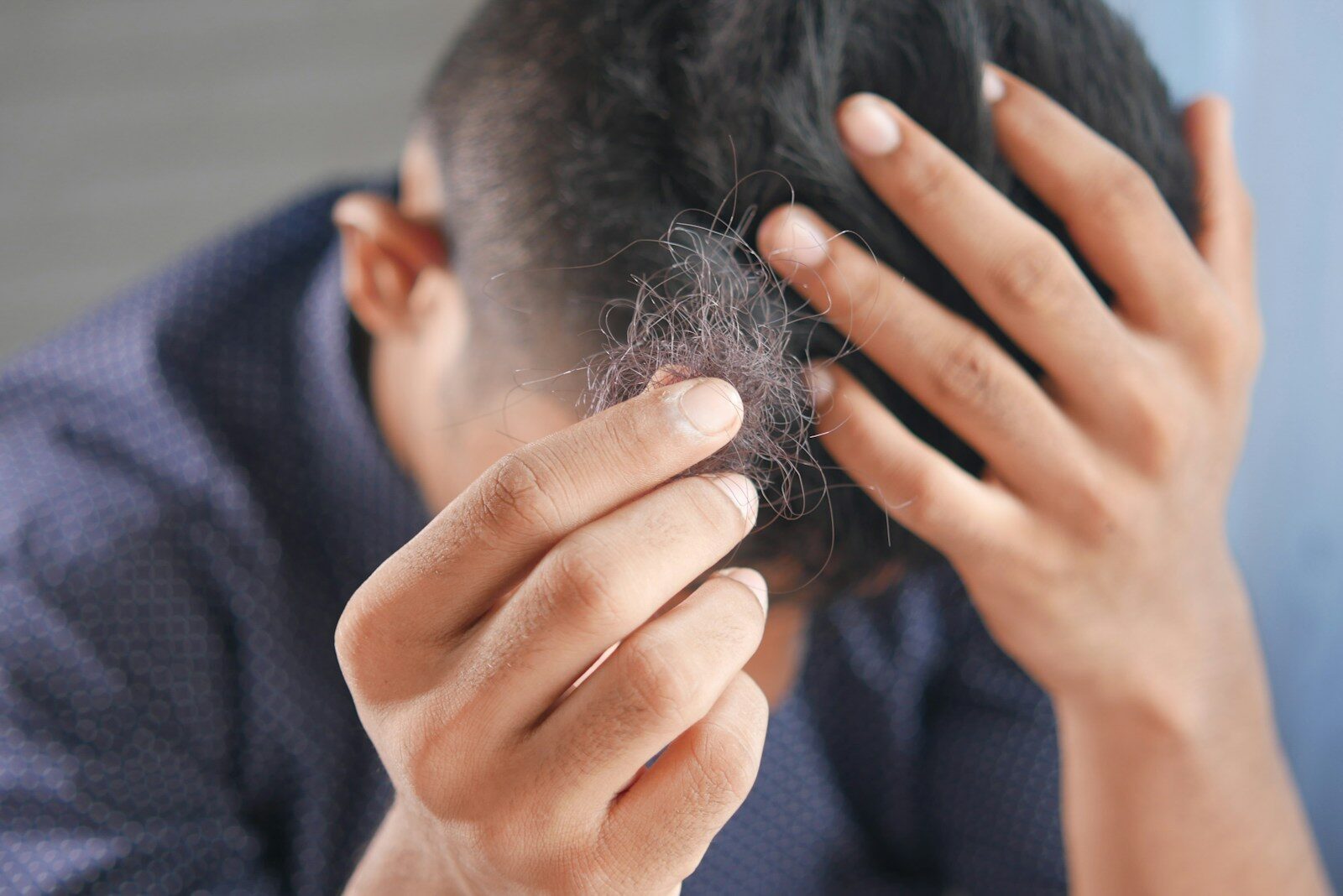
However, severe itching can lead to frequent scratching.
Repeated scratching can irritate the scalp and may contribute to hair breakage or make an existing scalp problem worse.
You may therefore notice more hair coming out while dealing with a severely itchy scalp.
Another reason dandruff and hair fall may appear together is that the same person can have two separate conditions at the same time.
For example, a man may have hereditary male pattern hair loss and dandruff.
The dandruff causes flakes and itching, while genetics are responsible for the gradual recession of the hairline.
Because both problems are visible at the same time, it is easy to blame dandruff for all the hair loss.
Looking at the pattern can help.
If your hairline has been slowly moving backward over several years, hereditary hair loss is more likely to be involved.
If you are mainly noticing flakes, itching, and scalp irritation, dandruff may be the more immediate scalp problem.
If you suddenly develop smooth bald patches, that is different again and should not simply be called dandruff.
Sudden or patchy hair loss can have other causes and may require medical evaluation.
Dandruff can affect almost anyone, but it is particularly common in men.
This is one reason men may frequently notice dandruff and hair thinning at the same time.
Age is also a period when hereditary hair loss can become more noticeable.
That overlap can create confusion.
If you are experiencing both problems, the best approach is to address the scalp condition while also paying attention to the actual pattern of hair loss.
One of the simplest ways to manage mild dandruff is regular washing.
Regular shampooing can help remove excess oil and dead skin from the scalp. If gentle washing does not control the problem, a medicated dandruff shampoo may be appropriate.
The important part is using the shampoo correctly.
Many medicated dandruff shampoos need to remain on the scalp for several minutes before being rinsed.
The exact instructions depend on the product.
Do not assume that applying shampoo and immediately rinsing it away will provide the same benefit.
Read the instructions on the bottle and follow them carefully.
Different dandruff shampoos contain different active ingredients.
Common ingredients include ketoconazole, selenium sulfide, salicylic acid, zinc pyrithione, sulfur, and coal tar.
You do not necessarily need the strongest shampoo available.
The right product depends on your scalp, the severity of the problem, and how your skin responds.
If one dandruff shampoo does not work, another formulation may be more suitable.
Some people may benefit from alternating shampoos with different active ingredients when appropriate.
However, more is not always better.
If a product causes burning, significant irritation, or worsening symptoms, stop using it and seek professional advice.
Your scalp should not feel increasingly painful every time you wash it.
Another mistake people make is aggressively scratching away the flakes.
It can feel satisfying temporarily.
But scratching can irritate the scalp and create more discomfort.
Instead, gently massage the scalp while washing.
Let the shampoo do the work.
Avoid using your fingernails aggressively against the scalp.
Your scalp is skin, and it needs the same gentle treatment as the rest of your body.
Another common question is whether dandruff causes hair to fall out from the root.
Dandruff itself is not generally considered the same thing as follicle-destroying hair loss.
But severe scalp inflammation, scratching, infection, or another underlying scalp condition can contribute to hair problems.
That is why persistent or severe symptoms deserve attention.
If you have flakes but no significant itching or inflammation, mild dandruff may be relatively straightforward to manage.
If you have thick scaling, redness, pain, swelling, crusting, bleeding, or significant hair loss, the situation may be more complicated.
Conditions such as psoriasis, eczema, seborrheic dermatitis, or scalp infections can sometimes resemble what people casually call dandruff.
This is where self-diagnosis can become risky.
You may buy several dandruff products when the actual condition requires a different treatment.
If the scalp problem does not improve after several weeks of appropriate dandruff care, speak with a healthcare professional or dermatologist.
Hair loss itself also has many possible causes.
Genetics is one of the biggest.
A man may notice his temples gradually becoming thinner or his crown becoming more visible.
That pattern can occur independently of dandruff.
Male pattern hair loss commonly begins at the hairline or top of the head and can progress over time.
This means treating dandruff may make your scalp more comfortable without stopping genetic hair loss.
That distinction is important.
Imagine you have dandruff and a receding hairline.
You start using an effective dandruff shampoo.
Your itching improves.
The flakes become less noticeable.
But your hairline continues to recede.
That does not mean the dandruff treatment failed.
It means the dandruff and genetic hair loss were two different problems.
The same thing can happen with temporary hair shedding.
Stress, significant weight loss, illness, surgery, or another physical shock can cause increased shedding several months later.
If you happen to develop dandruff during the same period, it can be tempting to blame the scalp flakes for everything.
But the actual trigger for the increased shedding may be something that happened months earlier.
This is why the timeline matters.
Think about when the hair fall started.
Think about when the dandruff started.
Think about whether you recently experienced illness, major stress, rapid weight loss, nutritional changes, or medication changes.
The answers may reveal that two separate issues are happening.
Your diet can also influence hair health.
A balanced diet that provides enough protein and essential nutrients supports normal hair growth.
Severe dieting and poor nutrition can contribute to hair shedding.
If you are already dealing with dandruff and hair fall, avoid crash diets or extreme food restrictions.
Instead, focus on balanced meals.
Protein can come from foods such as eggs, fish, dairy products, lentils, beans, soy, nuts, and seeds, depending on your dietary preferences.
You do not need a special dandruff diet.
You need adequate nutrition overall.
Another popular question is whether oily foods cause dandruff.
There is no simple rule that eating one particular food automatically causes dandruff.
Dandruff can be influenced by scalp oiliness, skin sensitivity, Malassezia, environmental factors, stress, and other conditions.
Instead of eliminating random foods, pay attention to your overall health and scalp routine.
Stress is another factor worth considering.
Stress can make dandruff worse in some people.
Stress can also contribute to temporary excessive hair shedding.
So a stressful period could potentially make both problems more noticeable.
This does not mean that every episode of dandruff is caused by stress.
It simply means stress can be one factor influencing the situation.
Improving stress management can therefore be helpful for overall health, even though it is not a guaranteed treatment for hair loss.
Sleep is another part of a healthy routine.
Poor sleep does not automatically cause baldness.
However, chronic stress and poor lifestyle habits can occur together and may contribute to overall health problems.
Instead of looking for one miracle solution, focus on a consistent routine that supports your body.
Get enough sleep.
Eat regular balanced meals.
Stay physically active.
Manage stress.
Take care of your scalp.
And avoid unnecessary damage to the hair shaft.
Your hair-care routine also matters.
Avoid aggressively brushing or combing your hair, especially when it is wet.
Use gentle techniques to remove tangles.
If your hair is fragile, a wide-toothed comb can reduce unnecessary pulling.
Repeated mechanical stress can cause breakage.
Breakage can make your hair look thinner even though the follicles themselves may still be healthy.
Heat styling can also damage hair.
Excessive use of straighteners, curling tools, or very hot blow dryers can weaken the hair shaft.
This type of damage is different from genetic hair loss.
If your hair is breaking, reducing heat exposure may make a noticeable difference in its appearance.
Chemical treatments can also contribute to damage.
Frequent bleaching, coloring, relaxing, or aggressive coloring can weaken the hair.
If you already have an irritated scalp, be particularly careful with products that cause burning or discomfort.
Your scalp should not have to tolerate pain for the sake of hair styling.
Another common question is whether oiling the scalp can cure dandruff.
The answer depends on what is actually causing the flakes.
People often assume that every flake means the scalp is dry.
But dandruff can also occur on an oily scalp.
Applying more oil is therefore not automatically the solution.
In some people, heavy products may make the scalp feel more greasy or difficult to manage.
If you enjoy using hair oil on the lengths of your hair, that is a separate cosmetic choice.
But do not assume that putting oil on the scalp will eliminate dandruff.
Tea tree oil is another popular home remedy.
Although tea tree oil is included in some products, there is not strong evidence that it treats dandruff, and it can cause allergic reactions in some people.
Natural does not automatically mean risk-free.
If you apply essential oils directly to the scalp without appropriate dilution, irritation or allergic reactions can occur.
A simple medicated dandruff shampoo with a recognized active ingredient may be a more predictable option.
Another myth is that dandruff means your scalp is dirty.
That is not necessarily true.
Dandruff has multiple causes and can occur even in people who maintain good personal hygiene.
Washing regularly can help manage it, but developing dandruff does not mean you are unhygienic.
This is important because embarrassment can lead people to hide the problem instead of treating it.
There is nothing unusual about dandruff.
It is common and generally manageable.
The goal is to control the symptoms and identify anything unusual.
If you have severe flakes, you may also notice them on your eyebrows or around the ears.
Dandruff and seborrheic dermatitis can affect areas beyond the scalp.
If scaling becomes persistent in several areas, a dermatologist can help determine what is happening.
Another warning sign is significant redness.
Ordinary dandruff may cause some itching and flaking, but intense inflammation deserves attention.
Pain is another reason to seek advice.
Dandruff should not normally cause severe scalp pain.
If you have painful bumps, sores, crusts, bleeding, or pus, do not assume that you simply need a stronger shampoo.
A scalp infection or another dermatological condition may need specific treatment.
Hair loss with scalp scaling is also worth evaluating.
Some scalp infections can cause scaling, broken hairs, redness, swelling, and sometimes oozing.
This is particularly important because scalp infections can require medical treatment.
Another warning sign is a sudden bald patch.
If you wake up and notice a smooth, round area with missing hair, do not automatically blame dandruff.
Patchy hair loss can occur with conditions such as alopecia areata.
The correct treatment depends on the diagnosis.
This is why a dermatologist can be more helpful than repeatedly changing shampoos.
You should also pay attention to the hairline.
If your hairline is slowly receding while dandruff comes and goes, the two issues may be unrelated.
Dandruff can improve and return.
Genetic hair loss can continue progressing.
Treating one does not necessarily stop the other.
If you are concerned about hereditary hair loss, early evaluation can be useful.
Evidence-based treatments are available for certain types of hair loss.
Minoxidil is one commonly used option for pattern hair loss.
It may help some people slow hair loss or encourage regrowth, but it is not a universal treatment.
This is very different from dandruff treatment.
A dandruff shampoo is designed to manage scalp flaking and related symptoms.
It is not a treatment for male pattern baldness.
Similarly, a hair-growth medication is not necessarily a treatment for dandruff.
Understanding what each product is intended to do can prevent wasted money and unrealistic expectations.
Another issue is using too many products at once.
You might use an anti-dandruff shampoo, hair oil, scalp serum, onion juice, rosemary oil, hair-growth supplement, and styling product all at the same time.
If your scalp becomes irritated, you will not know which product caused it.
Keep your routine simple.
Introduce one new product at a time.
Follow the product instructions.
Give it enough time to work.
And stop if you develop significant irritation.
Your scalp does not need ten different products to be healthy.
It needs an appropriate routine.
If your dandruff is mild, regular gentle washing may be enough.
If that does not work, consider an appropriate medicated dandruff shampoo.
Different active ingredients work in different ways.
Ketoconazole and selenium sulfide, for example, are used in dandruff shampoos to target factors associated with dandruff. Salicylic acid can help with scaling.
Always follow the instructions on the product you use.
Some medicated shampoos should be used several times per week initially, while others may be used differently.
Once the dandruff improves, some people need less frequent maintenance use.
The exact schedule depends on the product and your scalp.
If you have curly, coiled, or textured hair, your washing routine may need to be adjusted to avoid excessive dryness.
The goal is to control the scalp condition without unnecessarily damaging the hair.
Another useful habit is to apply medicated shampoo to the scalp rather than concentrating it only on the hair lengths.
The active ingredient needs contact with the scalp to work where the dandruff is occurring.
Gently massage the scalp.
Do not aggressively scratch.
Then rinse thoroughly.
If the product causes burning or stinging, stop using it.
Do not assume irritation means the product is “working.”
Persistent irritation can make your scalp problem worse.
If over-the-counter treatment does not help after a few weeks, professional evaluation is sensible.
You may need a prescription-strength treatment or a different diagnosis.
A dermatologist can examine your scalp directly.
They can determine whether the flakes are consistent with dandruff or whether another condition is involved.
This is especially useful when hair loss is happening at the same time.
A professional may also ask about your diet, hair-care routine, medications, family history, recent illness, stress, and other factors.
Hair-loss evaluation may sometimes involve blood tests or other examinations depending on the suspected cause.
There is no universal blood test for every person with hair fall.
Testing should be based on the individual situation.
The same principle applies to supplements.
Do not automatically take biotin, iron, zinc, vitamin D, or other supplements simply because you see hair fall.
Supplements are most useful when there is a genuine nutritional need.
Taking excessive amounts can create health problems.
A balanced diet is the better foundation.
Another common concern is whether dandruff causes permanent hair loss.
Ordinary dandruff is generally not the same as a scarring hair-loss condition.
But persistent inflammation, infection, severe scratching, or another underlying scalp disorder can change the situation.
That is why severe or unusual symptoms should be assessed.
Do not wait until a large area of hair has disappeared.
Early evaluation can be particularly important when inflammation or scarring is suspected.
The appearance of your scalp can provide useful clues.
White or yellowish flakes with itching may fit dandruff.
A gradually receding hairline may fit male pattern hair loss.
Smooth circular bald patches may fit alopecia areata.
Scaling with broken hairs and inflammation may indicate an infection.
These are only general patterns, not a diagnosis.
Your symptoms can overlap.
That is why professional assessment is important when the situation is unclear.
If you are experiencing dandruff and hair fall right now, start with simple steps.
Keep your scalp clean.
Use a suitable dandruff shampoo if needed.
Avoid aggressive scratching.
Reduce unnecessary styling products.
Protect your hair from excessive heat.
Avoid very tight hairstyles.
Eat a balanced diet.
Get adequate protein.
Manage stress.
Monitor your hair-loss pattern.
And seek medical advice if the problem is persistent, severe, sudden, or unusual.
Do not panic because you see flakes.
Do not panic because you see a few hairs in the shower.
But do pay attention when your normal pattern changes significantly.
Hair loss is easier to manage when you identify the cause instead of treating every symptom with the same product.
If dandruff is the main problem, treat the scalp.
If hereditary hair loss is present, consider evidence-based hair-loss treatment.
If nutritional deficiency is suspected, address the deficiency.
If an infection or inflammatory condition is present, get appropriate medical treatment.
The solution depends on the cause.
This is the most important lesson.
Dandruff and hair fall can appear together without one directly causing the other.
Sometimes dandruff is simply a scalp problem happening alongside genetic hair loss.
Sometimes severe scalp irritation contributes to breakage or increased shedding.
Sometimes the flakes are not dandruff at all.
The best approach is to look at the whole picture.
Your scalp should be comfortable.
Your hair-care routine should be gentle.
Your diet should be adequate.
And persistent hair loss should not be ignored.
You do not need to chase every viral home remedy.
You do not need to oil your scalp every day.
You do not need to stop washing your hair.
And you certainly do not need to assume that every hair in the shower means you are going bald.
Start with the basics.
Understand the difference between dandruff and hair loss.
Treat the scalp appropriately.
Watch the pattern of your hair.
And get professional advice when something does not look or feel normal.
There is no shame in caring about your hair.
There is also no need to chase every viral hair-growth trick.
The best approach is calm, consistent, evidence-based, and tailored to the reason your hair is changing.
Can dandruff cause hair fall? Ordinary dandruff is not usually a direct cause of permanent follicle-related hair loss. However, itching, scratching, irritation, infection, or another scalp condition occurring alongside dandruff can contribute to hair problems.
Does dandruff cause baldness? Dandruff itself is not the usual cause of male or female pattern baldness. Genetic hair loss is a much more common explanation for gradual thinning and receding hairlines.
Can scratching dandruff cause hair loss? Aggressive or repeated scratching can irritate the scalp and may contribute to breakage or worsen an existing scalp problem.
Does dandruff stop hair growth? Mild dandruff does not normally stop hair follicles from producing hair. However, significant inflammation or another underlying scalp disorder can affect hair health.
Can dandruff cause permanent hair loss? Ordinary dandruff is generally manageable and is not the same as a scarring hair-loss disorder. Persistent inflammation, infection, or other scalp conditions can require medical treatment.
Why am I losing hair when I have dandruff? You may have dandruff and another type of hair loss at the same time. Genetics, stress, nutritional problems, illness, medications, and other factors can cause hair loss independently of dandruff.
What is the best shampoo for dandruff and hair fall? A dandruff shampoo can help control scalp flaking, but it is not necessarily a treatment for every type of hair loss. Ingredients used in dandruff shampoos include ketoconazole, selenium sulfide, salicylic acid, zinc pyrithione, sulfur, and coal tar.
How often should I use dandruff shampoo? Follow the instructions on the specific product. Some medicated shampoos are commonly used a few times a week, while maintenance frequency may be reduced once symptoms improve.
Can I use oil if I have dandruff? Hair oil may be useful for conditioning the hair, but applying oil to the scalp is not a guaranteed treatment for dandruff. If your scalp is oily, heavy products may not be helpful.
Does coconut oil cure dandruff? Coconut oil should not be considered a guaranteed cure for dandruff. If you have persistent flakes and itching, an appropriate dandruff shampoo may be more useful.
Can rosemary oil treat dandruff and hair loss? Rosemary oil should not be treated as a guaranteed solution for either condition. Persistent dandruff or progressive hair loss may require evidence-based treatment.
Can tea tree oil remove dandruff? Some products contain tea tree oil, but evidence for treating dandruff is limited and tea tree oil can cause allergic reactions in some people.
Does dandruff cause itchy scalp? Yes. Itching is one of the common symptoms associated with dandruff.
Why does my dandruff get worse when I am stressed? Stress can make dandruff worse in some people.
Can dandruff cause a receding hairline? A gradually receding hairline is more commonly associated with male pattern hair loss than ordinary dandruff.
Can dandruff cause hair thinning in men? Dandruff is not usually the main cause of progressive male pattern thinning. A man can have dandruff and genetic hair loss at the same time.
Can dandruff cause hair thinning in women? Persistent scalp irritation can affect hair comfort and handling, but gradual thinning in women can have several causes, including hereditary hair loss and hormonal or medical factors.
What if dandruff shampoo does not work? If dandruff does not improve after several weeks of appropriate treatment, see a healthcare professional or dermatologist. You may need a different treatment or evaluation for another scalp condition.
When should I see a dermatologist for dandruff and hair loss? Seek professional advice if hair loss is sudden, patchy, rapidly increasing, or accompanied by scalp pain, severe redness, swelling, crusting, sores, significant scaling, or broken hairs.
Can scalp infection look like dandruff? Yes. Some scalp infections can cause scaling, broken hairs, redness, swelling, and sometimes oozing. These symptoms require appropriate evaluation rather than simply using dandruff shampoo.
Does dandruff shampoo regrow hair? Dandruff shampoo is primarily intended to control scalp flaking and related symptoms. It should not be assumed to regrow hair lost from hereditary or other medical causes.
Can minoxidil help if I have dandruff and hair loss? Minoxidil can help certain types of pattern hair loss, but it does not replace appropriate treatment for dandruff or other scalp conditions.
How can I prevent dandruff-related hair problems? Maintain appropriate scalp hygiene, use suitable dandruff treatment when needed, avoid aggressive scratching, limit irritating products, handle hair gently, and seek professional advice if symptoms persist.
Medical Disclaimer: This article is for general educational purposes and does not replace individualized medical advice, diagnosis, or treatment. Hair loss and scalp conditions can have many different causes. If you experience sudden, severe, patchy, painful, or rapidly progressing hair loss, or persistent scalp inflammation, consult a qualified dermatologist or healthcare professional.