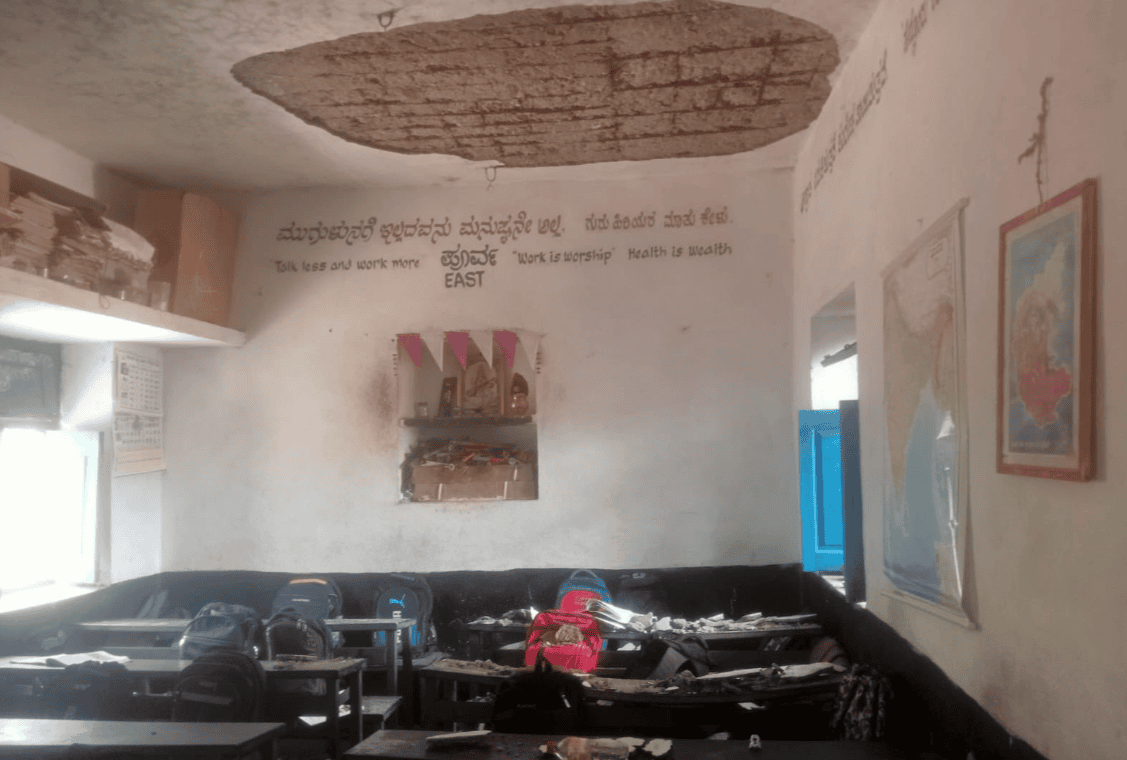
A portion of the concrete roof of a government school collapsed while classes were underway in Karnataka’s Bagalkot district, leaving six students with minor injuries and raising fresh concerns about the safety of school buildings.
The incident took place at the government school in Mugallolli Tanda in Bagalkot taluk on Wednesday, September 2, when students were attending classes inside the building.
According to officials, six children suffered minor injuries after part of the classroom ceiling came down. The injured students were taken to hospital for treatment and were reported to be out of danger.
Bagalkot Zilla Panchayat Chief Executive Officer Gajanan Bale said the injured students were receiving appropriate medical treatment. The administration has directed the Panchayat Raj Engineering Department to immediately repair the damaged portion of the school building.
काश कर्नाटक में कॉंग्रेस सरकार होती तो स्कूल की छत का प्लास्टर गिरने से चार छात्र घायल न होते pic.twitter.com/mxgCzdnpsQ
— खुरपेंच (@khurpenchh) September 2, 2026
The incident occurred while classes were being conducted, making the collapse particularly concerning for students, teachers and parents.
Reports indicate that the affected classroom was being used by students of Classes 5 and 6. The school reportedly has students from Classes 1 to 6 and serves dozens of children from the surrounding area.
The injured children were initially provided medical assistance before being taken to Bagalkot District Hospital. Officials later confirmed that their injuries were minor and that their condition was stable.
Education department officials also visited the hospital to check on the students and assess their condition.
The incident has prompted parents to raise questions about the condition of the school building. Parents have reportedly been concerned about the deteriorating condition of the premises and have demanded permanent repairs rather than temporary measures.
The demand comes amid concerns over the structural condition of government school buildings in several parts of Karnataka.
Parents have argued that children should not be required to study in classrooms where there are visible signs of structural deterioration.
The administration has now ordered urgent repair work on the damaged portion of the building. However, parents are seeking broader safety measures and a proper assessment of the entire school premises.
The concern is that repairing only the portion that collapsed may not be sufficient if other parts of the building have also developed structural weaknesses.
Local reports indicate that the school building has suffered damage, with recent rains being cited as one possible contributing factor. Officials are expected to assess the condition of the building before deciding what additional measures are required.
The incident has also raised questions about whether classrooms in poor condition should have continued to be used.
Deputy Director of School Education R.S. Seetharamu said officials would inspect the school and collect details about what happened.
He also indicated that instructions had already been issued that children should be taught only in safe premises and that responsibility would be fixed if negligence is established.
The statement suggests that the education authorities will examine whether the condition of the classroom had previously been reported and whether appropriate action was taken.
The investigation will be important because a school building is expected to meet basic safety requirements before children are allowed to occupy its classrooms.
A roof or ceiling collapse during school hours can result in serious injuries or fatalities, particularly when a classroom is full.
In this case, the students were fortunate that the injuries were reported to be minor.
The incident nevertheless demonstrates the risks associated with deteriorating school infrastructure.
For parents, the immediate concern is the safety of their children when they send them to school each day.
Government schools often serve communities where families have limited alternatives for education. This makes the condition of school buildings particularly important.
If classrooms become unsafe, students can face disruption to their education as well as physical risks.
The Bagalkot incident has therefore renewed attention on the need for regular structural inspections of government schools.
School authorities and local administrations need to identify buildings showing signs of damage before an accident occurs.
Cracks, water seepage, weakened ceilings, exposed reinforcement and other visible signs of deterioration can indicate that a detailed engineering assessment may be required.
Recent heavy rainfall can further increase concerns about buildings that are already in poor condition.
Water entering through damaged roofs can weaken plaster and other components over time. However, the exact reason for the collapse at Mugallolli Tanda will need to be established through an official assessment.
It would be premature to attribute the collapse solely to rainfall without a technical inspection.
The authorities are now expected to assess the damaged classroom and determine what repairs are necessary.
Parents have called for permanent repairs and adequate safety measures so that students can continue their education without being exposed to avoidable risks.
The incident has also highlighted the importance of communication between schools and parents.
Parents reportedly expressed concern over how the incident was handled and demanded greater attention to student safety.
When an accident occurs on school premises, families need timely information about what happened and the condition of their children.
Quick medical assistance is equally important.
In the Mugallolli incident, the injured students were taken for medical treatment and officials later confirmed that they were safe.
The fact that no serious injuries were reported has prevented what could have been a much larger tragedy.
Nevertheless, authorities are now under pressure to ensure that similar incidents do not happen again.
The education department will have to determine whether other classrooms in the school are safe for use.
If additional structural problems are identified, alternative arrangements may be necessary until permanent repairs are completed.
Temporary classrooms or other safe premises could be considered if the existing building is found unsuitable for students.
The situation also raises a wider question about how frequently government school buildings are inspected.
Routine maintenance can help identify problems before they become dangerous.
A school building should not have to experience a partial collapse before authorities are alerted to its condition.
Regular engineering inspections, especially before and after the monsoon season, can help reduce the risk of accidents.
The responsibility for school infrastructure is generally shared among education authorities, local administrations and engineering departments.
Clear coordination between these agencies is therefore essential.
If a school reports structural damage, the concerned engineering authority should be able to inspect the premises and recommend appropriate repairs quickly.
Delays can become dangerous when children continue to occupy a deteriorating building.
The Bagalkot administration has now instructed the Panchayat Raj Engineering Department to undertake urgent repairs.
Officials will also need to determine whether the remaining structure can safely accommodate students.
The parents’ demand for permanent repairs reflects concerns that a temporary patch may not address the underlying structural problem.
The government will need to assess whether the affected section can be safely repaired or whether more extensive reconstruction is required.
For the six injured students, the immediate priority remains their recovery.
Officials have confirmed that their injuries are minor and that they are receiving treatment.
Their families will understandably remain concerned about whether the school is safe when classes resume.
The administration’s response in the coming days will therefore be closely watched by parents and the local community.
The incident comes at a time when school infrastructure and student safety are receiving increasing public attention.
Across India, incidents involving damaged classrooms, collapsing ceilings and unsafe school buildings periodically raise concerns about maintenance standards.
Such accidents can have serious consequences because schools are occupied by children for several hours every day.
The Bagalkot case is a reminder that infrastructure safety needs to be treated as a basic part of education administration.
A school cannot provide a secure learning environment if its classrooms are structurally unsafe.
The focus should therefore extend beyond repairing visible damage after an accident.
Authorities need to identify vulnerable buildings, conduct technical inspections and take preventive measures.
Parents also play an important role in reporting visible problems.
If they observe cracks, damaged ceilings, water leakage or other warning signs, they can bring those concerns to school authorities and local officials.
Prompt reporting can help authorities intervene before a situation becomes dangerous.
In Mugallolli Tanda, parents had already raised concerns about the condition of the school building, according to reports.
The latest incident is likely to increase pressure for a comprehensive inspection of the premises.
Officials have indicated that action will be taken if negligence is found.
Any investigation should establish whether the classroom had previously been identified as unsafe, whether maintenance requests had been made and whether officials failed to take appropriate action.
Establishing responsibility will be important not only for this particular school but also for ensuring accountability in the maintenance of other government schools.
The administration’s response could also determine whether parents regain confidence in the safety of the school.
If the authorities carry out a detailed inspection and complete the necessary repairs, the incident could become an opportunity to address longer-standing infrastructure concerns.
If only the visibly damaged section is repaired without examining the rest of the building, concerns may remain.
The safety of students should remain the primary consideration when deciding whether classrooms can continue to be used.
For teachers, the incident also highlights the difficult position they can face when working in older buildings.
Teachers are responsible for supervising students but may not have the technical expertise to determine whether a ceiling or roof is structurally safe.
That responsibility lies with qualified engineering and administrative authorities.
Schools therefore need a clear mechanism for reporting infrastructure problems and obtaining professional assessments.
The monsoon season can make such systems even more important.
Heavy rain can expose weaknesses in roofs, walls and drainage systems.
Schools with older buildings may require additional inspections before and during the rainy season.
The Karnataka government and local authorities will now face pressure to ensure that the affected students are safe and that the school receives the necessary repairs.
The immediate response has been to provide medical treatment and order repair work.
The longer-term response should focus on preventing similar incidents.
The collapse fortunately resulted only in minor injuries, but the consequences could have been much more serious if a larger portion of the roof had fallen.
The incident therefore serves as a warning about the importance of preventive maintenance.
For the families of the injured students, the priority is that their children recover fully and can return to a safe learning environment.
For the authorities, the responsibility is to establish why the ceiling collapsed and ensure that the school building meets required safety standards before normal classes continue in affected areas.
The Bagalkot school roof collapse has once again placed government-school infrastructure under scrutiny.
Six students were injured while attending classes, but all have been reported safe and out of danger.
The administration has ordered urgent repairs and education officials are examining the situation.
The coming days will be important in determining whether the damaged classroom is repaired adequately and whether the rest of the school building is inspected for additional risks.
The incident ultimately highlights a basic requirement that should never be compromised: children must be able to attend school in buildings that are safe, properly maintained and fit for regular use.
Preventing another accident will require more than repairing the collapsed portion. It will require a careful assessment of the entire school, timely maintenance and clear accountability wherever negligence is established.