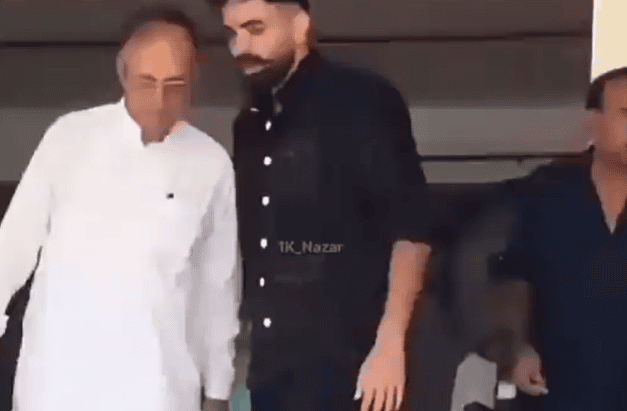
A political dispute within the Congress party in Rajasthan’s Bikaner escalated into violence when city district Congress president and former Indian Police Service officer Madan Gopal Meghwal was allegedly assaulted by party workers during an election programme.
The incident took place in Bikaner on Wednesday, September 2, during the inauguration of the election office of Congress candidate Navratan Daga in Ward 50. The confrontation has brought the party’s internal differences over ticket distribution into the public spotlight.
According to police and statements attributed to Meghwal, he had gone to the Ward 50 election office inauguration when some people allegedly called him outside on the pretext of welcoming him and putting a garland around him.
SHOCKING 🚨 Congress workers beat up their own district president (Bikaner), Madan Meghwal.
BJP says Congress is Anti-Dalit Party. pic.twitter.com/D7mXVflgx7
— News Algebra (@NewsAlgebraIND) September 2, 2026
Meghwal has alleged that Congress worker Mohit Arora and three other people then confronted him over the party ticket for Ward 50.
The former IPS officer said Arora questioned him about why he had not been given the ticket. Meghwal allegedly replied that several people seek party tickets, but only one person can ultimately be selected as the candidate.
According to Meghwal’s account, the confrontation then turned physical and the four men allegedly slapped and punched him.
People present at the spot reportedly intervened and separated the individuals involved. The alleged attackers then left the area.
A video purportedly showing the incident has also circulated on social media, adding to the political controversy surrounding the episode.
Meghwal has alleged that the people who attacked him were Congress workers. However, the allegation regarding their party affiliation and the circumstances of the assault remain matters for authorities and the party organisation to establish.
The immediate trigger appears to have been dissatisfaction over the distribution of Congress tickets for the upcoming Bikaner municipal elections.
Mohit Arora was reportedly seeking the Congress nomination from Ward 50. The party ultimately selected Navratan Daga as its candidate, leading to dissatisfaction among some local party workers.
Meghwal said Arora had been seeking the ticket and had been in contact with him over the previous two days.
According to Meghwal, Arora had also visited the Congress office on Tuesday, where he was welcomed. The following day, he appeared at the Ward 50 election programme with several other people.
Meghwal said the group was initially present at the event and raised slogans in support of Congress.
The situation changed when he was called outside during the programme.
The alleged assault has exposed tensions within the local Congress organisation at a politically sensitive time.
Municipal elections are approaching in Bikaner, and ticket distribution is often one of the most contentious stages of an election campaign because multiple party workers can seek the same nomination.
Once candidates are announced, those who fail to receive tickets may decide to contest independently, support another candidate or express their dissatisfaction within the party.
In Bikaner, the disagreement appears to have escalated beyond political criticism and resulted in an alleged physical confrontation involving the city’s Congress president.
Meghwal has strongly criticised the incident and said that the episode reflects the seriousness of the internal dispute.
He has also alleged that the incident demonstrates that people with what he described as a criminal mindset were not given party tickets.
Those allegations are part of Meghwal’s response to the assault and should not be treated as an established finding against the individuals involved unless supported by an official investigation.
The incident has drawn a strong reaction from senior Congress leader and former Rajasthan Chief Minister Ashok Gehlot.
Gehlot condemned the alleged assault and described the incident as extremely unfortunate.
He said that such behaviour amounted to indiscipline and was unacceptable within the party.
Gehlot also said that those responsible could not be considered representatives of Congress values and called on the police to arrest the accused and take action according to law.
His reaction reflects the seriousness with which the incident is being viewed within the party.
Violence between members or supporters of the same political organisation can become particularly damaging during an election campaign.
Political parties depend heavily on local workers for campaigning, voter outreach and booth-level organisation.
Internal disputes over candidate selection can weaken that organisational structure if they are not resolved quickly.
The Bikaner episode has therefore raised concerns about whether the ticket dispute could affect Congress’s preparations for the municipal elections.
The controversy is also connected to allegations surrounding the distribution of party symbols.
Some local Congress workers have reportedly alleged that changes were made to candidate selections after names had initially been finalised.
The disagreement has been described by dissatisfied workers as a dispute over party symbols and candidate selection.
These claims have intensified the internal conflict, although allegations regarding irregularities in ticket distribution would need to be independently verified.
For Congress, the timing is particularly sensitive because municipal elections require strong coordination between the party’s local leadership and grassroots workers.
A divided organisation can make campaigning more difficult.
Candidate dissatisfaction can also lead to rebel candidates, public criticism and competing campaigns within the same political camp.
The assault on Meghwal has therefore become more than an isolated incident.
It has become a visible example of the tensions created by candidate selection.
Ticket distribution is frequently a difficult process for political parties because the number of aspirants is much larger than the number of available seats.
Party leaders have to consider electoral calculations, local influence, community support, organisational loyalty and other factors when selecting candidates.
Not every aspirant can receive a nomination.
The unsuccessful candidates and their supporters can sometimes become dissatisfied with the final decision.
In most cases, political disagreements remain verbal or are handled through internal negotiations.
The Bikaner incident allegedly crossed that line when the disagreement turned into physical violence.
Police are expected to examine the circumstances of the incident and determine what legal action is appropriate.
Statements from those involved, witnesses and any available video footage could be relevant to the investigation.
The alleged video circulating online may also be examined to establish the sequence of events, although social-media footage should be independently verified before being treated as conclusive evidence.
The police investigation will ultimately determine whether offences were committed and who should be held responsible.
At this stage, the allegations made by Meghwal should be distinguished from facts established by law-enforcement authorities.
The political response, however, has already been significant.
The involvement of a former Chief Minister in condemning the incident has increased attention on the dispute within Bikaner Congress.
The episode could also put pressure on the Rajasthan Congress leadership to address the underlying disagreement over ticket allocation.
If internal grievances remain unresolved, they could potentially affect the party’s campaign in multiple wards.
The Ward 50 dispute is particularly significant because the alleged assault occurred during the election office inauguration of the party’s chosen candidate.
Such public incidents can create embarrassment for a political organisation and provide opponents with an opportunity to question its internal unity.
The Congress will therefore have to balance disciplinary action with efforts to prevent further escalation among local workers.
The party may also need to communicate clearly about its candidate-selection process to prevent rumours and accusations from spreading.
Transparency around the process could help reduce dissatisfaction among unsuccessful aspirants.
The Bikaner controversy comes at a time when municipal politics is becoming increasingly competitive.
Local elections can be closely contested because candidates often have strong personal networks and relationships within individual wards.
Unlike larger state or national elections, municipal campaigns can be heavily influenced by local issues, personal equations and neighbourhood-level organisations.
This makes candidate selection particularly important.
A candidate who enjoys strong local support can become an important electoral asset for a party.
At the same time, denying a ticket to an influential aspirant can create the possibility of internal opposition.
The allegations surrounding the Ward 50 ticket demonstrate this tension.
Meghwal has said that many people seek party tickets but only one candidate can be selected.
That is the fundamental challenge faced by political organisations during elections.
The party must make a final decision even when multiple workers believe they are suitable candidates.
The Bikaner incident shows what can happen when political disagreement becomes personal and confrontational.
For the party leadership, preventing further incidents will be important as campaigning intensifies.
The alleged assault has also brought attention to Meghwal’s background.
Before entering active politics, he served as an IPS officer. His position as Bikaner city district Congress president places him at the centre of the party’s local electoral organisation.
An assault involving the city president therefore carries greater political significance than an ordinary dispute between individual workers.
It raises questions about internal discipline and the authority of the local leadership.
The Congress leadership will likely be expected to determine whether disciplinary proceedings are warranted against party members found to have participated in the incident.
Any such action would depend on the findings of the relevant investigation and the party’s internal procedures.
For the accused individuals, it is also important that allegations are not treated as proof of guilt before an investigation is completed.
The incident has generated strong political reactions, but the legal responsibility of those involved must be established through due process.
The episode also illustrates the pressure that municipal elections can place on political parties.
With multiple candidates competing for each party nomination, local disagreements can quickly become public.
Social media can further amplify such incidents.
A confrontation that might once have remained a local matter can now circulate widely through videos and posts, bringing immediate political attention.
The alleged assault on Meghwal has followed precisely that pattern.
The reported video has contributed to wider public discussion of the dispute and the internal situation within Bikaner Congress.
For the party, the immediate challenge is to prevent the controversy from overshadowing its municipal election campaign.
The organisation will need its workers to focus on candidates, local issues and voter outreach rather than internal conflict.
The leadership may also have to engage with dissatisfied ticket aspirants to prevent further rebellion.
If the dispute is resolved through internal dialogue, the party could still attempt to restore unity before polling.
If tensions continue, however, the impact could extend beyond Ward 50.
Other aspirants who believe they were overlooked could also become more vocal, particularly if they perceive the ticket process as unfair.
The allegations regarding changes in candidate names and symbols are therefore politically important, although they remain claims that require verification.
The Congress leadership’s handling of the matter could influence how local workers perceive the fairness of future decisions.
The police investigation is also expected to remain an important part of the developments.
If arrests or formal criminal proceedings follow, the incident could become an even larger political issue during the election campaign.
If the dispute is resolved without major legal escalation, attention may gradually return to the municipal contest itself.
For now, the central facts are that Madan Gopal Meghwal was allegedly assaulted during a Ward 50 election programme, he has identified Mohit Arora and three others as the alleged attackers, and he has linked the confrontation to dissatisfaction over the Congress ticket.
The police are responsible for establishing the precise circumstances and determining whether criminal offences were committed.
The Congress leadership must separately address the question of party discipline and internal disagreements.
The incident has exposed the extent of anger surrounding candidate selection in Bikaner.
It also highlights the risks political parties face when ticket distribution creates divisions among local workers.
With municipal elections approaching, Congress will need to manage the dispute carefully if it wants to maintain organisational unity.
For now, the alleged assault on Meghwal remains the most visible manifestation of the internal ticket dispute.
The coming days will be important for determining whether the controversy leads to disciplinary action, police proceedings or further political confrontation.
What began as a disagreement over a municipal election ticket has now developed into a significant internal Congress controversy in Bikaner, putting both party discipline and the local election campaign under renewed scrutiny.