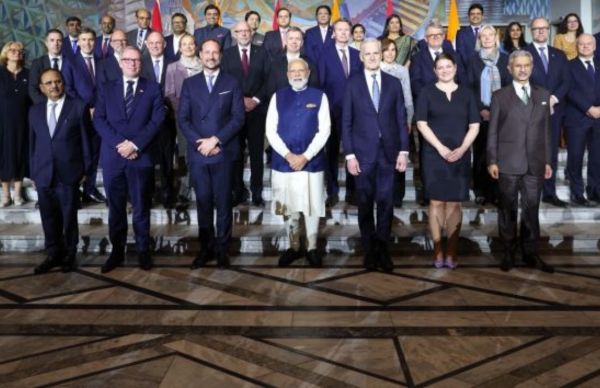
Prime Minister Narendra Modi attended the India Norway Business and Research Summit in Oslo, bringing together business leaders, researchers and policymakers from India and Norway to discuss opportunities for stronger economic and technological cooperation. Norwegian Crown Prince Haakon and Prime Minister Jonas Gahr Støre also participated in the summit, which highlighted the growing momentum in bilateral relations between the two countries.
The India Norway Business and Research Summit was attended by CEOs from more than 50 companies and over 250 representatives from Indian and Norwegian business and research communities. The event came at an important stage in bilateral economic relations following the entry into force of the India-EFTA Trade and Economic Partnership Agreement, or TEPA.
At the India Norway Business and Research Summit, Prime Minister Modi highlighted the potential for India and Norway to expand trade, investment and partnerships across emerging sectors. He encouraged Norwegian businesses to explore opportunities in India and pointed to India’s expanding economy, young population, business ecosystem and growing demand for advanced technologies and sustainable solutions.
A major focus of the India Norway Business and Research Summit was the India-EFTA TEPA. The agreement has created a framework for deeper economic engagement between India and the European Free Trade Association countries, which include Norway, Switzerland, Iceland and Liechtenstein. During the summit, Modi called on businesses from both sides to work towards the investment and employment objectives associated with the agreement.
The India Norway Business and Research Summit also highlighted the target of attracting $100 billion in investment under the India-EFTA agreement and supporting the creation of one million jobs in India. Prime Minister Modi urged businesses to work toward achieving these objectives by developing new partnerships and identifying sectors where Indian and Norwegian capabilities can complement each other.
Green technology was another important theme at the India Norway Business and Research Summit. India and Norway have elevated their bilateral relationship to a Green Strategic Partnership, creating a broader framework for cooperation in renewable energy, climate action, maritime decarbonisation and other areas connected with the green transition.
During the India Norway Business and Research Summit, Modi pointed to India’s rapidly expanding energy requirements and its efforts to increase renewable-energy capacity. He also highlighted areas such as green hydrogen, electricity-grid infrastructure and clean-energy technologies as potential fields for greater cooperation between Indian and Norwegian companies.
Norway brings experience in several areas that are relevant to India’s energy transition. Norwegian companies and institutions have expertise in offshore energy, maritime technology, ocean sustainability and climate-related investment. The India Norway Business and Research Summit provided an opportunity to connect this expertise with India’s large market and expanding infrastructure requirements.
The India Norway Business and Research Summit was not limited to energy and climate issues. Several specialised roundtable discussions were organised before the main event, covering healthcare innovation, maritime cooperation, batteries and energy-storage systems, digitalisation and electrification, and wind energy. These discussions were designed to identify more specific areas for business and research collaboration.
Healthcare innovation featured prominently in the India Norway Business and Research Summit because both countries have growing interests in health technology, research and advanced medical solutions. Cooperation between companies, universities and research institutions could support development in areas such as healthcare technology, digital health and medical innovation. The summit created a platform for representatives from these sectors to discuss possible partnerships.
The India Norway Business and Research Summit also placed attention on maritime cooperation. India has a large coastline and a major maritime sector, while Norway has long-standing expertise in shipping, offshore industries and ocean technologies. Cooperation in shipbuilding, green shipping, maritime infrastructure and ocean sustainability was identified as an area with potential for expanded engagement.
Batteries and energy-storage systems were another subject discussed around the India Norway Business and Research Summit. Energy storage is increasingly important as countries expand renewable-energy generation, particularly solar and wind power. Greater cooperation in battery technology, storage systems and related research could contribute to the development of clean-energy infrastructure in both countries.
Digitalisation and electrification were also included in the discussions surrounding the India Norway Business and Research Summit. India has developed large-scale digital public infrastructure, while Norway has strong capabilities in technology, energy systems and digital services. Combining expertise in these areas could open opportunities for companies and research institutions in both countries.
The India Norway Business and Research Summit also included discussions on wind energy. Norway’s experience in offshore energy and India’s expanding renewable-energy market provide potential areas for collaboration, particularly as both countries seek to reduce emissions and improve energy security. The two sides have also identified offshore wind and related technologies as areas where investment and technical cooperation can expand.
Space and advanced technology were among the other areas connected with the India Norway Business and Research Summit. Several business agreements involving Indian and Norwegian entities were signed during the broader visit, covering areas including space, digital public infrastructure, sustainability, tunnelling technology, healthcare and advanced technologies.
The agreements associated with the India Norway Business and Research Summit demonstrate that bilateral cooperation is moving beyond traditional trade. Technology, research, infrastructure, healthcare, energy and sustainability are increasingly becoming important parts of India-Norway economic relations. The participation of researchers alongside business leaders also underlined the role of innovation in the partnership.
The India Norway Business and Research Summit took place alongside wider diplomatic engagement between Modi and Norwegian Prime Minister Jonas Gahr Støre. During their bilateral meeting, the two leaders discussed trade and investment, climate action, energy transition, the blue economy, Arctic and polar cooperation, space, research, higher education and talent mobility. They also agreed to strengthen the relationship through a Green Strategic Partnership.
The India Norway Business and Research Summit was therefore part of a broader effort to expand the economic relationship between the two countries. Modi and Støre also discussed an ambition to double the value of current bilateral trade by 2030. They encouraged businesses to develop new partnerships that could support the investment and employment objectives connected with TEPA.
Another important aspect of the India Norway Business and Research Summit was the focus on the blue economy. Both India and Norway have significant interests in oceans, fisheries, maritime transportation and marine technology. The two governments have identified opportunities in areas including marine ecosystem protection, shipbuilding, green shipping, fisheries and aquaculture.
Research cooperation is also expected to remain an important part of the India Norway Business and Research Summit agenda. India and Norway have interests in climate science, renewable energy, oceans, health, critical minerals and emerging technologies. The two countries have discussed expanding collaboration among universities, research institutions and businesses to support innovation and technology development.
The India Norway Business and Research Summit also comes against the backdrop of India’s increasing engagement with the Arctic region. Norway is an important partner for India’s Arctic research activities, while India has maintained a research presence in Svalbard. India’s Himadri research station has supported scientific studies in the Arctic, including research related to climate and environmental changes.
The India Norway Business and Research Summit consequently has significance beyond immediate commercial agreements. The discussions connect economic cooperation with research, climate policy, maritime development, energy security and technological innovation. These areas are becoming increasingly interconnected as both countries seek new sources of growth while responding to changes in global supply chains and energy markets.
For Norwegian companies, the India Norway Business and Research Summit provided an opportunity to explore India’s large and expanding market. Prime Minister Modi invited Norwegian businesses to increase investment in India and highlighted sectors including the blue economy, shipbuilding, renewable energy, healthcare technology, critical minerals, startups and green technology.
For Indian companies and research institutions, the India Norway Business and Research Summit offered access to Norwegian expertise and potential partnerships in specialised technology-intensive sectors. Norway’s experience in maritime industries, renewable energy, ocean technologies and climate-related investment can complement India’s scale, manufacturing capabilities and growing domestic demand.
The India Norway Business and Research Summit also reflects the changing nature of India-Norway relations. The two countries are seeking cooperation across multiple areas rather than relying only on conventional trade. The Green Strategic Partnership, TEPA, technology collaboration and research connections provide several channels through which bilateral engagement can expand.
As the outcomes of the India Norway Business and Research Summit move into implementation, the focus will shift from announcements and agreements to actual investments, joint projects and research collaborations. The $100 billion investment objective under TEPA and the associated employment target represent long-term ambitions, and their progress will depend on individual businesses, investment decisions and the policy environment in both countries.
The India Norway Business and Research Summit has therefore added another layer to India’s growing engagement with Norway and the wider Nordic region. With cooperation spanning green energy, digitalisation, healthcare, maritime industries, space, research and advanced technology, both sides are seeking to build stronger economic and innovation links. The agreements and discussions from the summit provide a framework for future cooperation, while their longer-term impact will depend on how effectively businesses and institutions convert these opportunities into concrete projects.