
The CBSE Three Language Policy Class 6 implementation timeline has come under fresh consideration after the Supreme Court on September 17, 2026, asked the Central Board of Secondary Education (CBSE) to consider deferring the new language requirement for Class 6 students to the next academic session beginning in 2027. The suggestion was made during the hearing of petitions challenging aspects of the language policy.
The CBSE Three Language Policy Class 6 requires students to study three languages under the revised framework, with two of them being Indian languages. The Supreme Court’s latest suggestion does not itself change the CBSE rules because the board has been asked to consider the proposed deferment and return to the court with a fresh note. The court also clarified that its observations do not decide the underlying legal issues in the case.
The hearing on the CBSE Three Language Policy Class 6 was conducted by a bench comprising Chief Justice Surya Kant and Justices Joymalya Bagchi and V. Mohana. Justice Bagchi suggested that implementation could be postponed to the next academic year to provide students with additional time to adjust to the revised language requirements.
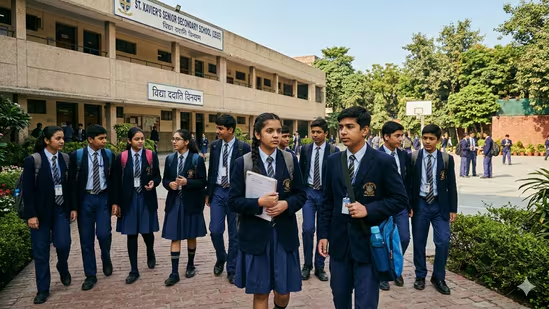
Under the CBSE Three Language Policy Class 6, the board had already begun introducing a third-language framework in Class 6 as part of changes to its Scheme of Studies for the 2026-27 academic year. A CBSE circular dated May 4, 2026, specifically addressed the introduction of R3, or the third language, in Class VI in line with the National Curriculum Framework for School Education 2023.
The CBSE Three Language Policy Class 6 is part of the broader restructuring of language education under the National Education Policy 2020 and the National Curriculum Framework for School Education 2023. The revised framework seeks to increase the role of Indian languages in school education while allowing students to continue studying other languages under specified conditions.
According to the CBSE framework, the CBSE Three Language Policy Class 6 involves the study of two Indian languages. The broader policy also applies to higher classes, with Class 9 students required to study three languages, of which at least two must be Indian languages. The Class 9 requirement took effect from July 1, 2026.
The CBSE Three Language Policy Class 6 allows language choices within the framework of Indian and non-Indian languages. Indian languages listed by CBSE include Hindi, Sanskrit, Tamil, Telugu, Kannada, Malayalam, Marathi, Bengali, Punjabi, Gujarati and Assamese, among others. Foreign languages such as French, German, Arabic and Spanish can be selected under the conditions specified by the board.
The current Supreme Court proceedings on the CBSE Three Language Policy Class 6 are partly focused on implementation and practical concerns. Schools need sufficient teachers, textbooks, digital learning material and suitable language options to introduce an additional language without creating disruption for students. The CBSE has therefore been examining implementation challenges through a committee constituted on September 16.
The committee working on the CBSE Three Language Policy Class 6 has been tasked with reviewing the language options available in affiliated schools and assessing the availability of qualified teachers and educational resources. It is also expected to recommend measures to address implementation difficulties identified by schools.
The issue of teacher availability has been an important part of the discussion surrounding the CBSE Three Language Policy Class 6. In its submission to the Supreme Court, CBSE said data from 20,777 schools showed that 19,386 schools, or approximately 93.3 percent, already had teachers for at least two distinct Indian languages. The board also said 3,523 schools had teachers for three or more Indian languages.
Textbook availability has also featured in the CBSE Three Language Policy Class 6 discussion. The CBSE told the court that Class 6 third-language textbooks were available through the NCERT website in all 22 scheduled Indian languages. According to the board, these resources covered the language choices of approximately 98.36 percent of schools, while other languages could use resources from State Councils of Educational Research and Training.
The CBSE Three Language Policy Class 6 has also faced questions over students who were already studying two non-Indian languages. CBSE has provided certain relaxations for students in Classes 7, 8 and 9 who were following such combinations, but the treatment of the current Class 6 batch became a central issue before the Supreme Court.
During the hearing, the Supreme Court considered whether students currently in Class 6 should receive additional flexibility. The court suggested that if students who are presently in Class 6 want to study three languages during the current academic year, they could still be allowed to do so, while mandatory implementation could be moved to 2027.
The CBSE Three Language Policy Class 6 issue reached the Supreme Court after petitions challenged the revised language framework. On May 27, 2026, the court agreed to examine a plea against the policy and issued notices to the Centre, CBSE and NCERT. The broader legal challenge remains pending, meaning Thursday’s suggestion does not represent a final ruling on the validity of the policy.
The Supreme Court’s approach to the CBSE Three Language Policy Class 6 has focused partly on giving students and schools more time to adapt. Justice Bagchi suggested that delaying the mandatory rollout could provide some comfort to children while allowing the education system to address logistical issues before full implementation.
For parents following the CBSE Three Language Policy Class 6, an important point is that the Supreme Court has not yet ordered CBSE to permanently change its language framework. The board has only been asked to consider the proposed deferment and submit a fresh note. Until CBSE formally communicates any revised implementation schedule, schools and parents should continue to rely on official CBSE instructions.
The CBSE Three Language Policy Class 6 is also connected to the larger objective of implementing the language-related provisions of NEP 2020. The policy places greater emphasis on Indian languages and multilingual learning, while the CBSE framework attempts to create a structured system through R1, R2 and R3 language categories.
For Class 9 students, the CBSE Three Language Policy Class 6 discussion is relevant because the broader framework has already introduced mandatory three-language study from July 2026. Under the current structure, at least two of the three languages must be Indian languages. CBSE has also said that there will be no separate Class 10 board examination for R3, with the aim of avoiding additional examination pressure on students.
The CBSE Three Language Policy Class 6 has also created operational questions for schools because language choices can vary considerably across regions. Schools need teachers who can teach different Indian languages, appropriate textbooks and learning resources, and systems that can accommodate students coming from different language backgrounds. These practical considerations are among the issues being examined by the CBSE committee.
The CBSE’s position on the CBSE Three Language Policy Class 6 has been that providing a one-time exemption to the current Class 6 batch could create learning gaps and disrupt the progressive implementation of the framework. The board has also argued that granting a special exemption could result in similar requests from future batches.
At the same time, the Supreme Court’s suggestion on the CBSE Three Language Policy Class 6 indicates that the implementation timeline can be reconsidered in light of student and school concerns. The proposed 2027 rollout would give institutions additional time to prepare language offerings, teachers and educational material before the requirement becomes mandatory for the affected students.
The CBSE Three Language Policy Class 6 debate also reflects the wider challenge of implementing curriculum reforms across thousands of schools. CBSE has more than 28,000 affiliated schools, and the availability of teachers and language resources can differ from one institution and region to another. The board’s committee has therefore been tasked with identifying gaps before the framework is fully implemented.
For students and families, the immediate situation surrounding the CBSE Three Language Policy Class 6 remains subject to CBSE’s next decision. The Supreme Court has suggested that mandatory implementation could begin in the 2027 academic session, while students who voluntarily want to study three languages during the current session could be permitted to do so. CBSE has agreed to consider the suggestion and provide a fresh note to the court.
The CBSE Three Language Policy Class 6 case is therefore still developing. The Supreme Court has not issued a final judgment on the broader challenge, and the CBSE has not yet formally announced that the Class 6 requirement has been postponed. The next update from the board and the court will determine whether the suggested 2027 timeline becomes the formal implementation schedule.
For now, the CBSE Three Language Policy Class 6 remains part of CBSE’s ongoing curriculum reform under NEP 2020 and NCF-SE 2023. The Supreme Court’s latest intervention has placed additional focus on the transition period, school preparedness and student convenience. The CBSE’s forthcoming note is expected to clarify how the board proposes to proceed with the Class 6 language framework and whether mandatory implementation will move to the 2027 academic session.