
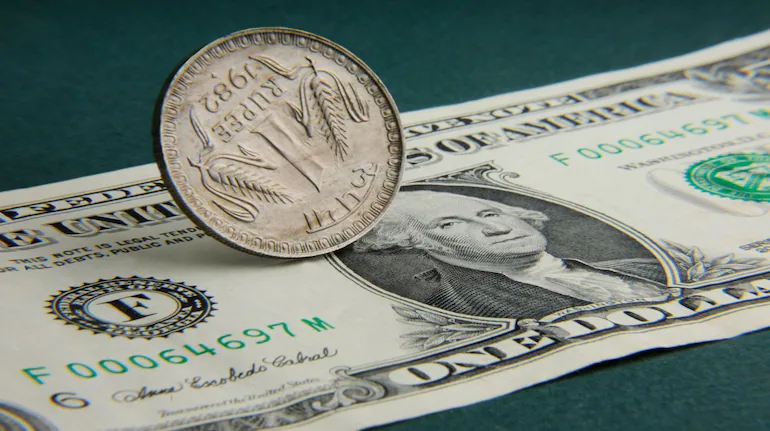
The Indian Rupee Falls Below 96 against the US dollar on September 17, 2026, as the domestic currency came under renewed pressure following the US Federal Reserve’s first interest-rate increase in three years. The rupee breached the psychologically important ₹96-per-dollar level in early trading, marking its weakest level in more than a month. The move came after the US central bank raised its benchmark interest rate by 25 basis points and signalled that further tightening could follow.
The Indian Rupee Falls Below 96 after the Federal Reserve lifted its overnight benchmark rate to a range of 3.75% to 4%. The September 16 decision marked the Fed’s first rate hike since 2023. The move strengthened the US dollar and increased pressure on emerging-market currencies, including the rupee, as investors reassessed global interest-rate and capital-flow conditions.
The Indian Rupee Falls Below 96 level was particularly significant because the currency had remained close to ₹96 for several sessions. The rupee had closed at ₹95.9550 against the dollar on September 16, before opening weaker on September 17 and moving beyond the ₹96 mark. Moneycontrol reported that the currency was trading around ₹96.03 after the previous session’s close.
The Indian Rupee Falls Below 96 amid a broader strengthening of the US dollar. The dollar index moved above 100 following the Federal Reserve decision, reaching its highest level in more than a month. A stronger dollar generally creates pressure on emerging-market currencies because investors can find dollar-denominated assets more attractive when US yields rise.
The Indian Rupee Falls Below 96 also reflects concerns about the possibility of additional US rate increases. Moneycontrol reported that futures markets were indicating roughly a 50% probability of another Federal Reserve rate hike in October, while markets had priced in several increases during the current tightening cycle. However, future Federal Reserve decisions will depend on incoming economic and inflation data.
The Indian Rupee Falls Below 96 has also been influenced by elevated crude oil prices. Brent crude remained above $100 a barrel, with Moneycontrol reporting prices around $105.69 on September 17. Higher oil prices can put pressure on India’s external finances because India imports a substantial share of its crude oil requirements, increasing demand for dollars from oil importers.
The Indian Rupee Falls Below 96 situation has therefore developed from several factors rather than the Federal Reserve decision alone. Higher oil prices, a stronger US dollar, foreign portfolio outflows and elevated global bond yields have all contributed to pressure on the currency. Reuters also reported that the rupee had been under pressure from these factors while the Reserve Bank of India continued efforts to limit sharp movements.
The Indian Rupee Falls Below 96 despite apparent intervention by the Reserve Bank of India. Reuters reported that traders observed state-run banks selling dollars, which they believed was likely being done on behalf of the RBI. Traders also indicated that the central bank may have used dollar-rupee sell/buy swaps as part of its efforts to manage liquidity and currency-market conditions.
The Indian Rupee Falls Below 96 was initially more pronounced during Thursday’s trading session, but the currency later recovered some of its losses. Reuters reported that the rupee eventually closed at ₹95.93 per dollar, almost unchanged from Wednesday’s ₹95.9550 close. This means the move above ₹96 during the session did not translate into a closing level above that threshold.
The Indian Rupee Falls Below 96 development therefore needs to be viewed differently from a sustained closing breach. The currency’s intraday movement above ₹96 shows pressure around the level, while the subsequent recovery indicates that dollar selling and other market flows helped limit the decline. Reuters said likely RBI intervention and inflows connected with an equity-index rebalancing helped cushion the impact of the Federal Reserve’s rate increase.
The Indian Rupee Falls Below 96 also comes after a period of continued weakness. The currency had declined for seven consecutive sessions through September 17, according to market reports. Before Thursday’s move, the rupee had already reached its weakest level since late July during the previous session.
The Indian Rupee Falls Below 96 has implications for India’s import costs. A weaker rupee means Indian companies require more rupees to purchase the same amount of goods priced in US dollars. This can be particularly important for crude oil, electronics, machinery, chemicals and other imported products. The impact on consumers ultimately depends on global commodity prices, domestic demand and how much of the currency movement businesses pass through to prices.
The Indian Rupee Falls Below 96 could also affect inflation expectations if the currency remains weak for an extended period. A sustained depreciation can increase the rupee cost of imported goods and raw materials. The effect is not immediate or uniform, however, because companies may hedge currency exposure, absorb some costs or have existing inventories purchased at earlier exchange rates.
The Indian Rupee Falls Below 96 has also increased attention on the Reserve Bank of India’s monetary-policy options. Moneycontrol reported that the Federal Reserve’s tightening could strengthen the case for an RBI rate increase when its Monetary Policy Committee meets in early October, particularly because elevated oil prices and geopolitical risks could complicate India’s inflation outlook. This remains a policy expectation reported by analysts rather than a confirmed RBI decision.
The Indian Rupee Falls Below 96 also matters for Indian companies that have significant foreign-currency exposure. Importers may face higher costs when purchasing goods or services in dollars, while companies earning substantial dollar revenues can receive more rupees when those foreign earnings are converted into the domestic currency. The overall effect therefore varies depending on whether a company is primarily an importer, exporter or has balanced foreign-exchange exposure.
The Indian Rupee Falls Below 96 can also influence foreign investment flows. Higher US interest rates can make dollar-denominated assets relatively more attractive to international investors. If investors reduce exposure to emerging markets or move funds toward US assets, demand for dollars can rise while demand for local currencies can weaken. However, individual capital-flow decisions depend on a much wider range of factors, including equity valuations, economic growth and country-specific risks.
The Indian Rupee Falls Below 96 also comes at a time when global markets are monitoring the Federal Reserve’s future policy direction. The latest increase was accompanied by indications that policymakers could raise rates again if inflation remains persistent. Fed Chair Kevin Warsh has emphasised that future decisions will depend on economic conditions rather than a predetermined path, meaning markets are likely to closely track inflation, employment and growth data.
The Indian Rupee Falls Below 96 could remain a key focus for currency traders because ₹96 has emerged as an important psychological level. Amit Pabari, managing director of CR Forex Advisors, told Moneycontrol that a sustained move above ₹96 could open the way toward ₹96.30–₹96.50 in the near term. This is an analyst projection rather than a guaranteed future exchange rate.
The Indian Rupee Falls Below 96 also comes as traders monitor developments in India’s equity markets. Reuters reported that inflows linked to an equity-index rebalancing helped support the rupee during Thursday’s session. In addition, traders were watching expected dollar inflows connected with the National Stock Exchange’s IPO, which could provide another source of dollar supply in the foreign-exchange market.
The Indian Rupee Falls Below 96 has implications beyond currency traders because exchange rates influence businesses, consumers and financial markets. Import-heavy industries may experience higher input costs, while exporters with dollar revenues may benefit from stronger foreign-currency receipts when converted into rupees. The net economic effect depends on how long the depreciation lasts and whether it is accompanied by changes in commodity prices and global demand.
The Indian Rupee Falls Below 96 also highlights the importance of crude oil prices for India’s currency outlook. Because oil is traded internationally in dollars, a combination of expensive crude and a weaker rupee can increase the domestic cost of energy imports. If such pressures persist, they can complicate inflation management and influence monetary-policy discussions.
The Indian Rupee Falls Below 96 is therefore not solely a reaction to one Federal Reserve decision. The September 17 move reflects the interaction of US monetary policy, dollar strength, oil prices, foreign investment flows, global bond yields and RBI market operations. The rupee’s subsequent recovery toward ₹95.93 at the close also demonstrates that intraday currency movements can change as market liquidity and central-bank activity evolve.
The Indian Rupee Falls Below 96 story will remain closely linked to the next steps taken by the Federal Reserve and the Reserve Bank of India. Markets will watch US inflation and employment data for clues about additional Federal Reserve increases, while Indian investors will monitor oil prices, foreign portfolio flows and RBI actions. Any change in these factors could influence the rupee’s direction.
For now, the Indian Rupee Falls Below 96 is best understood as an important intraday currency milestone rather than confirmation of a permanent new exchange-rate level. The rupee briefly moved beyond ₹96 after the Fed’s rate hike but later recovered and finished Thursday near ₹95.93. The combination of continued dollar strength, elevated oil prices and monetary-policy uncertainty means the currency is likely to remain sensitive to global developments in the near term.