
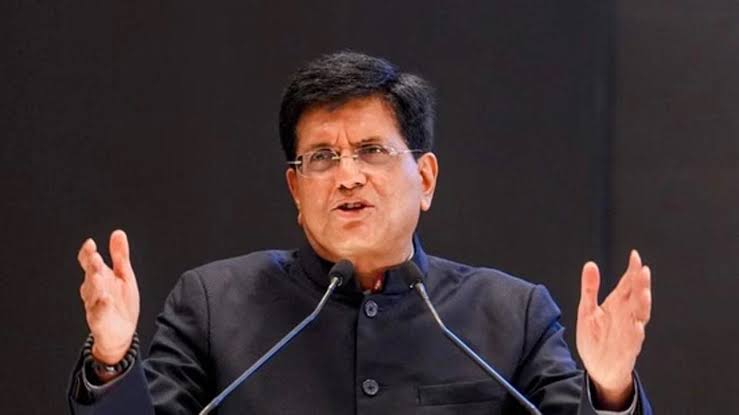
Union Commerce and Industry Minister Piyush Goyal has strongly defended India’s latest GDP growth figures after Opposition leaders and former government officials questioned the reported 7.8% economic expansion in the April-June quarter of 2026-27. Piyush Goyal on GDP Growth said the latest figure reflects the country’s economic performance and criticised those questioning the data.
The comments from Piyush Goyal on GDP Growth came amid an ongoing debate over India’s revised GDP series and the methodology used to calculate economic growth. India recorded real GDP growth of 7.8% in the first quarter of the 2026-27 financial year, a figure that was higher than several earlier expectations and was welcomed by the government as evidence of economic resilience.
Goyal accused critics of comparing figures from different GDP series and argued that such comparisons could create a misleading impression about India’s economic performance. He said ministers do not manufacture economic data and urged people not to accept what he described as attempts to distort the latest figures. Piyush Goyal on GDP Growth also linked the performance to the contribution and hard work of people across the country.
The controversy began after former Finance Secretary Subhash Chandra Garg questioned the basis of the 7.8% growth figure. Garg argued that the previous year’s GDP estimate had been revised significantly under the new GDP series and suggested that, without that revision, current-price growth would have been considerably lower. His comments were subsequently cited by Opposition leaders questioning the government’s interpretation of the latest economic data.
Former Reserve Bank of India Governor Raghuram Rajan also raised questions about the latest growth numbers and broader economic indicators. Rajan questioned whether the headline growth figure fully represented the state of the economy and pointed to concerns surrounding job creation and investment. These comments added another dimension to the debate that Piyush Goyal on GDP Growth has sought to counter.
Goyal responded sharply to the criticism, accusing some commentators of using television appearances to create a negative narrative about India’s economy. He also questioned comparisons between the old and new GDP series, saying the base year had changed and that figures from the two systems should not be compared directly. Piyush Goyal on GDP Growth therefore focused heavily on the methodology behind the latest official figures.
The Ministry of Statistics and Programme Implementation has separately defended the GDP calculations. The ministry explained that India’s GDP series was updated with a new base year of 2022-23 in February 2026, replacing the earlier 2011-12 base year. According to the ministry, revisions reflected updated data sources, methodological improvements and the regular revision process rather than an attempt to artificially increase the latest growth rate.
The ministry also rejected the argument that the revision of the previous year’s GDP was deliberately carried out to make the latest growth figure appear stronger. Officials said that economic comparisons should be made using figures from the same GDP series and at constant prices when assessing real growth. The government’s explanation has become an important part of the debate surrounding Piyush Goyal on GDP Growth and the criticism from economists and Opposition leaders.
India’s 7.8% real GDP growth in the first quarter of FY27 was higher than the Reserve Bank of India’s earlier forecast of 7%. The strong performance has allowed the government to highlight India’s resilience at a time when international economic conditions remain uncertain. Piyush Goyal on GDP Growth has emphasised that the figure represents the combined efforts of Indian citizens and businesses rather than simply a government achievement.
The debate also extends beyond the headline GDP number. Critics have questioned whether strong economic growth is translating into sufficient job creation and private investment. Rajan, for example, asked why stronger growth was not accompanied by greater creation of quality employment and investment. These questions indicate that the discussion surrounding Piyush Goyal on GDP Growth is not limited to statistical methodology but also concerns the broader condition of India’s economy.
The government, however, maintains that the latest figures should be evaluated using the revised methodology and comparable data. Officials have pointed to growth in sectors such as manufacturing as evidence of underlying economic activity. Manufacturing real GVA grew 9.2% during the quarter, while other parts of the economy also recorded expansion.
The GDP debate has also become politically charged. Congress leaders have criticised the government’s interpretation of the numbers and argued that strong headline growth does not necessarily reflect conditions experienced by households and businesses. Goyal, in response, has accused Opposition leaders of attempting to portray the Indian economy negatively. Piyush Goyal on GDP Growth has consequently become part of a wider political and economic discussion about how India’s growth should be interpreted.
Another issue raised during the debate concerns the GDP deflator and the treatment of manufacturing data. MoSPI has explained that manufacturing GVA is calculated using a double-deflation approach, in which output and intermediate consumption are separately adjusted for price changes. According to the ministry, this methodology can result in differences between nominal and real growth rates without necessarily indicating an error in the data.
The ministry has also explained that the GDP deflator should not be directly compared with measures such as the Consumer Price Index or Wholesale Price Index. Each indicator covers different parts of the economy and uses different weights and price concepts. These technical details have become increasingly relevant as economists and policymakers debate the credibility and interpretation of the new GDP series.
For readers following the latest developments surrounding Piyush Goyal on GDP Growth, India’s economy, government policy and national affairs, 50 News provides regular coverage of major political and economic developments in India.
The dispute is likely to continue as economists, government officials and Opposition leaders examine the revised GDP series and its implications. While the government has presented the 7.8% figure as evidence of strong economic momentum, critics are continuing to raise questions about employment, investment, methodology and the effect of revisions to earlier estimates.
For now, Piyush Goyal on GDP Growth represents the government’s strongest response to criticism of the latest economic numbers. Goyal has maintained that the data should be understood within the framework of the new GDP series and has rejected claims that revisions were designed to make India’s growth appear stronger.
The controversy demonstrates how economic statistics can become the subject of intense public and political debate. GDP growth provides an important measure of economic activity, but analysts also examine employment, investment, inflation, household consumption and sector-specific performance when assessing the overall health of an economy.
As India continues to release updated economic data, the debate over the 7.8% growth figure is expected to remain active. The government’s defence, including comments from Goyal and explanations from MoSPI, will likely be weighed against assessments from independent economists and Opposition leaders. Piyush Goyal on GDP Growth has therefore emerged as a prominent part of the current discussion over India’s economic performance and the interpretation of official statistics.