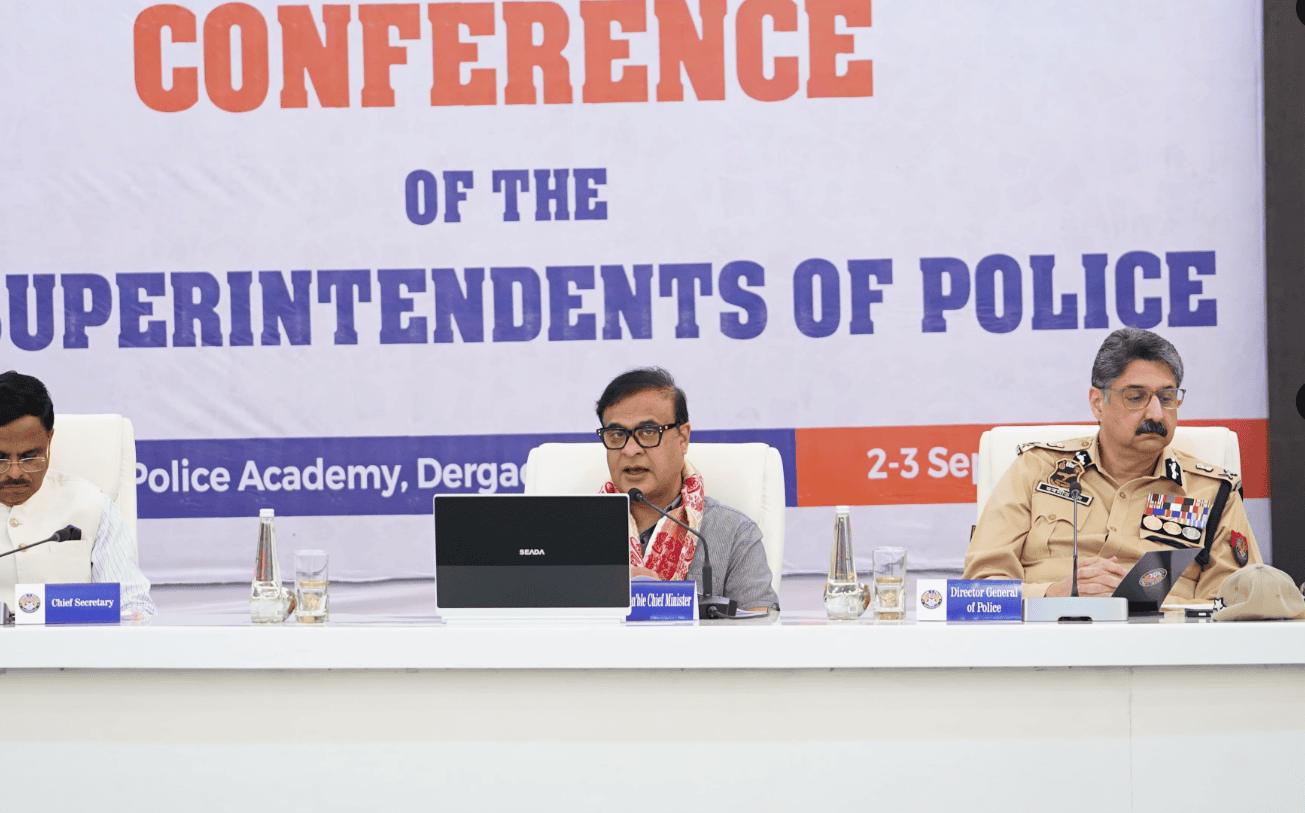
Assam Chief Minister Himanta Biswa Sarma on September 2 attended the passing-out parade of 403 newly trained police personnel at the Lachit Barphukan Police Academy in Dergaon, Golaghat district, before beginning a two-day conference with senior police officials to review the state’s law and order situation.
The police conference, being held at the same academy on September 2 and 3, is focusing on several major policing challenges, including drug trafficking, crimes against women and children, police recruitment and the overall law and order situation in Assam.
The meeting is the first interaction between Sarma and the state’s senior superintendents of police since he returned to power for a second consecutive term in May 2026.
We will not allow Assam to be a safe heaven or transit route for drugs or drug lords. We will be ruthless in executing our mission of #AssamAgainstDrugs and CRACK DOWN relentlessly on the perpetrators. pic.twitter.com/7aokWg8JXx
— Himanta Biswa Sarma (@himantabiswa) September 2, 2026
Before the conference, Sarma reviewed the passing-out parade of 403 personnel who completed their training at the Lachit Barphukan Police Academy.
The newly trained personnel include 32 Deputy Superintendents of Police (Probationers) and 371 constables from the Assam Police Communication Branch.
Sarma congratulated the recruits and said their passing-out marked the beginning of a new phase of dedicated service to the people of Assam.
The Chief Minister also presented awards to personnel who performed exceptionally during their training.
The training programme included modern policing areas such as cybercrime and digital fraud, reflecting the changing nature of law enforcement and the growing importance of technology in criminal investigations.
Sarma said the Lachit Barphukan Police Academy has developed into a national-level police training institution.
Apart from Assam, police personnel from states including Goa and Manipur have undergone training at the academy, while other states have also expressed interest in sending their personnel for specialised training.
The academy’s expanding role is significant as police forces across India increasingly require specialised training in areas such as cybercrime, digital investigations, organised crime and modern policing technologies.
Following the passing-out parade, Sarma turned his attention to the two-day conference of senior police officials.
The conference is intended to provide a platform for detailed discussions on the state’s current law and order situation and the challenges faced by the police force.
Drug trafficking has emerged as one of the most important issues on the agenda.
Sarma has called for a stronger approach against drug trafficking networks operating through Assam.
The Chief Minister has pointed to Assam’s geographical position in the Northeast as an important factor in the state’s vulnerability to drug trafficking.
According to Sarma, traffickers have used routes through neighbouring northeastern states to move drugs from Myanmar towards Assam and other parts of India.
He said a newer trafficking route has been identified through Changlang district in Arunachal Pradesh and into Assam.
The state government intends to increase vigilance along these routes and strengthen enforcement against trafficking networks.
Sarma has said Assam Police seized drugs worth approximately ₹3,250 crore and arrested around 26,000 people for alleged involvement in drug trafficking since the government’s anti-drug campaign began in 2021.
The figures reflect the scale of the enforcement campaign, although arrests and seizures alone do not necessarily establish guilt in individual cases.
The Chief Minister has called for intensified action in areas including the Barak Valley, Golaghat, Tinsukia and Dibrugarh.
He has also asked authorities to remain vigilant along routes passing through Karbi Anglong, Dima Hasao and Nagaon.
Dhubri and Kokrajhar have also been identified as areas requiring greater vigilance to prevent drugs from moving onward to other parts of India.
The focus on drug trafficking comes as Assam continues to position itself as an important transit region in the Northeast.
Its location connects several northeastern states and places the state along routes that can be exploited by organised trafficking networks.
Authorities therefore face the challenge of preventing Assam from becoming a transit corridor while also strengthening action against local drug distribution.
Sarma has also placed crimes against women and children high on the police agenda.
During the conference, he called for a zero-tolerance approach toward offences against women and stressed that police must ensure their safety and security across the state.
The issue is particularly important because crimes against women and children require specialised investigation, victim support and coordination between police and other government agencies.
The Chief Minister has directed the police to maintain sustained action against crimes involving women and children.
He has also referred to the state’s continuing enforcement efforts against child marriage and polygamy.
The Assam government has taken a strong position on these issues in recent years, making them an important part of its broader law-and-order and social-policy agenda.
The conference is expected to examine how district-level police forces can strengthen enforcement and improve responses to such cases.
Another issue under discussion is the changing nature of crime.
Sarma has pointed out that as insurgency-related challenges have declined in Assam, the police force has increasingly been able to concentrate on conventional law-and-order responsibilities.
These include crime prevention, investigation, public safety and responding to emerging threats.
Cybercrime and digital fraud have become increasingly important areas of policing.
The newly trained Assam Police personnel have received training in these areas, according to the Chief Minister.
The expansion of digital payments, online services and social media has created new opportunities for criminals to target individuals and businesses.
Police forces therefore need personnel who can investigate digital evidence and respond to cyber-related offences.
The training at the Lachit Barphukan Police Academy is intended to prepare new recruits for these changing requirements.
Communication personnel also have an important role in modern policing because effective communication is essential during emergencies, investigations and large-scale law-and-order operations.
The addition of 371 trained communication constables is therefore expected to strengthen the technical and communication capabilities of the Assam Police.
The 32 newly trained Deputy Superintendents of Police will also join the force after completing their probationary training.
Their responsibilities will involve supervising police operations and contributing to law-and-order management and criminal investigations.
The passing-out parade consequently represents not only the completion of a training programme but also the addition of new personnel to Assam’s policing system.
The government is seeking to use the new recruits to strengthen the police force at a time when policing priorities are changing.
The two-day SSP conference provides an opportunity to translate those broader priorities into district-level strategies.
Senior police officials are expected to discuss the challenges specific to their jurisdictions and identify measures that can improve enforcement.
The conference is also expected to consider police recruitment and strengthening the force’s overall capacity.
Recruitment is important because adequate staffing directly affects the ability of police departments to respond to crimes, conduct investigations and maintain public order.
A larger and better-trained police force can also help reduce pressure on existing personnel.
Sarma has expressed confidence that the brainstorming session will lead to positive measures for strengthening the Assam Police.
The conference is being conducted at the Lachit Barphukan Police Academy, which the Chief Minister has described as an institution with growing national importance.
The academy’s ability to train personnel from different states could eventually make it a larger centre for specialised police training.
Assam’s location and security environment also make professional training particularly important.
The state has historically dealt with insurgency-related challenges, although the government says the nature of policing has increasingly shifted toward conventional crime prevention and emerging threats.
The police must now deal with issues ranging from drug trafficking and organised crime to cyber fraud and crimes against women and children.
This requires a broader set of skills than traditional law-and-order policing.
The government is therefore placing greater emphasis on modern and specialised training.
The newly trained personnel have received instruction in these areas, and the Chief Minister has urged the force to remain technologically equipped and people-oriented.
The emphasis on a people-oriented police force is significant because public confidence is an important part of effective law enforcement.
Citizens need to be able to report crimes and seek police assistance without unnecessary obstacles.
Improving response mechanisms and investigation standards can help strengthen that confidence.
At the same time, the government has indicated that it wants stronger enforcement against serious offences.
Sarma’s zero-tolerance message on crimes against women and the government’s intensified campaign against drugs indicate a tougher policing approach in areas it considers high priority.
The challenge for the police will be to combine strict enforcement with due process and professional investigation.
The two-day conference also gives senior officials an opportunity to assess how different districts are performing and where additional resources may be required.
Law-and-order problems can vary considerably across Assam because of the state’s geography and diverse communities.
District police units therefore need strategies tailored to local conditions while following broader state-level priorities.
Drug trafficking is one example where routes and methods can change quickly.
If traffickers identify new routes, police forces must adapt their intelligence and enforcement mechanisms.
Sarma’s reference to the Changlang route illustrates this challenge.
The authorities believe traffickers are increasingly attempting to use routes through Arunachal Pradesh before moving narcotics into Assam and other parts of India.
This requires coordination between police forces and other security agencies across state borders.
The same principle applies to crime involving digital networks.
Cybercriminals can operate from outside Assam or even outside India, making traditional jurisdiction-based policing more complicated.
Training, digital investigation capabilities and cooperation between agencies are therefore becoming increasingly important.
The conference comes at an important time for Assam’s police administration.
Sarma has returned for a second consecutive term, and this meeting gives the government an opportunity to establish its policing priorities for the new term.
The focus on drugs, women and children, cybercrime and recruitment indicates that the government wants to combine traditional law-and-order responsibilities with targeted action against emerging threats.
The Chief Minister’s participation throughout the two-day programme also signals the political importance being attached to the police and security administration.
Sarma is scheduled to remain at the academy during the conference and participate in discussions with senior police officials.
The second day of the programme on September 3 includes a review of the Lachit Barphukan Police Academy project followed by another session of the SSP conference.
The review of the academy’s development is particularly relevant given the government’s plans to strengthen its position as a national-level training centre.
If more state police forces begin using the academy for specialised training, its role could expand considerably.
That could also require additional infrastructure and specialised facilities.
For Assam Police, however, the immediate focus remains on improving law-and-order outcomes within the state.
The Chief Minister’s message to senior officials has been clear: action against drug trafficking must be intensified, crimes against women and children require a strong response and police capabilities must continue to improve.
The government also wants the police to remain alert to emerging criminal methods.
The increasing use of technology in crime means that police officers need continuous training rather than relying solely on the skills acquired during initial recruitment.
Cybercrime and digital fraud can involve complex financial transactions, online identities and electronic evidence.
Developing specialised investigation capabilities will therefore be essential for protecting citizens.
The addition of new trained personnel provides some additional capacity, but the effectiveness of the force will ultimately depend on how well those personnel are deployed and supported.
The passing-out ceremony at Dergaon marked the formal entry of 403 personnel into the Assam Police system.
For the recruits, it represents the beginning of their professional careers and their responsibility toward the public.
For the government, it represents an expansion of the state’s policing resources.
The conference that followed provided a direct link between recruitment and broader police strategy.
New personnel are being added at the same time that senior officials are reviewing how the force should respond to Assam’s most pressing security and law-and-order challenges.
The emphasis on drug trafficking is likely to remain one of the government’s major policing priorities.
Assam’s geographical location makes cooperation with neighbouring states especially important.
Stopping drugs at one location may not be enough if trafficking networks can simply shift to another route.
Intelligence sharing, border vigilance and coordinated investigations will therefore remain important components of the state’s anti-drug strategy.
The focus on women’s safety will also require sustained attention.
A zero-tolerance policy can provide a clear message, but effective implementation depends on prompt registration of complaints, professional investigation, victim support and timely prosecution.
The same applies to crimes involving children, where sensitive handling and specialised procedures are essential.
The government’s broader approach to child marriage and polygamy also places additional responsibilities on police and district administrations.
The conference could help senior officials coordinate enforcement strategies and identify areas where implementation needs strengthening.
Overall, the two-day meeting represents a major review of Assam’s policing priorities after the state’s recent political transition.
The Chief Minister has used the occasion to emphasise a tougher approach to drugs and crimes against women and children while also highlighting the need for modern, technologically capable policing.
The passing-out of 403 police personnel adds new strength to the force, while the expansion of the Lachit Barphukan Police Academy could give Assam a larger role in police training beyond the state.
The success of these initiatives will ultimately depend on implementation at the district level.
The government will need to ensure that the priorities discussed at the conference translate into measurable improvements in policing, crime prevention and public safety.
For now, the September 2-3 conference has placed law and order at the centre of Assam’s administrative agenda, with drug trafficking, women’s and children’s safety, cybercrime, recruitment and modern police training emerging as key areas of focus.
The newly trained personnel will now begin their service, while senior police officials continue their discussions on how to strengthen Assam’s response to both longstanding security challenges and the rapidly changing nature of crime.