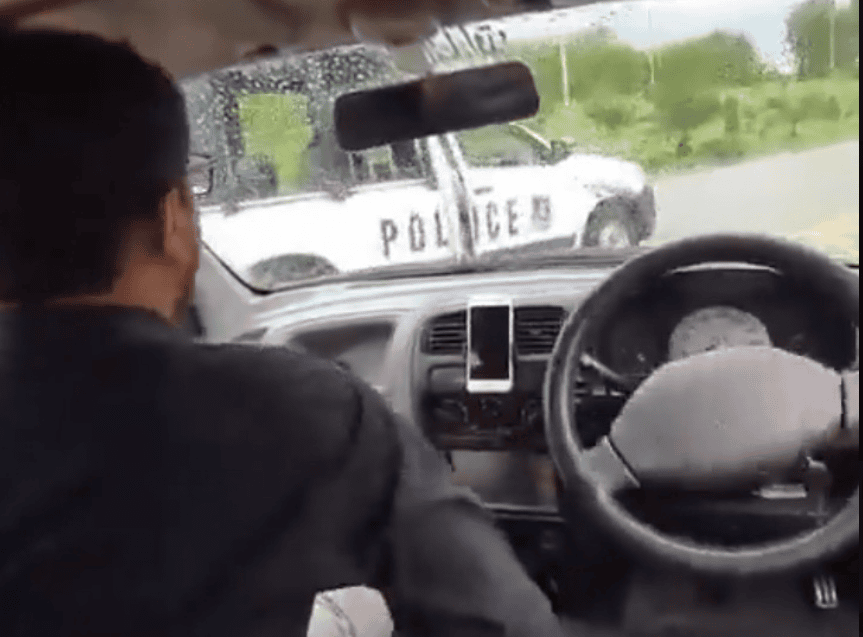
A demonstration of a remotely controlled car in Pakistan took an unexpected turn when the experimental vehicle suddenly lost control and crashed into a parked police van in Islamabad. The unusual incident was captured on video and has since gone viral on social media.
The incident took place at D-Chowk, also known as Democracy Square, in Islamabad, where a technology enthusiast was demonstrating a modified car that could be operated remotely without a person sitting behind the steering wheel.
The vehicle was developed by Pakistani technology enthusiast Ehsan Zafar of Abbottabad. A journalist, Muhammad Aalijah, was documenting the demonstration while sitting in the front passenger seat of the vehicle.
Live example of “Pakistan mein talent ki koi kami nahi hai” 💀
Driverless Car Experiment in Pakistan Ends in an Unexpected Crash 😂
=> Pakistan is always in SELF-DESTRUCT mode 🤡 pic.twitter.com/Ac7bp45dcW
— Megh Updates 🚨™ (@MeghUpdates) September 2, 2026
At the beginning of the demonstration, everything appeared to be working normally. The vehicle moved forward while its steering and other functions were being controlled remotely.
The demonstration was intended to showcase the technology and its ability to operate a conventional car from a distance.
However, the situation changed within moments when the remote-control system apparently developed a technical problem.
The steering suddenly turned and the car began moving toward a police van parked nearby.
Aalijah can be seen attempting to stop the vehicle by pulling the handbrake as it approaches the police vehicle. His attempt was unsuccessful, and the experimental car eventually collided with the parked police van.
The collision occurred at relatively low speed, and reports indicate that there were no injuries or major damage as a result of the incident.
The unusual footage quickly attracted attention online, with thousands of users sharing the video and commenting on the unexpected failure of the demonstration.
According to Aalijah, the vehicle was being operated remotely through internet and satellite connections. He said an interruption in the internet connection caused the system to lose control of the vehicle.
He explained that the car had been functioning normally until the connection problem occurred.
The incident therefore appears to have been caused by a technical failure rather than a deliberate action by the operator.
The vehicle was not a fully autonomous self-driving car in the same sense as advanced commercial autonomous vehicles. It was an experimental vehicle that could be controlled remotely from a distance.
This distinction is important because the demonstration involved external control through a communications connection rather than a completely independent artificial-intelligence driving system.
The technology enthusiast behind the project had reportedly been working on remote-control technology that allows a conventional vehicle to be operated from a distance.
The latest demonstration was intended to show the capabilities of that system.
The crash nevertheless highlighted one of the biggest challenges associated with remotely operated vehicles: maintaining safe control when the communication link fails.
A remote-controlled vehicle depends on a reliable connection between the operator and the vehicle.
If that connection suddenly disappears, the vehicle needs a reliable fail-safe mechanism capable of bringing it to a controlled stop.
Without such a system, even a relatively simple communication failure can result in an unexpected movement.
The Islamabad incident demonstrated exactly that risk.
The car was being tested in an area with limited traffic, and the police van it hit was stationary.
As a result, the incident did not lead to serious injuries.
However, the same type of failure on a busy public road could have had much more serious consequences.
Aalijah himself later emphasised this concern and said that the purpose of sharing the footage was not to ridicule the inventor.
Instead, he said the incident should serve as a warning that experimental technology needs to be thoroughly tested before being considered safe and reliable.
He encouraged young innovators to continue experimenting but stressed that safety should remain the priority.
The response online has been mixed.
Many social-media users treated the incident as a humorous technology failure and created memes around the moment when the vehicle struck the police van.
Some compared the experimental vehicle with commercially developed self-driving cars, while others joked about the unusual choice of the police vehicle as the first obstacle encountered during the demonstration.
Several users, however, praised the effort behind the project and argued that technical failures are a normal part of developing new technology.
The debate reflects two different perspectives on experimental innovation.
One side sees the incident as an amusing demonstration failure that should not overshadow the technical achievement involved in modifying a conventional vehicle for remote operation.
The other side has focused on the safety implications of testing such technology in a public environment.
Both perspectives highlight important aspects of the incident.
Developing a vehicle that can be controlled remotely requires integration of mechanical systems, electronics, communications technology and vehicle controls.
The steering, acceleration and braking systems must respond accurately to commands from the remote operator.
More importantly, the system needs to know what to do when those commands stop arriving.
A reliable fail-safe mechanism could potentially include automatic braking or another method of safely stopping the vehicle when the connection is lost.
The Islamabad incident suggests that the experimental system was not yet sufficiently reliable to prevent the vehicle from moving uncontrollably following a communications failure.
That does not necessarily mean the underlying concept is unsuccessful.
Technology development commonly involves repeated testing, identifying failures and improving the design.
The key issue is ensuring that testing is conducted in controlled environments where a failure cannot endanger other people.
The location of the demonstration also attracted attention because D-Chowk is a prominent and highly sensitive area of Islamabad.
At the time of the incident, traffic was reportedly limited around the location, which reduced the potential consequences of the crash.
The police vehicle was parked rather than moving through traffic.
The relatively low-speed collision therefore resulted in a much less serious outcome than could have occurred under different circumstances.
The inventor’s work has also attracted attention because it represents an example of locally developed automotive experimentation.
Pakistan has a growing community of technology enthusiasts, engineers and young innovators working on projects involving robotics, automation and vehicle technology.
Remote-control systems can have legitimate applications beyond demonstrations.
Such technology could potentially be developed for controlled industrial environments, research projects, hazardous areas or specialised transportation applications.
However, public-road deployment introduces significantly higher safety requirements.
A vehicle operating near pedestrians and other road users cannot depend entirely on an internet connection for critical control functions.
Communication links can fail for numerous reasons, including network outages, signal interference, equipment malfunction or software errors.
A safe system therefore needs to assume that a connection failure will eventually occur.
The vehicle should be designed to enter a safe state immediately when communication is interrupted.
This principle is common across safety-critical technologies.
The Islamabad crash provides a practical example of why redundancy and fail-safe mechanisms matter in automated and remotely operated systems.
The incident also highlights the difference between a technology demonstration and a commercially deployable product.
An experimental vehicle may be able to perform successfully under normal conditions while still having significant weaknesses when something unexpected happens.
For a demonstration, the system may appear impressive when everything works correctly.
Real-world reliability is tested when something goes wrong.
In this case, the internet connection reportedly failed, and the vehicle did not respond safely enough to prevent a collision.
That failure provides useful information for the next stage of development.
The inventor can potentially use the incident to improve the communication architecture, braking system, steering controls and emergency shutdown mechanisms.
The vehicle’s performance could then be tested repeatedly in a controlled environment before another public demonstration.
The incident also demonstrates the importance of having a person capable of taking immediate manual control during experimental testing.
Aalijah attempted to use the handbrake after the vehicle began moving toward the police van.
His action shows that the team recognised the need for a physical emergency control inside the vehicle.
However, the handbrake was not enough to stop the vehicle before the collision.
Future versions of such systems would likely require more effective emergency controls.
An independent emergency stop system could provide another layer of protection if the primary remote-control connection fails.
The exact technical design of the vehicle and the reason for the steering malfunction have not been independently examined in detail in publicly available reports.
The explanation that an internet disruption caused the failure comes from the journalist involved in documenting the demonstration.
Therefore, the incident should not be interpreted as a complete technical assessment of the system.
The available information does, however, establish that the vehicle was remotely operated and that it collided with a parked police van during the demonstration.
The footage has made the incident particularly visible because the failure happened directly in front of the camera.
The journalist was speaking about the vehicle’s capabilities when the steering suddenly changed direction.
The unexpected crash transformed what was intended to be a technology demonstration into a viral social-media moment.
The video has been widely circulated in Pakistan and internationally.
Many users have used humour to describe the incident, while others have focused on the potential of the technology.
Some comments have praised the inventor for attempting to develop a locally engineered system rather than simply dismissing the project because of one failed demonstration.
That response is significant because experimental technology inevitably involves failures.
A failed prototype does not automatically mean that an idea has no future.
What matters is whether the failure is analysed and whether the next version addresses the underlying safety problem.
For remotely operated vehicles, communication reliability is only one part of the challenge.
The system must also handle latency, unexpected obstacles, sensor failures, braking emergencies and operator error.
A remote operator may be physically separated from the vehicle by a significant distance.
That means the operator may not have the same visual awareness or immediate reaction capability as someone sitting behind the steering wheel.
Cameras, sensors and other systems would therefore be needed to provide the operator with sufficient information.
The control system must also respond quickly enough to avoid dangerous delays between an operator’s command and the vehicle’s action.
The Islamabad experiment appears to be an early-stage demonstration rather than a finished commercial autonomous-driving system.
That makes the safety warning particularly relevant.
Experimental vehicles should ideally be tested away from pedestrians and ordinary road traffic until their emergency systems have been thoroughly validated.
A controlled testing area provides developers with an opportunity to deliberately simulate failures and confirm that the vehicle stops safely.
Such testing could include disconnecting the internet connection, interrupting power to individual components and introducing communication delays.
The vehicle should respond predictably to each failure.
If it does not, the system should not move to public-road demonstrations.
The police vehicle collision was relatively minor, but it nevertheless provided a real-world demonstration of what can happen when remote control is interrupted.
The incident could therefore become a valuable learning experience for the developer.
Instead of being viewed solely as a viral accident, it can be seen as a reminder that innovation and safety must develop together.
The reaction of the journalist involved also reflects this approach.
Aalijah later clarified that he did not intend to defame the young innovator.
He said the purpose of publishing the footage was to encourage caution and demonstrate that new technology needs extensive testing before it can be considered completely safe.
The inventor has also reportedly continued to receive attention for his work despite the failed demonstration.
The incident has not erased interest in the underlying technology.
If anything, the viral attention has introduced the project to a much larger audience.
The challenge now is whether the technology can be improved enough to demonstrate reliable operation under a wide range of conditions.
The public’s fascination with driverless and remotely controlled vehicles continues to grow globally.
Companies and research organisations are investing heavily in autonomous driving, robotics and vehicle automation.
But highly automated vehicles require extensive testing because mistakes can have serious consequences.
The Islamabad incident occurred at a much smaller experimental scale, but the underlying lesson is similar.
A vehicle must always have a safe response when its control system stops working as expected.
For traditional cars, the human driver is generally responsible for reacting to an unexpected situation.
For remotely controlled or autonomous vehicles, that responsibility is shared between software, hardware, communications systems and the remote operator.
That makes safety architecture particularly important.
The incident also shows why public demonstrations should be carefully planned.
Developers need to consider not only whether the technology works but also what happens if it fails.
A parked police vehicle may have been the unintended target in this case, but a pedestrian, cyclist or moving vehicle could have been involved under different circumstances.
Fortunately, the reported collision did not result in injuries or significant damage.
The vehicle reportedly suffered only limited damage, with its bumper later replaced, according to information attributed to the inventor.
That relatively minor outcome means the incident can now serve primarily as a lesson rather than a major road-safety tragedy.
The video, meanwhile, continues to attract attention because of its unusual combination of technology, unexpected failure and police involvement.
The incident has generated humour, criticism and support in roughly equal measure.
For the young innovator, the most important outcome may be the technical lessons gained from the failure.
If the system is redesigned with stronger fail-safe mechanisms, independent braking controls and more reliable communication safeguards, future demonstrations could be substantially safer.
The incident also provides an important message for other technology enthusiasts experimenting with vehicles.
Innovation should be encouraged, but testing must be conducted in a way that protects bystanders and public infrastructure.
A system that works perfectly under normal conditions is not ready for public use until it has also demonstrated what happens when the connection fails.
The Islamabad demonstration has made that point in a very visible way.
The remote-controlled vehicle was able to operate without a conventional driver behind the wheel, showing the potential of the underlying technology.
But when the internet connection reportedly failed, the vehicle lost control and collided with a parked police van.
No serious injuries were reported, and the damage appears to have been limited.
The incident has since become a viral example of both the possibilities and limitations of experimental vehicle technology.
Rather than marking the end of the project, the crash could become a turning point for improving its safety.
The next stage will be to make the system capable of safely handling communication failures and other unexpected situations.
Until those safeguards are proven through controlled testing, remotely operated vehicles should remain experimental rather than being treated as fully autonomous or road-ready technology.
The Islamabad crash ultimately demonstrates a simple but important principle: technological innovation can be exciting, but when a vehicle is involved, safety must come before the spectacle of the demonstration.