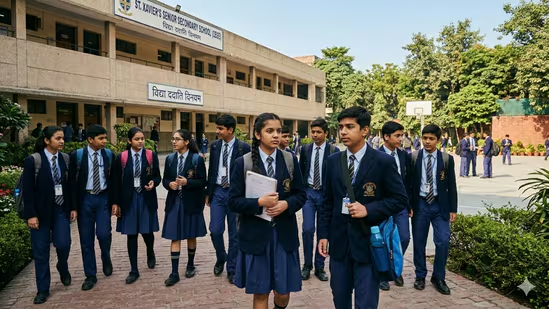

Students from economically weaker families who are studying in eligible schools have another opportunity to apply for the National Means-cum-Merit Scholarship Scheme for the 2026-27 academic year. The Ministry of Education has extended the deadline for submitting NMMSS scholarship applications on the National Scholarship Portal to September 30, 2026.
The extension is particularly important for students who could not complete their applications by the earlier deadline. The Union Ministry of Education announced the revised schedule on September 1, giving eligible students additional time to complete the process.
Under the revised schedule, students can submit their applications until September 30, 2026. The deadline for Institute Nodal Officer verification has been fixed for October 15, while District Nodal Officer verification will continue until October 31, 2026.
The National Means-cum-Merit Scholarship Scheme is designed to provide financial assistance to meritorious students from economically weaker sections and encourage them to continue their education after the elementary level.
The scheme aims to reduce school dropouts by providing financial support from Class IX through Class XII. Students who qualify for the scholarship receive Rs 12,000 per year, subject to the applicable continuation and eligibility conditions.
The scholarship is not automatically available to every student who meets the income and academic requirements. Fresh candidates must qualify through the NMMSS selection examination conducted by their respective State or Union Territory authorities.
For the 2026-27 project year, the scheme provides one lakh fresh scholarships nationally for students entering Class IX. Students who are already selected can continue receiving the scholarship through the renewal process from Class X to Class XII if they satisfy the required academic conditions.
Students applying for the fresh scholarship generally need to be studying in Class VIII and must have achieved the prescribed marks in Class VII. According to the Ministry of Education, candidates are required to have secured at least 55 percent marks or an equivalent grade in Class VII.
There is a relaxation of five percentage points for students belonging to the Scheduled Caste and Scheduled Tribe categories. This means the minimum academic requirement is lower for eligible SC and ST candidates.
Another major eligibility condition relates to family income. The combined annual income of the applicant’s parents from all sources must not exceed Rs 3.50 lakh.
Students seeking the benefit under the scheme must provide the required income-related documentation during the application and verification process. Applications can be affected if the information provided does not match the supporting documents.
The scholarship is intended specifically for students studying in State Government, Government-aided and local body schools. Students studying in private unaided schools are not covered under the central NMMSS eligibility framework.
The scheme also has specific exclusions. Certain types of schools, including Jawahar Navodaya Vidyalayas, Kendriya Vidyalayas, Sainik Schools and residential schools, are not covered under the applicable Bihar NMMSS selection framework.
For students in Bihar, the State Council of Educational Research and Training, Bihar, is involved in implementing the NMMSS examination process. The Bihar-specific notification describes the scheme for students studying in eligible schools and provides the state-level conditions applicable to candidates.
Bihar has a designated quota under the national scholarship scheme. According to the Bihar SCERT notification, the state’s share is 5,433 scholarships, with district-wise quotas also determined within the state’s allocation.
The selection process is therefore competitive. Merely submitting an application does not guarantee that a student will receive the Rs 12,000 annual scholarship.
Eligible students first have to appear for the selection examination conducted by the concerned State or Union Territory authority. Their performance is considered along with the applicable eligibility requirements and state-level quota.
The NMMSS examination is generally based on two major components: the Mental Ability Test and the Scholastic Aptitude Test. These tests are intended to assess students’ reasoning ability as well as their understanding of school-level subjects.
Students preparing for the examination should therefore focus on both logical and analytical questions and their academic subjects. The exact examination schedule, centre details and other state-specific instructions should be checked through the relevant State or Union Territory authority.
For Bihar students, the state-level NMMSS examination process is separate from the central scholarship application process on the National Scholarship Portal. Students and schools should carefully follow the instructions applicable to their respective stage of the selection process.
The scholarship amount is Rs 12,000 per year, which means a selected student can receive financial assistance of Rs 1,000 per month when calculated on an annual basis. The amount is intended to support students in continuing their education through the secondary and higher secondary levels.
The money is not normally handed over as cash through schools. The Ministry of Education states that NMMSS scholarships are transferred directly into the bank accounts of selected beneficiaries through Direct Benefit Transfer using the Public Financial Management System.
This direct transfer system makes accurate bank and beneficiary information particularly important. Students should ensure that the details submitted during the scholarship process are correct and that their application completes the required verification stages.
For the 2026-27 academic year, students are required to complete One Time Registration, or OTR, on the National Scholarship Portal before applying for the scholarship scheme. After completing the registration, eligible candidates can proceed with the relevant scholarship application.
Students who have already submitted their applications should not assume that the process is finished. The Ministry of Education has specifically advised applicants to ensure that their applications are properly verified by the concerned Institute, District or State Nodal Officers.
The first verification level is conducted by the Institute Nodal Officer. The final date for Level-1 verification is October 15, 2026.
After institute-level verification, applications proceed to the District Nodal Officer for the next level of scrutiny. The deadline for Level-2 verification has been fixed for October 31, 2026.
The extension of the student application deadline to September 30 gives applicants additional time, but students should avoid waiting until the final day. Errors in personal details, bank information, income documents or academic records can create problems during verification.
Parents and schools can also play an important role in ensuring that eligible students complete the process correctly. Schools should check the submitted information and help students address any discrepancies before the verification deadlines.
The Ministry of Education’s latest figures show that the scholarship application process had already received a substantial number of submissions before the deadline was extended. As of August 31, 2026, 79,398 fresh applications and 1,87,208 renewal applications had been submitted through the National Scholarship Portal.
The extension therefore provides an opportunity for additional eligible students to complete their applications and for those who may have faced difficulties during the initial application period to finish the process.
For Bihar students, the opportunity is particularly relevant because the state has a fixed scholarship allocation and selection is linked to the state-level examination and merit process. Students who qualify should therefore pay close attention to both the scholarship portal requirements and Bihar’s examination-related instructions.
The NMMSS scheme has a broader educational objective beyond providing immediate financial assistance. By supporting students from economically weaker families, the government aims to reduce the financial pressure that can contribute to students leaving school after elementary education.
The scholarship continues from Class IX to Class XII through renewal, provided students meet the required academic standards and other conditions. This makes the scheme potentially valuable for families seeking sustained financial support during the secondary-school years.
However, students should understand that the scholarship is merit-based and subject to eligibility requirements. Meeting the income limit or minimum marks requirement alone does not mean that the scholarship will automatically be awarded.
Candidates should also keep copies of their submitted application and supporting documents for future reference. Any communication regarding verification, corrections or additional requirements should be handled within the prescribed timelines.
The September 30 deadline is now the key date for students applying for NMMSS 2026-27 through the National Scholarship Portal. After that, the process moves into the verification stages, with institute-level verification scheduled to continue until October 15 and district-level verification until October 31.
For students in Bihar and other states who are eligible for the scheme, the extended deadline provides a valuable second chance to complete the application process. With the scholarship offering Rs 12,000 annually and continuing through Class XII subject to renewal conditions, timely application and successful selection can provide meaningful support for school education.
Students and parents should rely on the latest instructions issued through the National Scholarship Portal and their respective State or Union Territory education authorities, particularly for examination dates and state-specific procedures. The central application deadline, however, is clear: eligible NMMSS 2026-27 applicants must submit their scholarship applications by September 30, 2026.