
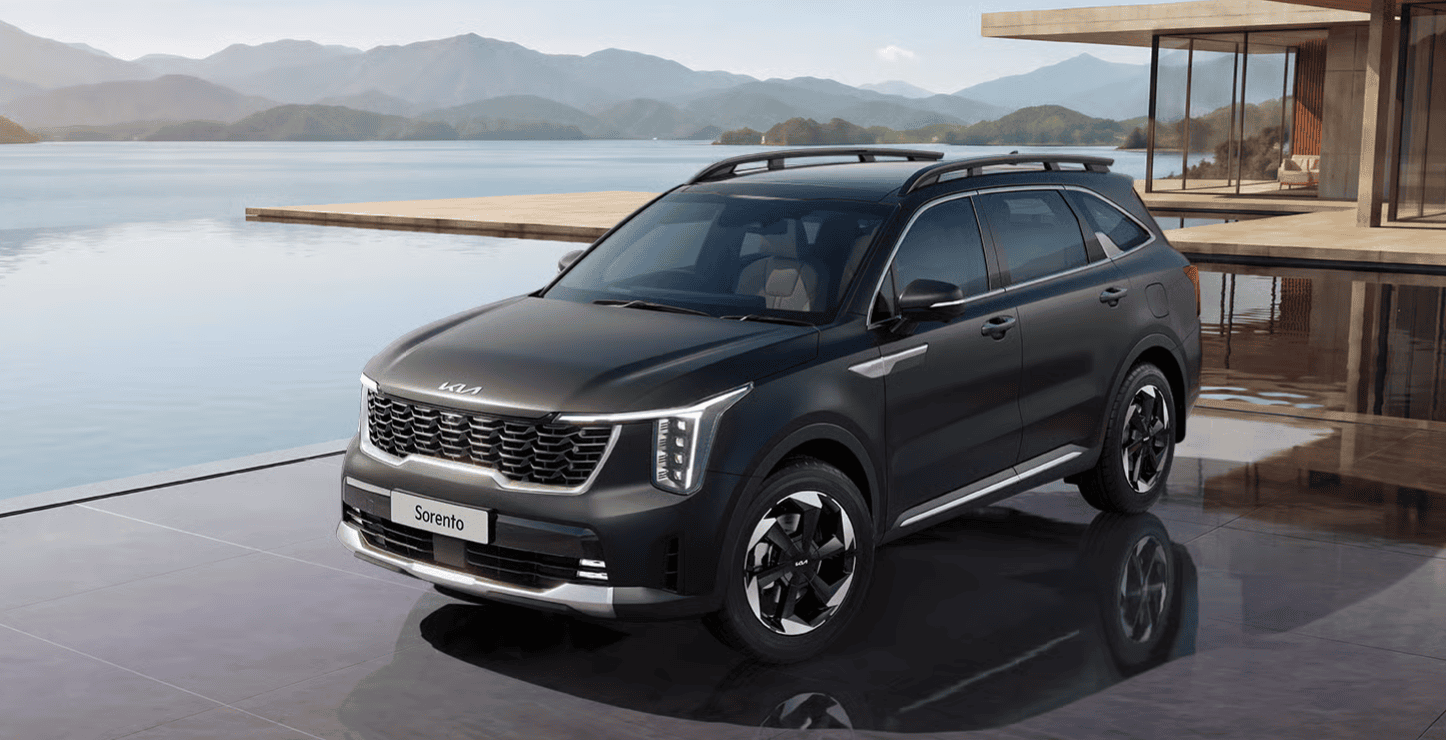
The new Kia Sorento has started reaching dealer stockyards in India ahead of its official launch on September 4, 2026. The arrival of the premium three-row SUV at dealerships signals that Kia is ready to introduce its new flagship internal-combustion SUV to the Indian market.
The Sorento is an important product for Kia India because it will sit above the Seltos and enter a more premium three-row SUV category. It will also introduce Kia’s strong-hybrid technology to the Indian market for the first time.
Images and reports from dealer locations show India-spec Sorento units already arriving ahead of the launch. A seven-seat diesel version equipped with an automatic transmission has also been spotted, giving buyers an early look at one of the variants expected to be available in India.
Kia has scheduled the official launch for September 4, when the company is expected to announce the SUV’s prices, variants, detailed specifications and other market-specific information.
The arrival of vehicles at dealerships before the launch suggests that Kia has already begun preparing its retail network for customer enquiries, demonstrations and eventual deliveries.
The Sorento is expected to be offered with two different powertrain options in India. These include a turbo-diesel engine and a strong-hybrid petrol setup.
The diesel version is expected to use a 2.2-litre turbo-diesel engine producing around 202 PS and approximately 441 Nm of torque. It is expected to be paired with an eight-speed dual-clutch automatic transmission.
The diesel configuration is particularly significant for Indian buyers because diesel-powered three-row SUVs continue to have strong demand in the premium SUV market.
A seven-seat Sorento diesel with the eight-speed DCT has already been spotted at a dealer location. The vehicle carries a DCT badge at the rear, providing a strong indication of the transmission configuration being prepared for the Indian market.
The second powertrain will be a 1.6-litre turbo-petrol strong-hybrid system. International versions of the Sorento use a turbocharged petrol engine combined with an electric motor and battery system.
For India, the hybrid is expected to produce roughly 238 PS and 380 Nm, although Kia’s final India-spec output and technical specifications are expected to be confirmed at the launch.
The hybrid powertrain is one of the most important aspects of the Sorento’s India debut because it marks Kia’s entry into the country’s strong-hybrid passenger vehicle segment.
The hybrid version is also expected to offer all-wheel drive. If confirmed in the final specification, the combination of a strong-hybrid powertrain and AWD could give the Sorento a distinctive position in India’s premium three-row SUV market.
Unlike a mild-hybrid system, a strong hybrid can use electric power to assist the vehicle during different driving conditions and can also operate using electric propulsion for certain periods.
This technology is expected to help improve fuel efficiency while maintaining the performance expected from a large premium SUV.
Kia is positioning the Sorento as its flagship ICE SUV in India. The model is larger and more premium than the Seltos, while its three-row configuration gives it a more direct role in the family SUV market.
The Sorento measures around 4,815 mm in length, 1,900 mm in width and 1,700 mm in height in its global specification. Its wheelbase measures approximately 2,815 mm.
These dimensions give the SUV a substantial road presence and provide room for three rows of seating.
Depending on the variant, the India-spec Sorento is expected to be available in six-seat and seven-seat configurations. The six-seat version is likely to feature captain seats in the second row, while the seven-seat configuration provides a more conventional three-row arrangement.
The interior follows Kia’s modern premium design language. The cabin is expected to feature a dual-screen dashboard arrangement, with digital instrumentation and a large infotainment display positioned prominently ahead of the driver.
A premium upholstery package, panoramic sunroof, ventilated seats and electrically operated tailgate are among the features expected on higher variants.
The Sorento is also expected to receive advanced driver-assistance technology. Level 2 ADAS features are expected to be part of the SUV’s equipment list, adding functions designed to assist drivers with tasks such as maintaining lane position and managing traffic conditions.
A head-up display, electronic parking brake, wireless smartphone connectivity, wireless charging and ambient lighting are also expected to be available.
Kia is putting particular emphasis on connected technology with the India-spec Sorento. The SUV is expected to feature Kia’s AI Assistant with Live Gen AI technology, giving occupants access to more advanced voice-based interaction and connected functions.
This technology could become one of the model’s key selling points as Kia attempts to distinguish the Sorento from established premium SUV rivals.
The Sorento will enter a competitive segment in India. Potential rivals include the Toyota Fortuner, Skoda Kodiaq, Volkswagen Tayron, MG Majestor and Jeep Meridian, although the exact positioning will depend heavily on Kia’s final pricing.
The Toyota Fortuner remains one of the strongest names in India’s premium SUV market, particularly among buyers who prioritize a traditional body-on-frame SUV and diesel power.
The Skoda Kodiaq and Volkswagen Tayron offer a more road-focused premium SUV experience, while models such as the MG Majestor target buyers looking for a larger, feature-rich three-row vehicle.
Kia will attempt to differentiate the Sorento through its combination of premium features, three-row practicality and powertrain choices.
The strong-hybrid option could be particularly important because most established SUVs in this price category continue to rely heavily on petrol or diesel engines.
A hybrid powertrain could appeal to buyers who want the size and practicality of a premium SUV while also seeking improved efficiency in urban driving.
The diesel option, meanwhile, gives Kia a conventional alternative for customers who frequently travel long distances or prefer the strong low-end torque associated with diesel engines.
Kia has already started production of the Sorento in India at its manufacturing facility in Anantapur, Andhra Pradesh. Local assembly is expected to play an important role in keeping the SUV competitive in its segment.
The company’s decision to manufacture or assemble the vehicle locally also reflects Kia’s growing focus on premium SUVs for the Indian market.
The Sorento fills an important gap in Kia’s existing Indian portfolio. The Seltos occupies the mid-size SUV category, while the Carnival serves the premium MPV segment.
The Sorento sits between these products in terms of positioning, offering a large SUV body and three rows without moving all the way into the luxury vehicle segment.
The model’s international success has also created expectations around its Indian launch. Kia has sold the Sorento in multiple global markets, where it is positioned as a premium family SUV.
For India, however, Kia has made changes and preparations specific to the local market. The company has been testing the vehicle extensively on Indian roads and has worked toward local production before the launch.
The early arrival of dealer vehicles suggests that Kia is confident about the readiness of its retail network.
It also means potential customers may soon be able to see the vehicle in person before making a purchase decision. Dealer stockyards receiving vehicles ahead of a launch is generally an indication that showroom displays and test-drive preparations are underway.
The exact timing of customer deliveries will depend on Kia’s announcement and the availability of specific variants.
Pricing will be one of the most important factors in determining the Sorento’s position.
Before the official launch, industry estimates have placed the starting price around ₹40 lakh ex-showroom, although the final figure could differ depending on variants, powertrain and equipment levels.
Kia has not officially confirmed the complete price structure ahead of the launch.
A competitive price will be important because the Sorento is entering a segment where buyers have several established options.
If Kia prices the hybrid competitively, it could become one of the more interesting alternatives for customers considering a premium three-row SUV.
The hybrid technology could also help Kia attract customers who are looking beyond conventional diesel SUVs.
The Sorento’s design is another important part of its appeal. The SUV features vertically oriented LED headlamps, distinctive daytime running lights, a large grille and a muscular body profile.
The rear design also uses vertically positioned lighting elements, creating a distinctive appearance compared with the more familiar SUV designs available in India.
The overall design combines the traditional proportions of a large SUV with Kia’s newer styling language.
Inside, the focus is on technology and premium materials. The dashboard is expected to have a clean, horizontally oriented layout, while the large displays and connected features give the cabin a modern appearance.
Second-row comfort will also be important because buyers in this segment often use their SUVs as family vehicles.
The expected six-seat version with captain seats could appeal to customers who prioritize second-row comfort, while the seven-seat configuration will be more practical for larger families.
Boot capacity naturally changes depending on how the three rows are used. With all seats occupied, luggage space is limited compared with a five-seat SUV, but folding the rear seats significantly increases the available cargo area.
The Sorento is therefore designed to provide flexibility rather than simply maximum luggage capacity.
Safety technology is expected to be another strong area. Along with multiple airbags and standard electronic safety systems, higher variants are expected to offer ADAS functions.
The exact safety equipment and number of airbags will be confirmed when Kia announces the final India-spec specifications.
The company is also expected to offer multiple variants, although the final variant names and equipment distribution have not been fully confirmed before the launch.
Kia’s strategy will likely be to offer different combinations of diesel and hybrid powertrains while reserving the most advanced features for higher-end versions.
The arrival of the Sorento at dealerships just before launch has therefore added another layer of excitement to an already highly anticipated introduction.
The model has been discussed in the Indian market for several months, with test vehicles and production-related sightings building expectations around its arrival.
Now that production has begun and dealer vehicles are appearing, the launch is moving from speculation to reality.
The September 4 event will provide the missing details that buyers need before making a decision. Kia is expected to announce the exact prices, variant lineup, specifications, feature distribution, booking details and delivery timeline.
The launch will also clarify the final engine outputs and transmission combinations available to Indian customers.
For the diesel model, the spotted seven-seat configuration and eight-speed DCT indicate that Kia is preparing a conventional premium SUV option for customers who prefer diesel.
For the hybrid, the combination of a 1.6-litre turbo-petrol engine and electric motor could make the Sorento one of the more technologically advanced SUVs in its segment.
The expected AWD configuration could further improve its appeal to buyers who want additional traction and a more capable premium SUV.
However, buyers should wait for official specifications before drawing conclusions about fuel economy, performance and pricing.
The Sorento’s real-world efficiency will also depend on driving conditions, vehicle load and the final India-specific calibration of the hybrid system.
Kia’s decision to introduce both diesel and hybrid options is strategically important. The company is not forcing customers into a single powertrain technology but is instead offering alternatives for different usage patterns.
The diesel can appeal to traditional SUV buyers, while the hybrid targets customers interested in efficiency and electrification without the charging requirements associated with a fully electric vehicle.
This approach could help Kia cover a broader portion of the premium SUV market.
The Sorento’s arrival also comes at a time when India’s SUV market is moving toward greater electrification. Strong hybrids are becoming increasingly relevant as manufacturers seek to improve efficiency while charging infrastructure and consumer preferences continue to evolve.
By introducing its first hybrid in India through a premium three-row SUV, Kia is making a significant statement about its future product strategy.
The company will now have to convince buyers that the additional technology and premium positioning justify the vehicle’s expected price.
The success of the Sorento will ultimately depend on several factors, including its launch price, fuel efficiency, equipment levels, driving experience and long-term ownership costs.
For now, the most immediate development is that the new Kia Sorento has reached Indian dealer stockyards ahead of its official launch.
The sighting confirms that Kia’s flagship three-row SUV is ready for its market introduction and that customers will soon be able to experience the vehicle through the company’s dealer network.
With the September 4 launch just hours away, attention is now focused on the final price and specifications.
If Kia manages to combine competitive pricing with its strong-hybrid technology, premium features, three-row practicality and diesel option, the Sorento could become a significant new competitor in India’s premium SUV segment.
The arrival of dealer vehicles is therefore more than a routine pre-launch development. It signals the beginning of Kia’s next major push into India’s premium SUV market and sets the stage for the company’s most important new SUV launch of 2026.