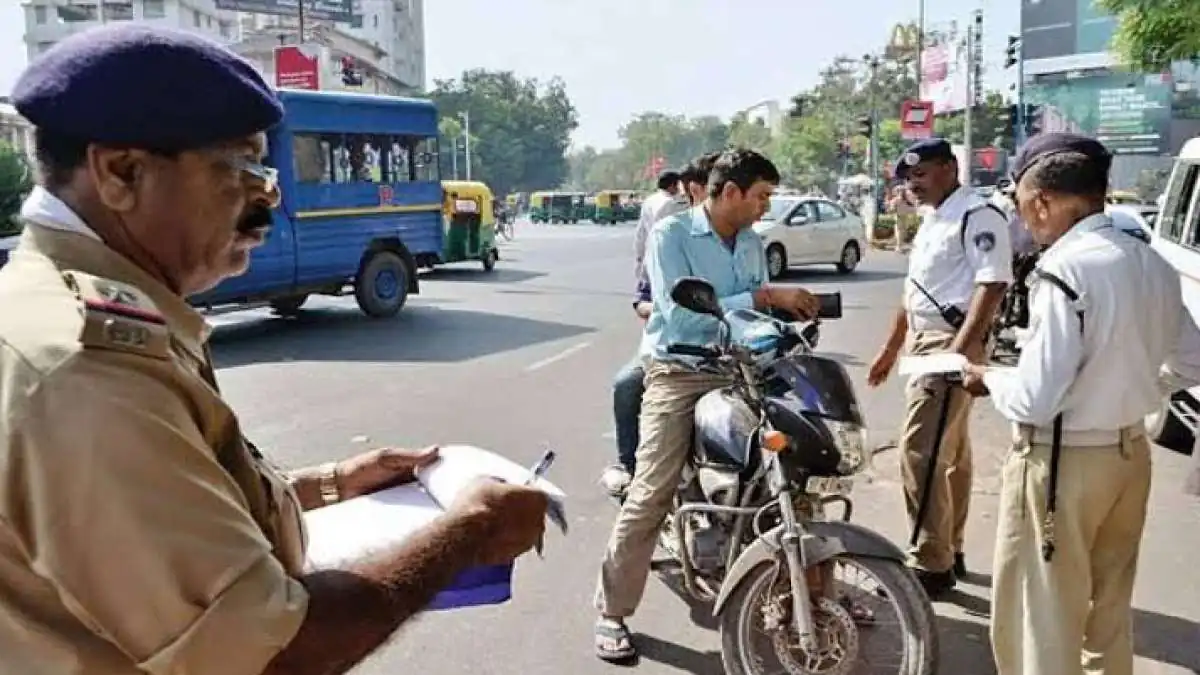
The Jaipur Police Challan User ID system has come under tighter scrutiny after the Jaipur Police Commissionerate issued new directions prohibiting authorised officers from sharing their challan login credentials with constables or other personnel. The order makes it clear that the officer assigned a Jaipur Police Challan User ID must personally remain responsible for its use, and violations can lead to departmental action.
The directive was issued by Jaipur Police Commissioner Sachin Mittal through Order Number 342 dated October 1, 2026. Under the order, police personnel of the rank of head constable and above working in police stations and the traffic branch are authorised to issue traffic challans. The Commissionerate has now specifically instructed authorised officers not to hand over their Jaipur Police Challan User ID to anyone else.
The order follows reports that some authorised officers were allegedly sharing their individual challan IDs with constables, who would then use those credentials to generate traffic challans. Jaipur Police has described this practice as unauthorised and has warned that the officer responsible for the account could face departmental proceedings if the Jaipur Police Challan User ID is shared or misused.
The latest decision is significant because an electronic challan is connected to a digital account and therefore creates a record of the user through whose credentials the action was completed. When one officer’s Jaipur Police Challan User ID is used by another person, it can become difficult to determine who actually entered the information and issued the notice. The new instruction is intended to establish a clearer chain of responsibility.
According to the Jaipur Police order, head constables and officers above that rank are authorised to issue traffic challans in police stations and the traffic branch. The restriction on sharing a Jaipur Police Challan User ID applies regardless of whether the credentials are handed over temporarily or used routinely by another employee. The direction states that authorised personnel should not provide their challan-system credentials to another person.
The Jaipur Police Commissionerate has circulated the order to senior officials across the department. Copies were reportedly sent to the Special Commissioner of Police (Operations), Additional Commissioners of Police, Deputy Commissioners of Police, Additional Deputy Commissioners, Assistant Commissioners, police station heads and traffic inspectors. The Inspector of the Reserve Police Line was also included in the circulation.
The decision has particular relevance for the Jaipur Police Challan User ID process because digital traffic enforcement depends on individual authentication. A user ID is not simply a technical login when it is connected to an official enforcement action. The person whose credentials are used can potentially be associated with the challan record, making control over those credentials important for administrative accountability.
The order also comes shortly after a dispute involving a mobile e-challan issued to a Secretariat employee in Jaipur. According to a report by The Times of India, the employee complained after allegedly being stopped on September 25 and receiving a challan from a traffic constable. The employee reportedly questioned whether the constable was authorised to issue the challan, after which an altercation was alleged. The allegations concerning the interaction remain allegations and are separate from the broader departmental order.
The incident brought attention to a basic question for motorists: who is actually authorised to issue a traffic challan? Jaipur traffic authorities have clarified that head constables and personnel above that rank are authorised to issue traffic challans. The new restrictions on the Jaipur Police Challan User ID are therefore intended to ensure that the digital account used to create a challan belongs to the authorised officer actually performing the task.
The issue is important because a traffic challan is no longer necessarily a paper notice handed to a motorist at the roadside. Digital and mobile-based enforcement systems allow notices to be generated electronically and associated with vehicle records. This makes the accuracy of the underlying digital entry and the identity of the authorised user increasingly important.
Under the new system, an authorised officer cannot simply provide a Jaipur Police Challan User ID to a constable so that the constable can issue challans on the officer’s behalf. If such sharing is found, the authorised officer can be held responsible for violating the Commissioner’s directive. The precise departmental penalty in an individual case would depend on the applicable service and disciplinary process.
The order therefore places responsibility directly on officers who receive individual credentials. Rather than treating the user ID as a shared departmental resource, Jaipur Police is treating it as an individual credential linked to the authorised officer. This approach can help the department determine who was responsible for a particular digital action.
The Jaipur Police Challan User ID restrictions may also improve the department’s ability to audit challan records. If each authorised officer uses only their own account, digital records can provide a clearer trail showing which account was used to generate a notice. This can be useful if a motorist later disputes the challan or if the department needs to examine irregularities in enforcement records.
The development also highlights the difference between roadside enforcement and digital authorisation. A constable may be involved in traffic regulation or stopping vehicles, but the department’s current clarification establishes which rank is authorised to issue traffic challans. The new Jaipur Police Challan User ID rule reinforces that distinction by preventing an authorised officer’s digital identity from being transferred to another person.
For motorists, the latest order does not mean that every challan issued previously using a shared account is automatically cancelled. The available order specifically prohibits the practice and provides for departmental action when the instruction is violated. Whether an individual challan is valid or incorrect must be determined through the applicable grievance and review process.
Jaipur traffic authorities have already explained that motorists who believe an e-challan has been issued incorrectly can raise a grievance through the official ITMS challan system. According to ACP Traffic East-II Mukesh Choudhary, a vehicle owner can access the notice using the vehicle number or notice number and use the “Raise Grievance” facility to submit details and supporting evidence.
The grievance process is important in the context of the Jaipur Police Challan User ID controversy because it gives motorists an administrative route to challenge a disputed notice. Supporting evidence, including a picture of the vehicle, can reportedly be submitted with the grievance. The department then examines the submission and determines whether the challan was incorrectly issued or should remain valid.
If the department finds that a challan was issued incorrectly, the notice can be cancelled. If the department finds that the challan is valid, it remains in force. This distinction means that questioning the process or the authority behind a challan does not automatically result in cancellation; the department still has to examine the individual case.
The Jaipur Police Challan User ID issue therefore has two separate aspects. The first concerns internal police procedure and the responsibility of officers who are authorised to issue challans. The second concerns the rights of motorists who believe they have received an incorrect traffic notice. Keeping these two processes separate is important because a departmental rule concerning user credentials does not by itself decide whether a particular traffic violation occurred.
The recent order can also be viewed as an attempt to improve accountability within Jaipur’s increasingly digital traffic enforcement system. When individual accounts are used correctly, the department has a stronger digital trail. If an officer personally uses their credentials to generate a challan, there is less ambiguity about which authorised account was involved in the transaction.
Sharing a Jaipur Police Challan User ID, by contrast, creates an additional layer of uncertainty. The officer whose credentials appear in the system may not necessarily be the person who physically generated the challan. The Commissioner’s new instruction seeks to remove that ambiguity by requiring authorised personnel to keep their credentials under their own control.
The issue is not limited to constables. The wording of the order reportedly prohibits an authorised officer from providing the challan user ID to “any other” person. Therefore, the central principle is that the Jaipur Police Challan User ID belongs to the authorised account holder and should not be used as a shared login by other personnel.
The order comes at a time when Jaipur Traffic Police has also experienced a recent leadership change. Reports said IPS officer Praveen Naik Nunawat was given responsibility for Jaipur Traffic following a recent transfer of IPS officers. The user-ID directive was subsequently issued, although available reports do not establish a direct causal connection between the leadership change and the new order.
For Jaipur residents, the most important practical takeaway is that motorists should carefully check the details of any digital traffic notice they receive. If they believe a challan contains an error, they can use the designated grievance mechanism rather than relying solely on an argument at the roadside.
A motorist challenging an e-challan should retain relevant information about the notice, including the vehicle or notice number and any available evidence supporting the complaint. The department’s stated process allows supporting material to be submitted through the ITMS grievance facility.
The Jaipur Police Challan User ID order could also lead to greater scrutiny of the way traffic challans have been generated in the past. Some reports have raised questions about whether older challans were generated using shared credentials and whether previous records should be examined. However, there is currently no confirmed official announcement establishing that all historical challans will be audited.
That distinction is important. Reports raising questions about historical challans should not be interpreted as confirmation that previous traffic notices were invalid. The new directive establishes a rule for the use of credentials going forward and warns officers of departmental consequences for violating it. Any review of older records would require a separate decision or investigation by the relevant authorities.
The Jaipur Police Challan User ID policy also illustrates a wider challenge faced by law-enforcement agencies as more administrative and enforcement functions move to digital platforms. Digital systems can improve speed and record-keeping, but they also require strong access controls. Individual credentials, proper authorisation and traceable activity become increasingly important when electronic records can have legal or financial consequences for citizens.
For Jaipur Police, ensuring that only authorised personnel use their own accounts could help strengthen the integrity of the e-challan system. It may also make internal reviews easier when complaints are received. If an issue arises with a particular notice, investigators can examine the relevant account and transaction record without the additional uncertainty created by shared credentials.
The Jaipur Police Challan User ID ban is therefore not simply an administrative restriction on password sharing. It is connected to the larger question of accountability in digital traffic enforcement. The person authorised to issue a challan should be identifiable, and the credentials used to create that challan should remain under that officer’s control.
The latest directive also sends a clear message to police personnel that convenience cannot replace authorised procedure. Even if sharing an account makes it easier to process a larger number of challans, the department has now explicitly prohibited the practice. Officers who allow their credentials to be used by others risk departmental action under the new order.
For motorists, the order may provide greater clarity about who is authorised to issue traffic challans and how disputed notices can be challenged. The department has identified head constables and above as authorised personnel and has provided the ITMS grievance route for motorists who believe an e-challan was issued incorrectly.
The wider impact of the Jaipur Police Challan User ID directive will depend on how consistently the rule is implemented and whether further action is taken against officers who violate it. Monitoring the use of individual accounts, maintaining accurate digital records and responding to citizen grievances will be important for ensuring that the policy produces the intended improvement in accountability.
At present, the confirmed position is that Jaipur Police has prohibited authorised traffic-challan officers from sharing their user IDs and has warned that violations can lead to departmental action. The order also confirms that head constables and above are authorised to issue traffic challans in the relevant police and traffic units.
The Jaipur Police Challan User ID rule could ultimately make the city’s e-challan process more traceable by ensuring that the digital identity attached to a traffic notice corresponds to the authorised officer responsible for issuing it. For motorists, the availability of a formal grievance mechanism provides a separate route to challenge notices they believe are incorrect.
As Jaipur continues to expand technology-based traffic enforcement, maintaining a clear connection between the authorised officer, the digital account and the challan record will remain important. The latest order from Jaipur Police represents a significant step toward tightening that connection and making individual officers more accountable for the use of their challan credentials.