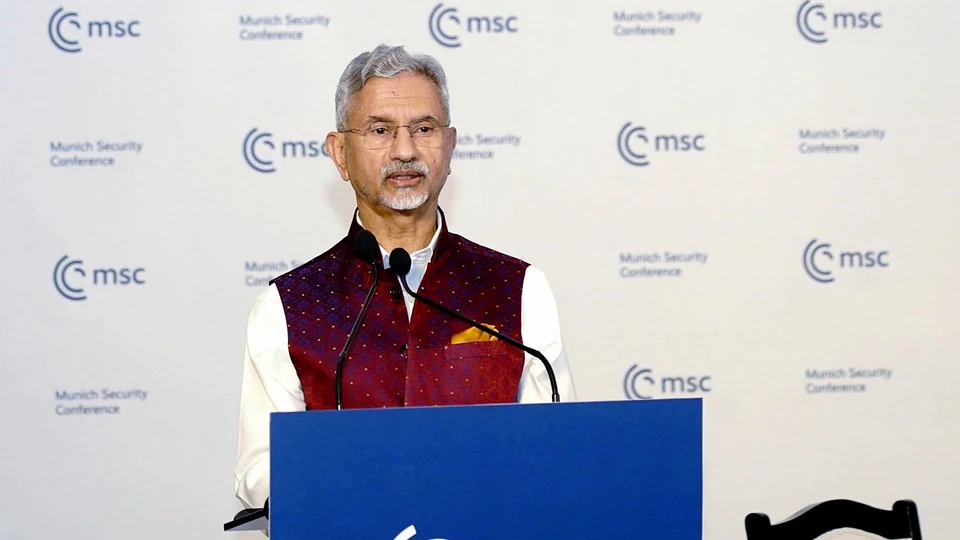
External Affairs Minister S Jaishankar has highlighted major changes taking place in the Jaishankar US China Global Order, saying the international system is being reshaped by a significant repositioning of the United States, the rise of China and the growing influence of emerging and middle powers. His remarks came during the Munich Leaders Meeting in New Delhi, where he discussed the changing balance of power and the future of international cooperation.
Jaishankar said the current global landscape is marked by what he described as a “radical repositioning” of the United States. According to the External Affairs Minister, this change represents a deliberate shift in Washington’s posture and has contributed to the US becoming, in his words, “a lonelier power.” His assessment forms part of a wider discussion about how the role of the United States is changing within the international system.
The minister also identified China’s rise as another defining feature of the present global order. He said China’s growing economic and political influence has contributed to increasingly sharp competition between Beijing and Washington. The rivalry, however, is not restricted to the two countries, as other nations are also responding to the changing geopolitical environment.
Jaishankar’s comments suggest that the Jaishankar US China Global Order debate is increasingly about more than traditional military or diplomatic competition. Countries are also using economic, technological, trade and strategic capabilities as sources of leverage. The minister described this development as the “weaponization” of leverage, while noting that it exists alongside deep global interdependence.
This creates a complicated situation for countries that maintain relationships with several major powers. Economic dependence and strategic partnerships often cross geopolitical boundaries, meaning countries may cooperate with one power in one area while maintaining a different relationship with another power elsewhere.
Jaishankar said emerging and middle powers are becoming increasingly conscious of their own interests. Rather than depending entirely on one major power, many countries are looking at ways to strengthen their domestic capabilities, diversify partnerships and reduce exposure to geopolitical risks.
The concept of diversification has become increasingly important in global diplomacy. Countries are seeking alternative supply chains, new economic partnerships, additional energy sources and wider strategic relationships. This approach can provide governments with greater flexibility when international tensions increase.
Jaishankar said emerging and middle powers do not necessarily need complete agreement on every international issue before cooperating. Instead, countries can work together when they have sufficient areas of common interest. He described this as a more flexible model of international cooperation in which a “reasonable degree of convergence” can be enough to build partnerships.
This approach is visible through several international groupings and initiatives. Jaishankar cited the Quad, BRICS, the India-Middle East-Europe Economic Corridor, the International North-South Transport Corridor and the Northern Sea Route while discussing the changing architecture of international cooperation.
The Quad, involving India, the United States, Japan and Australia, has become an important platform for cooperation in the Indo-Pacific. BRICS, meanwhile, brings together countries seeking greater collective influence in global economic and political discussions. The two groupings have different objectives and memberships, but both illustrate the broader trend toward issue-based and interest-based cooperation.
Jaishankar also referred to India’s role in initiatives such as the International Solar Alliance and the Coalition for Disaster Resilient Infrastructure. These initiatives reflect India’s effort to build international cooperation around areas where countries share common interests, particularly renewable energy and climate resilience.
The changing Jaishankar US China Global Order is also linked to the emergence of a more multipolar international system. Jaishankar said countries are increasingly maintaining relationships with multiple powers even when those relationships are not always easy to reconcile. He described this approach as “advancing by hedging.”
For middle powers, such a strategy can offer greater diplomatic flexibility. A country can cooperate with the United States on technology or security while simultaneously maintaining economic relations with China and strategic or energy ties with other countries.
India itself follows a broad engagement strategy. New Delhi has strengthened its relationship with Washington while continuing longstanding relations with Russia and maintaining dialogue with China and European countries. India’s growing engagement with West Asia, Southeast Asia and other regions also reflects its attempt to expand its international options.
Jaishankar’s remarks also highlighted concerns about the effectiveness of traditional multilateral institutions. He pointed to visible gridlock at the United Nations and suggested that smaller groupings could become increasingly important as countries look for mechanisms that can produce practical cooperation.
This does not necessarily mean that traditional institutions will disappear. Instead, it could result in a layered international system in which countries use global organisations for some issues while relying on regional or smaller coalitions for others.
The changing role of the United States is central to this transition. Jaishankar said the existing international system had been significantly supported by American power and resources, but that this “underwriting” was now being diluted. He argued that the resulting gaps could create new responsibilities for other major powers.
At the same time, Jaishankar stressed the importance of distinguishing structural changes from temporary policy decisions. He noted that some US policies have continued across different administrations, suggesting that certain developments may reflect longer-term changes rather than the approach of one particular government.
China’s expanding role is another major factor in the changing international system. Jaishankar pointed to the country’s economic capabilities and growing influence as part of the transformation underway. The increasing competition between China and the United States has consequences for countries across Asia, Europe and other regions because trade, investment, technology and security relationships are interconnected.
The US-China rivalry also creates opportunities and challenges for India. Greater competition can encourage companies and governments to diversify manufacturing and supply chains, potentially creating opportunities for countries seeking additional investment. However, prolonged geopolitical rivalry can also increase uncertainty for international trade and economic planning.
Jaishankar has argued that India’s growing economic weight will also bring greater responsibilities. As India seeks a larger role in global affairs, New Delhi is likely to face increasing expectations on issues ranging from climate change and energy security to maritime stability and international development.
The minister also discussed India’s relationship with Russia, describing it as a partnership with deep historical roots. He said the relationship today extends beyond defence to nuclear cooperation, space, trade, investment, energy and resources. At the same time, he reiterated India’s position that the Russia-Ukraine conflict should be resolved through dialogue and diplomacy.
India’s approach demonstrates why the current international system cannot easily be described as a simple contest between two blocs. New Delhi maintains strategic cooperation with the United States while preserving important relations with Russia and engaging with other major economic and political centres.
The same pattern can be seen among other emerging and middle powers. Countries are increasingly trying to protect their national interests by maintaining multiple relationships rather than relying exclusively on one geopolitical camp.
The Jaishankar US China Global Order discussion therefore reflects a wider transition in international relations. The United States remains a major global power, China has expanded its economic and political influence, and countries such as India are seeking greater strategic space.
The international system is consequently becoming more complex. Competition exists alongside economic interdependence, while cooperation can develop between countries that may disagree on other issues. This combination makes diplomacy more flexible but also more difficult to manage.
Jaishankar’s comments indicate that India sees this transition as an environment in which emerging and middle powers can play a greater role. By strengthening domestic capabilities, diversifying partnerships and cooperating where interests overlap, countries can potentially gain more room to pursue independent priorities.
For India, this could mean deeper engagement with multiple regions and institutions rather than dependence on a single strategic relationship. India’s participation in the Quad and BRICS, its connectivity initiatives and its engagement with Europe, Russia, the US and other regions all form part of this broader diplomatic landscape.
The future of the Jaishankar US China Global Order will ultimately depend on how the major powers manage competition and how other countries respond to it. If strategic rivalry continues to intensify, flexible partnerships and diversified economic relationships may become even more important.
Jaishankar’s assessment at the Munich Leaders Meeting offers India’s perspective on that transformation. His central argument was that the world is moving through a period of significant change, driven by the repositioning of the United States, China’s rise and the increasing agency of countries outside the traditional group of major powers.
As the global balance continues to evolve, India is positioning itself to maintain relationships across competing centres of power while expanding cooperation with other emerging economies. The resulting international order is likely to be more multipolar, more interconnected and more dependent on flexible partnerships than the system that dominated global affairs in previous decades.