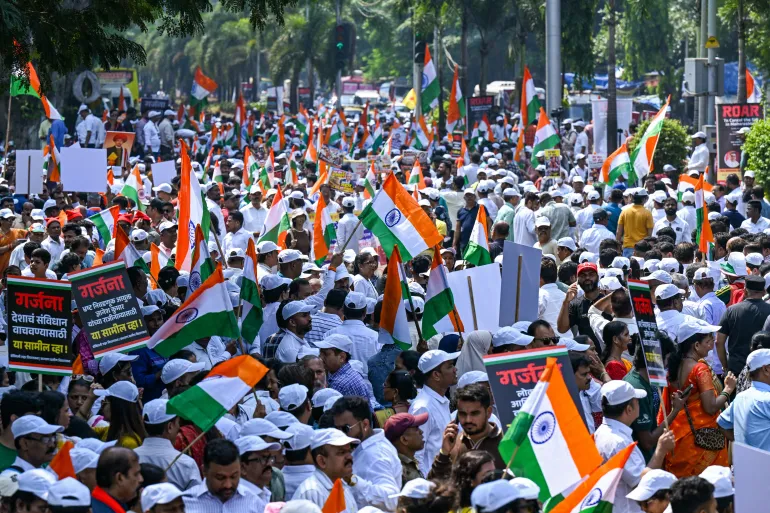
India Protests Against Gyanesh Kumar entered a third consecutive day on October 4, 2026, as thousands of young people, opposition supporters and activists gathered in Delhi and Mumbai demanding the resignation of Chief Election Commissioner Gyanesh Kumar. The demonstrations have centred on the Election Commission’s Special Intensive Revision (SIR) of electoral rolls and allegations that the exercise has resulted in eligible voters being removed from electoral lists. The Election Commission of India (ECI) and the Bharatiya Janata Party (BJP) have rejected allegations that the voter-roll exercise was designed to benefit the ruling party.
The latest India Protests Against Gyanesh Kumar took place in Mumbai and New Delhi, with opposition leaders Raj Thackeray and Uddhav Thackeray leading a major march in Mumbai. Demonstrators carried the Indian national flag and called for Gyanesh Kumar to step down. In Delhi, protesters again gathered despite restrictions on large assemblies, with police detaining some demonstrators. The protests followed two days of demonstrations during which hundreds of people were detained in the capital.
The central issue behind the India Protests Against Gyanesh Kumar is the ongoing Special Intensive Revision of electoral rolls. Protesters and opposition parties have raised concerns over the removal of names from voter lists and argue that the exercise could affect eligible citizens’ ability to vote. Some protesters have alleged that the changes could benefit Prime Minister Narendra Modi’s BJP, but those allegations have been denied by both the Election Commission and the BJP.
The Election Commission has presented a different explanation for the voter-roll revision. According to the ECI’s stated position, the process is intended to identify and remove duplicate, deceased or otherwise ineligible entries while ensuring that eligible voters are included. The commission has also directed officials to register eligible voters who may have been inadvertently omitted from the electoral rolls.
The dispute has therefore developed into a wider political and institutional confrontation. For opposition parties and protest groups, the issue is about electoral transparency, voter rights and public confidence in the Election Commission. For the ECI, the revision is presented as an administrative exercise intended to improve the accuracy and integrity of electoral rolls.
The India Protests Against Gyanesh Kumar have also brought together political groups that do not always share the same political agenda. In Mumbai, Shiv Sena (UBT) chief Uddhav Thackeray and Maharashtra Navnirman Sena leader Raj Thackeray jointly participated in Sunday’s march. The demonstration was organised under the banner of the Virat Garjana Morcha and focused on two principal demands: Gyanesh Kumar’s resignation and the withdrawal of the SIR exercise in Maharashtra.
The Mumbai march was notable because participating groups were asked to carry the Indian tricolour rather than party flags. The organisers presented the demonstration as a broader campaign centred on the Election Commission and electoral concerns rather than as a conventional party rally. Congress and Sharad Pawar-led NCP (SP) representatives also joined the mobilisation, according to reports.
Raj Thackeray also raised broader questions about the use of electronic voting machines during the Mumbai demonstration and called for a return to ballot-paper voting. These are political demands made by the protesters and do not represent a change in India’s election system. The existing electoral framework continues to use electronic voting machines, subject to the rules and procedures of the Election Commission.
In New Delhi, the India Protests Against Gyanesh Kumar have faced a stronger police response. Authorities had restricted gatherings in parts of central Delhi, including areas around Jantar Mantar and Parliament Street. During earlier demonstrations, police detained hundreds of protesters, with reports putting the number at around 700 on October 2.
On October 3, more than 150 people were reportedly detained after attempting to return to Jantar Mantar for another demonstration. Among those detained were activist Yogendra Yadav, AISA leader Neha Bora and senior advocate Prashant Bhushan. Delhi Police said prohibitory measures had been imposed to prevent unauthorised gatherings in the area.
The third day of the India Protests Against Gyanesh Kumar saw further confrontation between demonstrators and police. Reports from October 4 said some protesters climbed barricades and confronted security personnel near India Gate, while police warned demonstrators to disperse. Delhi Police reported that 120 people were detained during Sunday’s protest.
The differing detention figures across individual days reflect separate police operations rather than one single total. Earlier reports referred to hundreds detained during the October 2 demonstrations, while the October 4 protest was reported to have resulted in 120 detentions. These figures should therefore be understood in the context of the specific protest day being reported.
The India Protests Against Gyanesh Kumar have also raised questions about the balance between the right to protest and restrictions imposed by authorities. Protesters have argued that peaceful demonstrations against decisions of a constitutional institution are part of democratic participation. Authorities, meanwhile, have cited restrictions on unauthorised gatherings and public-order concerns while preventing demonstrations at locations where permission had not been granted.
Another development connected to the protests involves complaints made by three female journalists covering the demonstrations in Delhi. Delhi Police said on October 3 that it had received complaints alleging sexual harassment by police personnel during a law-and-order situation and that the complaints had been transferred to the Crime Branch for an impartial inquiry. The allegations remain subject to investigation.
The controversy surrounding the India Protests Against Gyanesh Kumar is also taking place against a larger political campaign by opposition parties. Leaders of the INDIA bloc announced a joint action plan on September 30 involving demonstrations and marches against alleged electoral irregularities and the SIR exercise. According to the Indian Express, opposition parties planned protests between October 2 and 8, a march by opposition MPs to the Election Commission office and a larger rally in Delhi later in the month.
The protests have also involved youth-led organisations. The Gen Z-led Cockroach Janta Party (CJP), which has emerged as one of the groups campaigning against the Election Commission, has announced another major rally in New Delhi for October 10. The group has framed its campaign around electoral transparency and concerns about voter-list changes.
The participation of younger protesters has given the India Protests Against Gyanesh Kumar a wider social dimension. While established opposition parties have played an important role in the demonstrations, youth organisations and independent activists have also participated. The combination has allowed the campaign to move beyond a conventional party-led protest and develop into a broader public mobilisation around electoral issues.
At the heart of the dispute is the question of voter-list accuracy. Electoral rolls naturally require periodic updating because voters die, move, change details or may appear more than once. The Election Commission says its revision process is intended to address these issues. Protesters, however, have questioned whether the process is being carried out in a manner that could unintentionally exclude legitimate voters.
This disagreement explains why the India Protests Against Gyanesh Kumar have continued despite the ECI’s explanation of the SIR process. The two sides are approaching the same issue from different perspectives: the Election Commission emphasises electoral-roll integrity, while protesters are focusing on the potential consequences for citizens whose names could disappear from the rolls.
The controversy has also placed Gyanesh Kumar personally at the centre of the political campaign. Protesters are demanding his resignation as Chief Election Commissioner and holding him responsible for the Election Commission’s handling of the voter-roll revision. However, the Election Commission has maintained that decisions of the three-member commission, including those related to SIR, have been taken through the institution’s established decision-making process.
The resignation demand is therefore a political demand from protesters rather than an indication that Gyanesh Kumar has resigned. As of October 4, there was no reported announcement that he had stepped down. Al Jazeera reported that Kumar had not publicly responded to the resignation demands or the protests.
The India Protests Against Gyanesh Kumar also coincide with increasing legal and political scrutiny of the Election Commission. The Supreme Court is expected to consider petitions connected with key voter-list decisions, according to reports. Legal proceedings could therefore become another avenue through which questions surrounding the SIR exercise are examined.
Separately, the Kerala government has ordered the reopening of a vigilance investigation into an alleged corruption matter dating back to 2006, when Gyanesh Kumar served as the state’s Public Works Department secretary. The development has been reported amid the wider controversy, but the existence of a reopened inquiry does not establish wrongdoing by Kumar.
The India Protests Against Gyanesh Kumar have consequently expanded beyond a single dispute over electoral rolls. They now involve questions about the Election Commission’s institutional credibility, the administration of voter lists, police restrictions on demonstrations, political opposition and public confidence in India’s electoral process.
The Election Commission faces the challenge of communicating its procedures clearly while addressing concerns raised by citizens and political parties. Electoral-roll revisions can be technically complex, and ensuring that eligible voters are not excluded is central to maintaining confidence in the process.
For protesters, however, the central concern remains the potential disenfranchisement of eligible voters. Their demand is that the SIR exercise be reconsidered and that Gyanesh Kumar resign as Chief Election Commissioner. Opposition leaders have also called for greater transparency in the management of electoral rolls and, in some cases, changes to the broader voting system.
The India Protests Against Gyanesh Kumar have therefore become one of the more significant recent demonstrations centred on India’s election administration. The participation of opposition leaders, youth organisations, activists and civil society figures has increased the visibility of the campaign across the country.
The developments in Delhi and Mumbai also demonstrate the contrasting approaches taken by authorities and protesters. In Mumbai, the October 4 march led by Raj and Uddhav Thackeray proceeded with thousands of participants, while Delhi authorities continued to enforce restrictions on gatherings and detained protesters who attempted to assemble in restricted areas.
The protests are expected to continue in the coming days. Opposition parties have announced further demonstrations, while the CJP has announced another rally for October 10. The planned actions mean that the dispute over Gyanesh Kumar, SIR and electoral-roll revisions is likely to remain a prominent political issue in the immediate future.
The India Protests Against Gyanesh Kumar ultimately reflect a wider debate about trust in India’s electoral institutions. Protesters argue that changes to voter lists require greater transparency and accountability, while the Election Commission maintains that the revision is intended to protect the accuracy and integrity of electoral rolls. The BJP has also rejected allegations that the exercise is intended to benefit the ruling party.
With protests continuing, legal scrutiny developing and opposition parties planning additional demonstrations, the dispute is likely to remain focused on three central questions: how voter-roll revisions are conducted, how eligible voters can ensure their names remain on electoral lists, and how the Election Commission responds to demands for greater transparency.
For now, Gyanesh Kumar remains Chief Election Commissioner, the SIR exercise remains at the centre of the controversy, and demonstrations demanding his resignation have continued across major Indian cities. The coming days could bring further protests, political negotiations and legal scrutiny as different stakeholders seek answers over the administration of India’s electoral rolls.