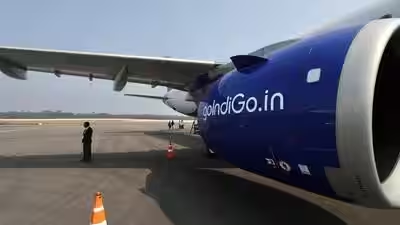
IndiGo Fuel Charges October 2026 have been increased for both domestic and international flights as the airline responds to a sharp rise in Aviation Turbine Fuel (ATF) prices. IndiGo announced that the revised fuel charges will apply to all new bookings made from 12:01 am on October 6, 2026, meaning passengers booking tickets from Tuesday will have to pay a higher fuel component in their fares.
The latest IndiGo Fuel Charges October 2026 revision comes after ATF prices increased significantly in recent months. IndiGo said the latest month-on-month rise in fuel prices exceeded 14%, pushing ATF costs to among the highest levels seen in the past decade. The airline said the sustained increase has affected operating expenses and required it to recalibrate fuel charges across its network.
Under the new IndiGo Fuel Charges October 2026 structure, domestic passengers will pay between ₹375 and ₹1,300 per sector depending on the distance of the flight. The revised structure means longer domestic journeys will attract a higher fuel charge, while shorter routes will have a comparatively lower additional amount.
For domestic flights covering up to 500 kilometres, the revised fuel charge has been set at ₹375. For flights between 501 and 1,000 kilometres, passengers will pay ₹600. Routes between 1,001 and 1,500 kilometres will attract a ₹900 fuel charge, while journeys between 1,501 and 2,000 kilometres will carry a charge of ₹1,150. Domestic flights covering more than 2,000 kilometres will have the highest fuel charge of ₹1,300 per sector.
| Domestic Flight Distance | New IndiGo Fuel Charge |
|---|---|
| Up to 500 km | ₹375 |
| 501–1,000 km | ₹600 |
| 1,001–1,500 km | ₹900 |
| 1,501–2,000 km | ₹1,150 |
| Above 2,000 km | ₹1,300 |
The IndiGo Fuel Charges October 2026 revision represents an increase across every domestic distance category compared with the structure introduced earlier in the year. The previous charges were ₹275 for flights up to 500 km, ₹400 for 501–1,000 km, ₹600 for 1,001–1,500 km, ₹800 for 1,501–2,000 km and ₹950 for flights above 2,000 km.
This means passengers on the shortest domestic routes will now pay ₹100 more in fuel charges per sector. The increase is ₹200 for the 501–1,000 km category, ₹300 for 1,001–1,500 km, ₹350 for 1,501–2,000 km and ₹350 for flights longer than 2,000 km. These amounts are per sector, so passengers travelling on a return journey could see the fuel component increase on both legs.
The IndiGo Fuel Charges October 2026 hike is also applicable to international flights, although the revised amount depends on the destination region rather than simply the distance for most international categories. The new international fuel charges range from ₹1,000 to ₹10,000.
For international flights within the SAARC region covering up to 500 kilometres, the new fuel charge is ₹1,000. SAARC routes covering 501 kilometres or more will carry a ₹3,000 charge. Flights to Southeast Asia, the Gulf Cooperation Council (GCC) and Middle East, and North and East Asia will each attract a fuel charge of ₹5,500.
Flights to Africa will carry a revised fuel charge of ₹6,000, while the charge for Europe will remain at ₹10,000. This means the increase is not uniform across all international destinations. Some routes have seen a higher surcharge, while the European category remains unchanged under the latest revision.
| International Region | Revised Fuel Charge |
|---|---|
| SAARC up to 500 km | ₹1,000 |
| SAARC above 500 km | ₹3,000 |
| Southeast Asia | ₹5,500 |
| GCC and Middle East | ₹5,500 |
| North and East Asia | ₹5,500 |
| Africa | ₹6,000 |
| Europe | ₹10,000 |
The increase in IndiGo Fuel Charges October 2026 comes at a time when international aviation markets are dealing with elevated fuel costs and geopolitical uncertainty. IndiGo specifically pointed to volatility in ATF prices and geopolitical developments in the Middle East as factors affecting fuel costs.
Aviation Turbine Fuel is one of the most important operating expenses for airlines. According to recent reporting, fuel can account for around 40% of an Indian airline’s operating costs. Consequently, a sustained rise in ATF prices can put significant pressure on airline margins and influence ticket pricing, route economics and network planning.
The IndiGo Fuel Charges October 2026 increase is therefore directly connected to the airline’s cost structure. IndiGo said that completely offsetting the rise in fuel costs would have required a significantly larger increase in the fuel charge. Instead, the airline described the latest adjustment as a measured and relatively modest increase intended to limit the additional burden on passengers.
The timing of the increase is particularly important for travellers planning flights during the upcoming festive and holiday season. Passengers making new bookings from October 6 will see the revised fuel charges incorporated into their fares. Travellers who already have confirmed bookings made before the effective time are not subject to the new charge simply because their flight takes place after October 6, based on the airline’s announcement that the revised rates apply to new bookings.
For passengers booking domestic flights, the impact will depend heavily on the distance of the selected route. Someone travelling on a short domestic route of less than 500 kilometres will face a ₹375 fuel charge, while passengers on a flight exceeding 2,000 kilometres will face ₹1,300. The distance-based structure means the additional cost will vary considerably between routes.
The IndiGo Fuel Charges October 2026 revision also means passengers should look beyond the basic fare when comparing flight prices. A ticket advertised at a lower base fare can still have a higher final price after taxes, fuel charges and other applicable components are added. Travellers comparing flights should therefore consider the complete fare rather than only the headline ticket price.
For example, a passenger booking a domestic flight longer than 2,000 kilometres will now have a ₹1,300 fuel charge added per sector. If the same passenger books a return journey, the fuel component alone could total ₹2,600 before considering other applicable taxes and charges. The actual final ticket price will depend on the fare, taxes and other components applicable to the booking.
The IndiGo Fuel Charges October 2026 hike is not the airline’s first fuel-charge adjustment this year. IndiGo had introduced or revised fuel charges earlier in response to elevated fuel costs, with the previous domestic structure introduced in April. The latest announcement represents another recalibration following further increases in ATF prices.
According to The Economic Times, domestic ATF prices increased by around ₹16 per litre, or approximately 13.2%, from October 1, rising from about ₹121 to around ₹137 per litre. This followed increases in August and September, making it the third consecutive monthly increase in ATF prices.
The continuing rise in ATF costs is therefore putting pressure on airline economics. Fuel prices can affect not only ticket prices but also decisions about route frequency, aircraft deployment and the profitability of individual sectors. The latest IndiGo Fuel Charges October 2026 announcement reflects the airline’s effort to pass on at least part of the higher fuel expense to passengers.
International passengers could see a more noticeable increase depending on their destination. The revised charge for Southeast Asia, the GCC and Middle East, and North and East Asia is ₹5,500. Africa-bound passengers will pay ₹6,000, while the Europe category remains at ₹10,000.
The international fuel-charge changes also show how IndiGo has structured the surcharge differently from its domestic system. Domestic charges are primarily based on distance bands, while international charges are grouped by destination regions. This allows the airline to reflect different fuel and operating-cost considerations across its international network.
The IndiGo Fuel Charges October 2026 announcement could also affect the overall cost of travel for passengers connecting through different destinations. While the surcharge is applied to individual sectors, travellers with multiple flight segments could see the fuel component accumulate across their itinerary depending on the applicable fare structure.
The airline has said it will continue to monitor fuel prices and market conditions. If ATF prices remain elevated or become more volatile, further adjustments cannot be ruled out, although IndiGo has not announced another increase beyond the October 6 revision.
The current IndiGo Fuel Charges October 2026 announcement also highlights the broader relationship between crude oil prices, refined aviation fuel prices and airline ticket costs. Changes in global energy markets can eventually reach passengers through higher fuel surcharges or changes in base fares. The impact is particularly relevant in India because airlines operate in a highly competitive market where fuel represents a substantial portion of overall costs.
Geopolitical developments have added another layer of uncertainty. IndiGo said ATF prices have remained volatile, particularly amid developments in the Middle East. The airline’s decision to increase fuel charges comes as international oil and aviation-fuel markets continue to respond to supply concerns and geopolitical risks.
For passengers, the immediate question is how much more they will pay. On domestic routes, the additional fuel charge now ranges from ₹375 to ₹1,300 per sector. Compared with the previous April structure, the increase ranges from ₹100 to ₹350 depending on the distance category. On international routes, the revised fuel charges range from ₹1,000 to ₹10,000 depending on the destination.
The IndiGo Fuel Charges October 2026 increase could make air travel more expensive for passengers at a time when demand traditionally rises around holidays. Travellers with flexible dates may therefore compare different flight timings, routes and airlines before making new bookings. However, the final difference between airlines will depend on their individual fare structures and applicable charges.
It is also important to distinguish between the fuel charge and the total ticket price. The fuel charge is one component of the fare and does not represent the complete amount a passenger pays. Taxes, airport charges, base fares and other applicable fees can also affect the final booking amount.
The airline’s decision to increase fuel charges illustrates the challenge carriers face when fuel prices remain elevated for an extended period. Passing the entire increase directly to customers could negatively affect demand, while absorbing the full increase could put pressure on profitability. IndiGo has said it has chosen a relatively moderate adjustment rather than fully offsetting the increase in fuel costs.
The IndiGo Fuel Charges October 2026 revision could also have implications for India’s wider aviation market. If ATF prices remain high, other airlines may face similar cost pressures. Whether competitors introduce or revise their own fuel surcharges will depend on their individual cost structures, pricing strategies and network economics.
For now, the revised IndiGo charges are confirmed for new bookings made from 12:01 am on October 6, 2026. Passengers planning to fly with IndiGo should check the final fare displayed during booking rather than relying on older ticket-price information published before the new charges came into effect.
The latest IndiGo Fuel Charges October 2026 structure can be summarised as a distance-based increase for domestic flights and region-based pricing for international flights. Domestic passengers will pay ₹375 to ₹1,300 per sector, while international fuel charges will range from ₹1,000 to ₹10,000.
The announcement comes after a sustained increase in ATF prices, with the latest month-on-month rise exceeding 14% and fuel costs reaching levels among the highest in the last decade. IndiGo has linked the revision to higher operating expenses and fuel-price volatility, particularly amid geopolitical developments affecting energy markets.
For travellers, the key takeaway is straightforward: new IndiGo bookings from October 6, 2026 will carry higher fuel charges. Short domestic flights will attract ₹375, while the longest domestic routes will carry ₹1,300. International charges will depend on the destination, with revised rates reaching ₹6,000 for Africa and ₹5,500 for several Asian and Middle Eastern regions, while Europe remains at ₹10,000.
The IndiGo Fuel Charges October 2026 increase is ultimately a response to higher aviation fuel costs rather than a standalone change to the airline’s base fares. With ATF prices remaining volatile, passengers and the wider aviation industry will continue to watch fuel-market movements closely. Any sustained change in fuel costs could influence future airfare levels and airline pricing decisions.