The 8th Pay Commission Bengaluru Meeting began on October 7, 2026, as the three-member commission started its two-day consultation with eligible central government employee organisations, unions, associations and other stakeholders. The Bengaluru visit is scheduled for October 7 and 8 and is part of the commission’s wider consultation process before it prepares recommendations on salaries, allowances, pensions and service conditions.
The 8th Central Pay Commission was constituted on November 3, 2025, and is headed by former Supreme Court Justice Ranjana Prakash Desai. Pankaj Jain is the Member-Secretary, while Professor Pulak Ghosh is the other member. The commission has an 18-month mandate to examine various aspects of remuneration and service conditions of central government employees and pensioners.
The 8th Pay Commission Bengaluru Meeting does not have a publicly announced subject-by-subject agenda. However, the representations already submitted by employee unions and pensioner organisations indicate that salary revision, the fitment factor, allowances, pension benefits, career progression and service conditions are among the major issues expected to be discussed.
The Bengaluru consultation is not an announcement of a new salary structure. Employees should therefore not treat figures being proposed by individual unions or circulating online as final. The commission will consider representations from a wide range of stakeholders before preparing its recommendations, which will subsequently require consideration and approval by the Central Government.
One of the biggest points of interest surrounding the 8th Pay Commission Bengaluru Meeting is the fitment factor. The fitment factor is used in the calculation of revised basic pay under a new pay commission. Employee organisations have submitted different proposals, but no final fitment factor has been announced by the 8th Pay Commission.
For example, the Indian Railways Technical Supervisors’ Association has proposed different fitment factors for different pay-level groups. Its memorandum reportedly seeks a 2.92 factor for Levels 1 to 5, 3.50 for Levels 6 to 8, 3.80 for Levels 9 to 12, 4.09 for Levels 13 to 16 and 4.38 for Levels 17 and 18. These are union demands, not recommendations approved by the commission.
The demand for higher basic pay is another major issue expected to feature during consultations. IRTSA has reportedly sought minimum pay of ₹52,600 along with changes to the existing career and pay structure for technical supervisors. It has also called for a 5% annual increment and revisions to allowances related to night duty, overtime, risk and hardship.
These proposals demonstrate why the 8th Pay Commission Bengaluru Meeting is important for employees, but they should not be interpreted as confirmation that central government salaries will rise by a particular percentage. The commission has to assess the demands of multiple employee categories alongside the government’s financial position, economic conditions and broader requirements of public administration.
Pensioners are another important group in the current consultation process. The Railway Senior Citizens Welfare Society has reportedly sought stronger retirement security and greater weightage for basic pay because the structure of basic pay and allowances can affect retirement benefits. The organisation has also raised issues related to the periodic revision of allowances and protection against inflation.
The commission’s mandate covers more than basic salary. It is examining pay, allowances and other facilities or benefits available to employees, along with issues such as increments, promotions and service conditions. The terms of reference also require consideration of rationalisation, contemporary functional requirements and specialised needs.
The 8th Pay Commission Bengaluru Meeting is part of a much larger nationwide consultation exercise. Before arriving at its recommendations, the commission has already held or scheduled stakeholder interactions in multiple parts of the country. Earlier visits included places such as Jaipur and Chandigarh, while Mumbai is scheduled for October 22 and 23.
The commission’s official notice for Bengaluru states that it would visit the city on October 7 and 8 and invited eligible organisations, institutions, associations and unions of central government employees that wished to interact with the panel. Interested stakeholders were required to submit appointment requests along with the unique memorandum ID generated after submitting their memorandum.
The Mumbai visit will provide another opportunity for stakeholder groups to put forward their concerns. According to the latest schedule, the commission will meet stakeholders in Mumbai on October 22 and 23. Organisations seeking appointments for that visit have been asked to submit requests by October 10.
Another important development concerns data collection by government departments. The 8th Pay Commission is seeking information from government offices as part of its wider assessment. A recent exercise involving the Central Government Employees Group Insurance Scheme, or CGEGIS, has required certain offices to provide relevant data. This is part of the commission’s information-gathering process and does not itself represent a decision to increase or alter CGEGIS benefits.
The 8th Pay Commission Bengaluru Meeting is therefore taking place alongside several administrative exercises designed to provide the commission with information about employees and existing benefits. Data from government departments, representations from employee associations and pensioner organisations, and consultations with stakeholders will all form part of the material available to the commission.
Dearness Allowance is also likely to remain an important consideration for employees during the pay commission process. Current discussions around DA and Dearness Relief are separate from the final recommendations of the 8th Pay Commission. Recent CPI-IW data has led to expectations of a possible increase in DA from January 2027, but the final figure depends on subsequent inflation data and government approval.
This distinction is important because the current DA revision process should not be confused with the eventual implementation of the 8th Pay Commission recommendations. DA is periodically revised using the applicable inflation-linked mechanism, while a pay commission undertakes a broader review of pay, allowances, pensions and service conditions.
The 8th Pay Commission Bengaluru Meeting is also being closely watched for potential developments concerning lower and middle pay levels. Employee associations have raised demands for revised minimum pay and higher fitment factors, while other groups have focused on promotions, career progression and compensation for specialised or difficult duties. The commission will have to consider these demands across different categories rather than adopting a single proposal from any one organisation.
Postal employees, for example, have submitted demands concerning the classification and pay structure of certain supervisory positions. According to a separate Mint report, the Federation of National Postal Organisations has sought higher pay levels for HSG-I positions, Group B gazetted status and a responsibility allowance for certain postal supervisors. These proposals are among the many sector-specific demands that may be presented during the consultation process.
The consultation process is also important for pensioners because retirement benefits are directly affected by the eventual structure of pay and pension revisions. Pensioner organisations have raised concerns about healthcare, housing, transportation and inflation-related expenses after retirement. However, the commission has not yet announced any final pension revision formula.
More than one crore people are expected to be affected by the eventual recommendations of the 8th Pay Commission, including approximately 50 lakh serving central government employees and around 65 lakh pensioners, according to recent reporting. Defence and railway personnel and pensioners are also covered within the broader beneficiary group.
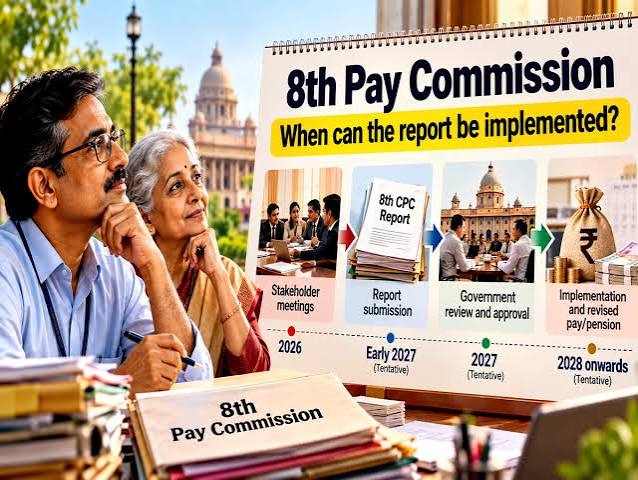
The timeline for the final report remains another important issue. The commission was constituted on November 3, 2025, with an 18-month period for submitting its recommendations. Recent reports have suggested that the final report could be submitted around May or June 2027, although this should be treated as an expected timeline rather than a confirmed implementation date.
This means employees should not expect the 8th Pay Commission Bengaluru Meeting to immediately result in higher salaries. The Bengaluru discussions are part of the consultation stage. After consultations are completed, the commission will analyse representations, data and financial implications before submitting its recommendations to the government.
There is also uncertainty over the exact implementation date. Even after the commission submits its report, the recommendations will need to be examined and accepted or modified by the government before implementation. If implementation occurs later than the effective date eventually decided by the government, questions relating to arrears could also become relevant.
For central government employees, the most important takeaway from the 8th Pay Commission Bengaluru Meeting is that the process is moving forward but no final salary hike has been approved yet. Figures such as a 2.57, 2.92, 3.50 or higher fitment factor currently represent proposals or scenarios discussed by employee groups and analysts, not confirmed government decisions.
Employees should therefore be cautious about online salary calculators that present a particular revised salary as guaranteed. The actual revised basic pay will depend on the fitment factor and pay-matrix structure ultimately recommended by the commission and accepted by the government.
The Bengaluru consultations could nevertheless provide an important opportunity for employee representatives to directly communicate their concerns. Issues involving minimum pay, increments, promotions, allowances, hardship compensation and retirement security can be formally presented to the commission through eligible organisations.
The 8th Pay Commission Bengaluru Meeting also demonstrates that the commission is continuing its consultation process across different regions instead of relying solely on written memoranda. Direct interactions with employee associations, unions and pensioner organisations can provide the panel with more detailed information about working conditions, pay disparities and category-specific requirements.
For pensioners, the focus is likely to remain on pension revision, inflation protection and healthcare-related financial pressures. For serving employees, salary structure, allowances, career progression and working-condition-related compensation are among the main concerns. The final recommendations will need to balance these demands with the government’s fiscal capacity.
The commission’s work is therefore still at an intermediate stage. Its Bengaluru visit is an important consultation milestone, but it is not the point at which the final salary or pension structure will be announced.
The 8th Pay Commission Bengaluru Meeting will continue through October 8, after which the commission’s scheduled consultation programme moves ahead to other locations, including Mumbai later this month. As more employee associations meet the panel, additional proposals on salary, fitment factor, allowances and pensions are likely to emerge.
For now, central government employees and pensioners should distinguish between confirmed developments and demands made by individual organisations. The confirmed development is that the 8th Pay Commission is conducting its Bengaluru consultations on October 7 and 8, 2026. The exact fitment factor, revised pay matrix, salary increase, pension formula and final allowance structure remain undecided.
The 8th Pay Commission Bengaluru Meeting is ultimately one step in a longer process that could shape the pay and retirement benefits of millions of central government employees and pensioners. With consultations continuing and the commission’s report expected within its 18-month mandate, the next major developments will depend on the representations received, the data examined and the recommendations eventually submitted to the Central Government.