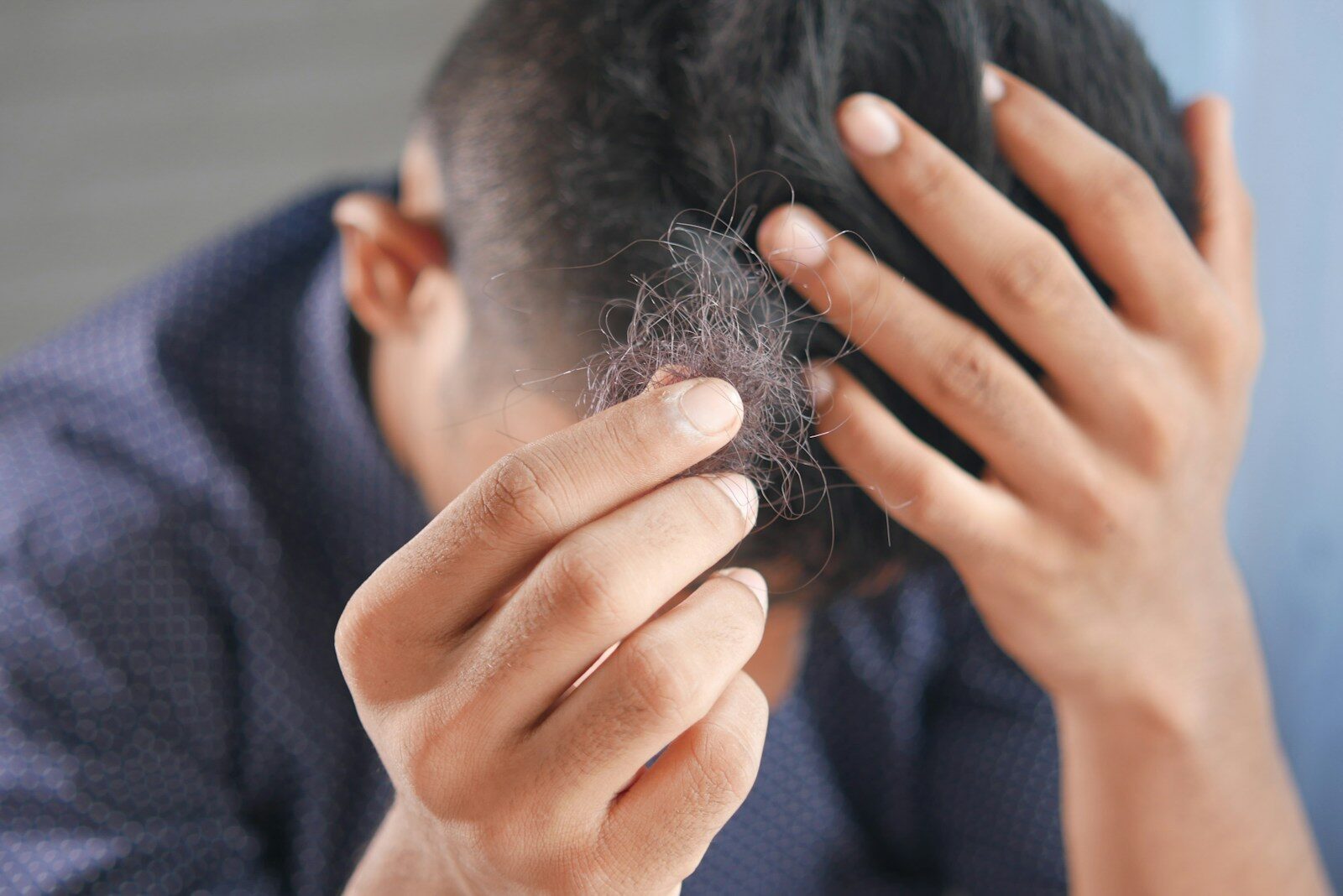
Hair fall can make even a normal day feel stressful. You notice strands on your pillow, in the shower, on your clothes, or stuck in your comb, and suddenly you start wondering whether you are losing too much hair.
The first thing to understand is that some daily shedding is completely normal. Most people lose around 50 to 100 hairs a day as part of the natural hair-growth cycle. The problem is when your normal pattern changes and you start noticing excessive shedding, visible thinning, a widening part, a thinner ponytail, or bald patches.
If you are searching for ways to stop hair fall naturally, it is important to separate genuine hair-care habits from internet myths.
There is no single food, oil, shampoo, or home remedy that can stop every type of hair loss. Hair loss can happen because of genetics, hormonal changes, medical conditions, stress, nutritional problems, medications, scalp infections, or repeated damage from hairstyles and treatments.
That means the best natural approach starts with understanding what may be causing your hair fall.
If your shedding started after a major illness, fever, surgery, childbirth, severe stress, or significant weight loss, the cause may be temporary excessive shedding.
If your hair has been gradually becoming thinner, especially around the part or crown, hereditary hair loss may be involved.
If you suddenly develop a smooth bald patch, significant scalp irritation, or rapidly progressing hair loss, it is better to speak with a dermatologist instead of relying only on home remedies.
One of the simplest things you can do is improve your diet.
Hair production requires adequate nutrition, and a severely restricted diet can contribute to hair problems. The American Academy of Dermatology lists inadequate iron, protein, zinc, and biotin among nutritional factors that can be associated with noticeable hair loss.
This does not mean you should immediately buy a collection of hair vitamins.
A better approach is to make your everyday meals more balanced.
Include adequate protein from foods such as eggs, fish, dairy products, lentils, beans, soy, nuts, and seeds according to your dietary preferences.
Protein is particularly important because hair is largely made from a protein called keratin.
If you have recently started a very restrictive diet, dramatically reduced your calorie intake, or lost a significant amount of weight, consider whether your body is receiving enough nutrition.
Rapid weight loss can be associated with hair shedding, particularly when nutritional intake becomes inadequate.
Crash dieting is therefore not a good hair-care strategy.
You may lose weight quickly, but your hair may pay the price later.
Instead, focus on sustainable eating habits that provide enough calories, protein, vitamins, minerals, and other nutrients.
Iron is another nutrient that deserves attention.
Iron deficiency can contribute to hair loss in some people, particularly when dietary intake is inadequate or there are other reasons for iron loss.
But do not start taking iron supplements simply because you noticed hair fall.
Too much iron can be harmful, so supplementation should be based on an actual need and appropriate medical guidance.
The same principle applies to biotin.
Biotin is heavily marketed as a hair-growth vitamin, but taking more biotin does not automatically mean growing more hair.
If you are not deficient, a high-dose supplement may not solve your problem.
In fact, excessive use of certain supplements can sometimes contribute to hair problems. The AAD advises against taking supplements unnecessarily because too much of certain nutrients can worsen hair loss.
Your daily hair-care routine also matters.
Be gentle when brushing and combing.
Hair can become more vulnerable to breakage when it is wet, so avoid aggressively pulling through tangles.
A wide-toothed comb can help reduce unnecessary pulling.
If your hair is very tangled, start at the ends and gradually work upward rather than forcing a brush through the entire length.
Your hairstyle can also make a difference.
Repeatedly wearing extremely tight ponytails, buns, braids, extensions, or other styles that pull on the scalp can cause traction alopecia.
The AAD warns that continuous pulling can eventually lead to permanent hair loss.
A simple rule is worth remembering.
If your hairstyle causes pain, tenderness, headaches, or a strong pulling sensation around your hairline, it is probably too tight.
Give your scalp regular breaks from high-tension hairstyles.
This is particularly important if you are already noticing thinning around your temples or hairline.
Heat styling is another area where small changes can protect your hair.
Straighteners, curling irons, and high-temperature blow dryers can damage the hair shaft.
The result may be dryness, brittleness, split ends, and breakage.
Breakage is different from hair falling out from the follicle, but repeated breakage can make your hair look significantly thinner.
Try using lower heat whenever possible.
Do not repeatedly apply high heat to the same section of hair.
Give chemically treated hair extra care because it may already be more fragile.
Chemical processing can also contribute to hair damage.
Frequent bleaching, relaxing, perming, coloring, and other treatments can weaken the hair shaft.
You do not necessarily have to stop every cosmetic treatment.
The important thing is to avoid excessive processing and give damaged hair time to recover.
If your scalp burns, becomes painful, develops sores, or becomes severely irritated after a chemical treatment, stop the treatment and seek professional advice.
Washing your hair is another topic surrounded by myths.
Many people believe that shampoo causes hair fall because they see loose hair in the shower.
In reality, washing often makes hairs that were already ready to shed more visible.
If you wash your hair after several days, you may see several days’ worth of normal shedding at once.
That does not mean the shampoo caused all those hairs to fall out.
Your washing frequency should depend on your scalp and hair needs rather than fear of losing hair in the shower.
If your scalp becomes oily, sweaty, flaky, or uncomfortable, avoiding shampoo may not be helpful.
A clean, healthy scalp is an important part of good hair care.
Dandruff and other scalp problems should also be taken seriously.
Mild dandruff may be manageable with appropriate hair-care products, but persistent itching, redness, scaling, pain, crusting, or unusual hair loss can indicate an underlying scalp condition.
Scalp infections can cause hair loss, and some infections require medical treatment.
Do not assume every itchy scalp is simply dandruff.
If the problem continues despite routine care, get it evaluated.
Stress is another factor that many people underestimate.
Significant physical or emotional stress can trigger excessive hair shedding.
The frustrating part is that stress-related shedding may not appear immediately.
A major event can happen months before you notice a noticeable increase in shedding.
That means you should think about the previous few months when trying to understand sudden hair fall.
Ask yourself whether you experienced a major illness, surgery, fever, severe emotional stress, childbirth, rapid weight loss, or another significant change.
If you did, temporary excessive shedding may be one possible explanation.
Managing stress is therefore useful, but it should not be presented as a magic hair-growth treatment.
Try to create a lifestyle that supports your overall health.
Get adequate sleep.
Eat regularly.
Stay physically active.
Make time for relaxation.
Take breaks when possible.
If you are dealing with persistent anxiety or severe emotional stress, professional support can be valuable.
Sleep is another part of the bigger picture.
One poor night’s sleep is unlikely to suddenly make you bald.
But chronically poor sleep combined with stress, inadequate nutrition, illness, or other lifestyle problems can place additional strain on your overall health.
Instead of searching for a single “hair-growth sleep position,” focus on getting consistent, restorative sleep.
Your hair does not need a complicated nighttime routine.
It needs a healthy body and a gentle hair-care environment.
Another common question is whether drinking more water can stop hair fall.
Staying hydrated is important for general health, but drinking excessive amounts of water is not a proven treatment for hereditary hair loss.
If you are dehydrated, correcting dehydration is important.
But if your hair is progressively thinning, drinking extra water is unlikely to address the underlying cause.
The same applies to coconut oil.
Coconut oil can be useful as part of a hair-care routine for some people because it can help condition the hair and reduce dryness.
But it should not be considered a cure for genetic hair loss, thyroid-related hair loss, nutritional deficiencies, autoimmune hair loss, or other medical conditions.
The distinction between improving hair quality and treating hair loss is extremely important.
You can have soft, shiny hair and still have progressive follicle-related hair loss.
You can also have dry, damaged hair without having a disease that causes hair loss.
The same distinction applies to rosemary oil and other natural remedies.
Natural products have become extremely popular online, but popularity does not automatically mean that a remedy can treat every form of hair loss.
If you want to use an oil as part of your cosmetic routine, be realistic about what it can and cannot do.
Do not allow a home remedy to delay evaluation of significant or progressive hair loss.
One of the biggest mistakes people make is trying too many treatments at the same time.
They start a new shampoo, oil, supplement, serum, scalp mask, and dietary restriction all in the same week.
Then, if the hair fall changes, they have no idea what caused the improvement or worsening.
A simpler approach is usually better.
Identify the problem.
Make sensible hair-care changes.
Address obvious nutritional or lifestyle problems.
Monitor the pattern.
Seek professional evaluation if the problem persists.
If you are experiencing gradual thinning, do not wait until most of the hair is gone before taking it seriously.
Hereditary hair loss is the most common cause of hair loss worldwide, and in women it often appears as overall thinning or a widening part. The AAD notes that treatment tends to work better when started early.
Female pattern hair loss can be especially easy to miss because it usually develops slowly.
You might not notice it from one day to the next.
Instead, you notice that your part looks slightly wider than it did a year ago.
Your ponytail may feel smaller.
Your scalp may become more visible under bright lighting.
These gradual changes are worth paying attention to.
Mayo Clinic also describes female-pattern hair loss as commonly involving reduced density along the part and the top-central scalp.
If this sounds familiar, natural hair care can help protect your existing hair, but it may not be enough to stop the underlying process.
This is where evidence-based treatment becomes important.
Minoxidil is one established treatment used for certain types of pattern hair loss.
Mayo Clinic notes that minoxidil can help many people slow hair loss or encourage regrowth.
However, it is not a universal treatment for every person with hair fall.
Sudden shedding, patchy hair loss, scalp infection, nutritional problems, thyroid disease, and other conditions require different approaches.
That is why diagnosis should come before assuming that any particular medication is right for you.
Another important issue is postpartum hair shedding.
Many women notice substantial hair fall a few months after giving birth.
This can be alarming, particularly when large amounts of hair come out during washing.
The AAD explains that postpartum excessive shedding is commonly related to falling estrogen levels and is generally temporary, with many women returning to their normal fullness by their child’s first birthday.
If you recently gave birth, focus on adequate nutrition, gentle hair care, and patience.
Do not start taking multiple supplements without discussing them with a healthcare professional.
If the shedding is unusually severe or does not improve as expected, get evaluated because other causes can coexist.
Menopause can also bring changes in hair density.
As women age, hair growth naturally changes, and genetic hair loss may become more noticeable.
Some women notice a widening part or thinning around the crown.
Mayo Clinic notes that female pattern hair loss is a common cause of thinning in women and may become more noticeable with age.
Do not assume that significant thinning is something you simply have to accept.
A dermatologist can determine whether the changes are consistent with female pattern hair loss or whether another condition should be considered.
Hormonal changes can also play a role.
Conditions such as PCOS can be associated with hormonal changes and scalp hair thinning.
However, hair loss alone does not mean you have a hormonal disorder.
If you have irregular periods, acne, increased facial or body hair, or other symptoms alongside scalp thinning, discuss the complete picture with a healthcare professional.
Another possible cause is thyroid disease.
Thyroid problems can cause thinning hair or increased shedding.
If your hair loss is accompanied by unexplained fatigue, changes in body weight, unusual sensitivity to heat or cold, or other symptoms, your doctor may decide whether thyroid testing is appropriate.
Again, the goal is not to diagnose yourself based on one symptom.
The goal is to identify whether something treatable is contributing to the hair loss.
Medications can also sometimes contribute to hair loss.
If you recently started a medication and noticed significant shedding afterward, tell the prescribing healthcare professional.
Do not stop prescribed medication on your own.
The AAD specifically advises people who suspect a medication is causing hair loss to discuss it with the prescribing doctor rather than stopping it themselves.
This is particularly important because suddenly stopping some medicines can create serious health problems.
The same principle applies to supplements.
Tell your healthcare professional about everything you are taking, including vitamins and herbal products.
If you want to prevent avoidable hair loss, focus on the things you can control.
Avoid extreme diets.
Eat enough protein.
Do not take high-dose supplements without a reason.
Avoid repeatedly wearing extremely tight hairstyles.
Limit excessive heat and chemical processing.
Handle your hair gently.
Keep your scalp appropriately clean.
Address persistent scalp problems.
And pay attention to gradual changes in density.
These habits cannot prevent every type of hair loss because genetics and medical conditions are outside your control.
But they can reduce avoidable damage.
One particularly useful habit is taking photographs.
Choose the same location, lighting, hairstyle, and camera angle.
Take a photograph every few months rather than every day.
This gives you a much clearer picture of whether your hair density is changing.
It can also be useful when speaking with a dermatologist.
A doctor evaluating hair loss may ask when the problem began, whether it is continuous or occasional, whether the hair loss is patchy or generalized, whether you have noticed breakage, what medications and supplements you take, and whether hair loss runs in your family.
Keeping a simple record can make that conversation easier.
You can note when the shedding started, recent illnesses, weight changes, major stress, pregnancy, dietary changes, new medications, and changes in your hair-care routine.
You do not need a complicated spreadsheet.
A few notes on your phone can be enough.
There are also situations where you should not wait and see.
Sudden bald patches deserve evaluation.
Rapidly progressing hair loss deserves evaluation.
Hair loss accompanied by scalp pain, redness, severe scaling, crusting, or inflammation deserves evaluation.
Loss of eyebrows or eyelashes along with scalp hair loss also deserves attention.
A receding hairline in an older woman can sometimes be related to frontal fibrosing alopecia, a condition where early treatment may help prevent significant permanent hair loss. Mayo Clinic specifically recommends medical attention for a receding hairline of this type.
The earlier the cause is identified, the more options you may have.
This is especially important because some forms of hair loss can permanently damage follicles.
Scarring alopecia is one example.
The AAD explains that when inflammation destroys a hair follicle, that follicle cannot regrow hair, which makes early diagnosis important.
That is why “I will just try oil for six months” is not always a safe strategy.
Natural hair care is useful.
But natural hair care should complement appropriate medical evaluation rather than replace it when warning signs are present.
If you are currently losing hair, start with the basics.
Look at your diet.
Look at your recent health.
Look at your stress.
Look at your hairstyle.
Look at your use of heat and chemicals.
Look at your family history.
Look at the pattern of the hair loss.
Then decide what the next step should be.
If the shedding is temporary, addressing the trigger may be enough.
If your hair is breaking, reducing damage may improve its appearance.
If you have a nutritional deficiency, correcting it may help.
If you have a scalp condition, treating that condition is important.
If you have hereditary hair loss, evidence-based treatment may be necessary to slow progression and preserve hair.
There is no reason to feel embarrassed about seeking help.
Hair loss can affect confidence and emotional well-being, and dermatologists routinely evaluate these concerns.
Mayo Clinic notes that hair loss can have a significant emotional and psychological impact, which is one reason appropriate diagnosis and treatment matter.
Most importantly, do not let fear push you toward miracle products.
If a product promises to completely stop hair fall in a few days, regrow all lost hair in two weeks, or permanently cure genetic baldness with one natural ingredient, be skeptical.
Hair follicles follow biological cycles.
Real improvement usually takes time.
Evidence-based treatment also requires patience.
Your goal should not be to stop every hair from falling.
Your goal should be to maintain a healthy scalp, reduce unnecessary damage, identify excessive shedding, and address the underlying cause when one exists.
If you notice a few hairs in your brush today, that does not automatically mean something is wrong.
If you notice that your part has been widening for a year, your ponytail is becoming thinner, or your scalp is increasingly visible, that is a different situation.
Look at the overall pattern rather than one shower.
Hair fall is easier to manage when you understand what you are actually dealing with.
The best natural approach is therefore not one magical remedy.
It is a combination of adequate nutrition, gentle hair care, healthy lifestyle habits, reduced mechanical and chemical damage, appropriate scalp care, and professional evaluation when the pattern suggests a medical problem.
If you are experiencing persistent or significant hair loss, do not spend months jumping from one viral remedy to another.
Find out why it is happening.
Once the cause is clear, you can choose the most appropriate path forward.
Your hair does not need more hype.
It needs the right care, realistic expectations, and evidence-based decisions.
Is hair fall normal every day? Some daily shedding is normal, with around 50 to 100 hairs commonly considered within the normal range. What matters more is whether your usual pattern has changed.
Can I stop hair fall naturally? Natural habits can reduce avoidable damage and support healthy hair, but they cannot treat every cause of hair loss. Genetic and medical forms may require specific treatment.
What should I eat to reduce hair fall? Focus on a balanced diet that provides adequate protein, calories, vitamins, and minerals. Eggs, fish, dairy, lentils, beans, soy, nuts, and seeds can all contribute protein depending on your diet.
Does protein deficiency cause hair fall? Inadequate protein intake can contribute to hair loss. This can be particularly relevant during restrictive diets or rapid weight loss.
Can stress cause excessive hair shedding? Yes. Significant physical or emotional stress can cause temporary excessive shedding.
Can postpartum hair fall be stopped? Postpartum shedding is usually temporary. Gentle hair care and adequate nutrition can support the recovery period, while persistent or unusual shedding should be evaluated.
Does oiling stop hair loss? Oiling can condition hair, but it does not treat every underlying cause of hair loss.
Can rosemary oil cure hair loss? There is interest in rosemary oil as a hair-care ingredient, but it should not be treated as a guaranteed cure for every type of hair loss.
Does shampoo cause hair fall? Normal shampooing does not generally cause follicle-related hair loss. Washing can simply make already-shed hairs easier to notice.
Can tight hairstyles cause permanent hair loss? Repeated pulling can cause traction alopecia and may permanently damage follicles if the tension continues.
Should I take biotin for hair fall? Do not automatically take high-dose biotin. Supplements are most useful when there is a genuine nutritional need, and excessive supplementation can sometimes cause problems.
Can iron deficiency cause hair fall? Yes, inadequate iron can be associated with hair loss. However, iron supplements should not be taken without an appropriate reason or professional guidance.
Can thyroid problems cause hair loss? Yes. Thyroid disorders can cause thinning or increased shedding, and treatment of the underlying condition may improve the hair problem.
Does minoxidil work for hair loss? Minoxidil can help many people with certain forms of pattern hair loss, but it is not appropriate for every cause.
When should I see a dermatologist? Seek professional evaluation if hair loss is sudden, patchy, rapidly progressing, persistent, or associated with scalp pain, inflammation, severe scaling, or other unusual symptoms.
Can hair grow back after hair loss? Sometimes. Temporary shedding can recover when the underlying trigger resolves, while other forms require treatment. Some forms of scarring hair loss can permanently destroy follicles, making early evaluation important.
Medical Disclaimer: This article is for general educational purposes and does not replace individualized medical advice, diagnosis, or treatment. Hair loss can have many causes. If you have sudden, severe, patchy, painful, or rapidly progressing hair loss, consult a qualified dermatologist or healthcare professional.