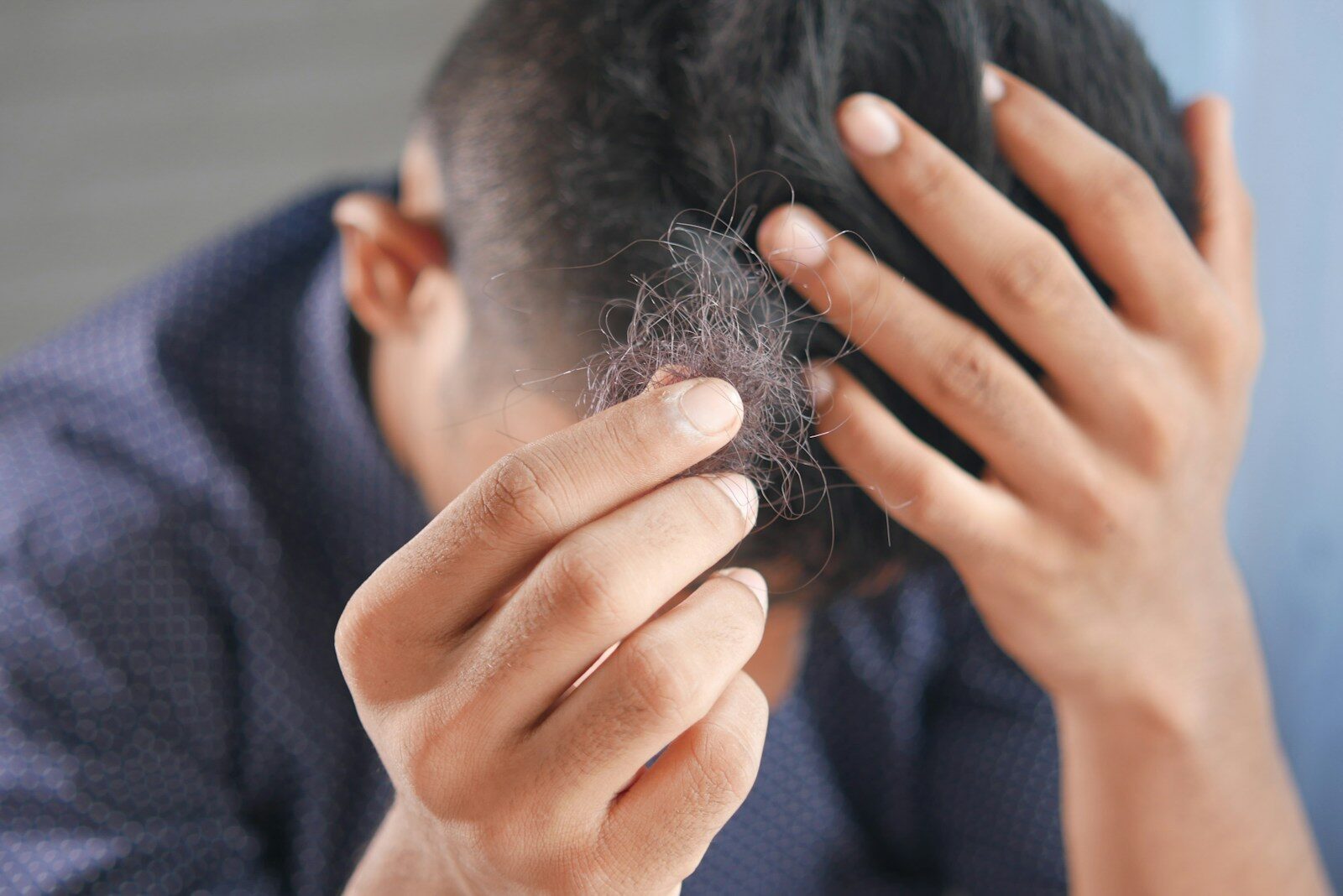
Hair fall is one of the most common concerns men have about their appearance. You may first notice a few extra strands in the shower, a slightly higher hairline, thinning around the temples, or more scalp showing through the hair.
At first, it can be easy to ignore.
Then you look at an older photograph and realize your hairline has changed more than you thought.
This is when questions usually begin.
Why is my hair falling out? Is it because of stress? Is my shampoo causing it? Is hair loss genetic? Can I stop a receding hairline? Will my hair grow back? Should I start using minoxidil?
The important thing to understand is that not all hair fall in men has the same cause.
Some shedding is normal. Some hair loss is temporary. Some types are caused by genetics and gradually progress over time. Other forms can be related to medical conditions, medications, nutritional problems, scalp disorders, or repeated damage to the hair.
The American Academy of Dermatology identifies hereditary hair loss as the most common cause of hair loss worldwide. It can affect men and women, but the pattern in men is often particularly recognizable. (aad.org)
Understanding the pattern is therefore one of the most useful things you can do.
Normal daily shedding is not necessarily a problem.
People naturally lose hair every day as part of the hair-growth cycle. Around 50 to 100 hairs a day is commonly considered normal, although the amount can vary between individuals. (aad.org)
The concern begins when you notice a persistent change.
Your hairline may slowly move backward.
Your temples may become more visible.
The crown may start thinning.
Your hair may become finer.
Your scalp may become easier to see.
These changes can indicate progressive hair loss rather than ordinary shedding.
One of the most common causes is male pattern hair loss.
Male pattern hair loss is also called androgenetic alopecia.
It is strongly influenced by genetics and hormones.
In susceptible men, certain hair follicles gradually become smaller.
The hairs produced by those follicles become thinner and shorter over time.
Eventually, some follicles may stop producing visible hair.
This process is usually gradual.
You may not notice a significant difference from one month to the next.
But after several years, the change can become obvious.
The typical pattern often begins around the temples or front hairline.
Some men notice a small change in the corners of the hairline first.
Others notice thinning around the crown.
Some experience both.
The pattern can vary significantly between individuals.
A receding hairline does not automatically mean that you will become completely bald.
Genetic hair loss can progress at different rates.
Family history can provide a clue, but it does not predict exactly what will happen to you.
You may have a strong family history of baldness and experience relatively mild thinning.
Another man may have no obvious family history and still develop significant hair loss.
Genetics are complicated.
That is why looking at your own hair pattern over time is more useful than trying to predict your future solely from your father’s hairline.
One of the earliest signs of male pattern hair loss can be a changing hairline.
You may notice that the temples look more exposed.
The front corners can gradually move backward.
The central hairline may remain relatively stable while the sides recede.
This can create an increasingly mature-looking hairline.
A slightly mature hairline is not necessarily the same as progressive baldness.
Many men naturally develop a higher hairline after adolescence.
The important factor is whether the hairline continues changing over time.
Photographs can help you see this more objectively.
Take a photograph from the front and both sides under similar lighting every few months.
You do not need to photograph your hair every day.
Daily checking can make normal variations feel alarming.
A longer-term comparison is much more useful.
Crown thinning is another common sign.
The crown can be difficult to monitor because you cannot easily see it yourself.
You may first notice it in a photograph taken from above.
A friend or family member may point it out.
Or you may see more scalp when your hair is wet.
If the crown is gradually becoming thinner, it is worth paying attention.
Some men have both crown thinning and a receding hairline.
Others mainly experience one pattern.
Male pattern hair loss can also cause the hair itself to become finer.
You may technically still have hair in an area, but each individual strand becomes thinner.
This process is called miniaturization.
The result is reduced visual density.
That is why simply looking for completely bald areas can cause you to miss early hair loss.
Early thinning can be much easier to treat or manage than advanced loss.
This is one reason dermatologists often emphasize early evaluation.
The AAD notes that treatment for hereditary hair loss works best when started early because the goal can include slowing progression and preserving existing hair. (aad.org)
Another question men frequently ask is whether stress causes hair loss.
Yes, significant stress can contribute to excessive shedding.
But stress-related shedding is different from male pattern baldness.
A major illness, high fever, surgery, severe emotional stress, rapid weight loss, or another physical stressor can cause a larger number of hairs to enter the resting phase.
This can result in noticeable shedding later.
The delay is important.
You may experience a stressful event today and not notice hair shedding until several months later.
That can make the connection difficult to recognize.
If you suddenly start losing much more hair than usual, think about what happened in the previous few months.
Were you seriously ill?
Did you have surgery?
Did you lose weight quickly?
Did you experience major emotional stress?
Did your diet change dramatically?
Did you start a new medication?
These details can help identify whether temporary shedding may be involved.
Stress-related shedding can be temporary.
Once the trigger is resolved and the body returns toward normal, the hair cycle may gradually recover.
The American Academy of Dermatology notes that temporary excessive shedding can improve as the body readjusts. (aad.org)
However, stress can also happen at the same time as genetic hair loss.
A man may therefore experience significant shedding after an illness and also have an underlying receding hairline.
When the temporary shedding improves, the hereditary thinning may remain.
This can create the impression that stress caused permanent baldness.
In reality, two different processes may have been occurring.
Another possible cause is nutritional deficiency.
Hair follicles require adequate nutrients to function normally.
A highly restrictive diet, significant weight loss, inadequate protein, or certain nutritional deficiencies can contribute to hair problems.
This does not mean every man with hair loss needs supplements.
It means your overall diet matters.
Make sure you are eating enough and getting adequate protein.
Good protein sources include eggs, fish, poultry, dairy products, beans, lentils, soy, nuts, and seeds.
If you have dramatically reduced your calorie intake or lost a significant amount of weight, review your diet.
Rapid weight loss can be associated with temporary excessive shedding.
Iron can also be relevant in certain cases.
Iron deficiency is not the most common explanation for male pattern hair loss, but it can contribute to hair loss in some individuals.
Do not take iron supplements simply because you are losing hair.
Too much iron can be harmful.
If deficiency is suspected, your healthcare professional can determine whether testing is appropriate.
Biotin is another supplement frequently marketed to men with thinning hair.
The problem is that biotin is often treated as though it is a universal hair-growth solution.
It is not.
Biotin deficiency can affect hair, but deficiency is relatively uncommon.
If you are not deficient, taking large amounts is unlikely to reverse hereditary hair loss.
The AAD also warns that excessive amounts of certain supplements can actually contribute to hair loss. (aad.org)
So before buying a supplement marketed as a baldness cure, find out what you are actually trying to treat.
Your hair-care habits can also influence hair quality.
Tight hairstyles are less commonly discussed in men than women, but men can still experience traction-related damage.
Repeatedly pulling hair backward or wearing styles that create constant tension can affect the follicles.
If a hairstyle causes pain or scalp tenderness, reduce the tension.
Hair should not hurt because of the way it is styled.
Heat can also damage hair.
Blow dryers, straighteners, curling tools, and other heated devices can weaken the hair shaft when used excessively.
This can cause breakage rather than true follicle-related hair loss.
If your hair is becoming dry, brittle, or uneven, reduce heat exposure.
Use a lower temperature and avoid keeping the heat focused on one area for too long.
Chemical treatments can also weaken hair.
Frequent bleaching, coloring, relaxing, or other chemical processing may increase breakage.
If you notice that your hair is snapping rather than falling out from the root, the problem may be hair-shaft damage.
That requires a different approach from treating male pattern hair loss.
Washing your hair is another area where myths cause unnecessary anxiety.
Many men believe that seeing hair in the shower means shampoo is making them bald.
Usually, that is not what is happening.
Loose hairs that were already ready to shed become visible during washing.
If you wash your hair every few days, you may see several days’ worth of shedding at once.
That can look dramatic.
You do not need to stop washing your hair because you are afraid of seeing loose strands.
Keep your scalp appropriately clean.
If you have dandruff, excessive oiliness, itching, redness, or scaling, address the scalp problem rather than avoiding shampoo.
Scalp health matters.
Persistent scalp problems can contribute to hair issues and may sometimes indicate an underlying condition.
If you have severe itching, painful areas, crusting, sores, or unusual hair loss associated with scalp changes, see a healthcare professional.
One common question is whether dandruff causes baldness.
Ordinary dandruff does not automatically cause male pattern baldness.
But significant inflammation, scratching, infection, or an underlying scalp condition can affect the hair and scalp.
If you have persistent scalp symptoms and hair loss at the same time, get the cause evaluated.
Another common concern is whether wearing a cap causes hair loss.
There is no good reason to believe that ordinary hat use causes male pattern baldness.
A cap does not suffocate your hair follicles.
Hair follicles do not need to receive oxygen directly from the air through the hair shaft.
If a hat is comfortable and does not cause irritation or excessive pulling, wearing it is not generally a cause of genetic baldness.
Your diet is much more important than whether you wear a cap.
Another popular question is whether shaving your head makes hair grow back thicker.
It does not.
Shaving cuts the hair shaft above the scalp.
It does not change the size, number, or genetic behavior of the follicles underneath.
Newly growing hair can look thicker because the end of the shaved hair is blunt.
That visual effect can make people believe the hair has become denser.
But shaving does not reverse male pattern hair loss.
Cutting your hair also does not make it grow faster.
Hair grows from the follicle, not from the ends.
Trimming damaged ends can make your hair look healthier, but it does not change the biological growth rate.
If your main concern is male pattern hair loss, you need to focus on the follicles rather than the length of the hair.
This brings us to treatment.
There is no single treatment that works for every man.
The appropriate approach depends on the cause and stage of the hair loss.
For male pattern hair loss, minoxidil is one established treatment.
The AAD notes that minoxidil can help slow hair loss and stimulate hair growth in some people. (aad.org)
Mayo Clinic also lists minoxidil among commonly used treatments for pattern hair loss. (mayoclinic.org)
But minoxidil is not an instant solution.
Hair growth takes time.
You may need several months before you can properly judge the response.
Continued use is generally needed to maintain the benefit.
This is why it is important to have realistic expectations.
Starting a treatment for two weeks and deciding that it has failed is usually too early.
At the same time, continuing a treatment indefinitely without understanding whether it is appropriate is also not ideal.
A dermatologist can help you determine whether your pattern fits male pattern hair loss and whether treatment is appropriate.
Prescription treatments are another possibility for some men.
Certain medications can reduce the hormonal activity involved in male pattern hair loss.
However, these medicines can have side effects and are not appropriate for everyone.
They should be discussed with a qualified healthcare professional rather than purchased or used based solely on online recommendations.
This is particularly important because men may find large amounts of conflicting information on social media about hair-loss medications.
Do not treat prescription medicines like ordinary grooming products.
A medical professional can discuss the potential benefits, risks, interactions, and whether a treatment makes sense for your specific situation.
Hair transplantation is another option some men consider.
A transplant moves hair follicles from one part of the scalp to areas where hair has become thinner.
It can produce a more permanent cosmetic change in appropriately selected candidates.
But it is a procedure, not a quick fix.
You need to consider the stability of your hair loss, donor hair, expectations, cost, and the experience of the surgeon.
A transplant also does not necessarily stop future genetic hair loss in untreated areas.
That is why a proper evaluation is important before making a decision.
There are also cosmetic options.
Hair fibers, styling techniques, shorter haircuts, and other approaches can make thinning less noticeable.
These do not treat the underlying hair loss, but they can improve appearance while you decide on a longer-term approach.
You should not feel embarrassed about using cosmetic strategies.
Hair loss is partly a medical issue and partly an appearance issue.
It is completely reasonable to want to feel confident while managing it.
Another important point is emotional health.
Men sometimes avoid talking about hair loss because they believe they are expected to simply accept it.
But hair loss can affect confidence, self-esteem, and social comfort.
There is nothing unusual about feeling bothered by it.
At the same time, try not to let hair loss consume your attention.
Checking the hairline every few hours will not make the follicles grow faster.
Take objective photographs every few months instead.
This allows you to see the trend without constantly monitoring your appearance.
If you have noticed a change, write down when it began.
Record whether the hairline is changing, whether the crown is thinning, whether shedding increased suddenly, and whether you experienced illness or major stress.
This information can be useful during a consultation.
You should also consider your family history.
Did your father experience significant hair loss?
What about your brothers?
Your mother’s side of the family can also provide useful information because genetic hair loss involves multiple genes rather than coming from one simple inheritance pattern.
But family history is only one clue.
Your actual pattern matters more.
If your hairline is slowly receding, your temples are becoming more exposed, or your crown is thinning, do not wait until the scalp is completely visible before seeking advice.
Early evaluation gives you more opportunity to understand what is happening.
Some men delay treatment because they believe that hair loss is inevitable.
Genetic hair loss may be progressive, but “inevitable” does not mean “nothing can be done.”
Depending on the cause and stage, treatment may help slow progression, preserve existing hair, or improve density.
The earlier you understand the situation, the more informed your choices become.
Another mistake is assuming that hair loss is always caused by testosterone.
Male pattern hair loss is related to the sensitivity of genetically predisposed follicles to a hormone called dihydrotestosterone, or DHT.
That does not mean that every bald man has unusually high testosterone.
A person can have normal hormone levels while still experiencing genetically determined follicle sensitivity.
This is an important distinction.
Hair loss is not simply a measure of how much testosterone a man has.
Another myth is that masturbation causes baldness.
There is no established evidence that masturbation causes male pattern hair loss.
Hair loss is influenced by genetics, follicle sensitivity, hormones, age, medical conditions, and other factors.
Do not waste time worrying about myths when you could be looking at the actual pattern of your hair.
Stress can also be blamed too quickly.
If your hairline has been gradually receding for five years, everyday stress is unlikely to explain the entire process.
If you experienced a major illness and then suddenly started shedding large amounts of hair several months later, stress or physical illness may be more relevant.
The timing and pattern matter.
If your hair is falling out in round patches, that is different again.
Alopecia areata is an autoimmune condition that can cause sudden smooth patches of hair loss.
It can also affect eyebrows, eyelashes, and other body hair.
If you notice a smooth bald patch, do not assume it is ordinary male pattern baldness.
Get it evaluated.
Scalp infection is another possibility when hair loss occurs with itching, scaling, inflammation, or other unusual symptoms.
Some infections require specific treatment.
Delaying treatment while trying oils or supplements may allow the problem to progress.
The same principle applies to scarring hair loss.
Some inflammatory scalp conditions can permanently damage hair follicles.
The AAD notes that once a hair follicle is destroyed by scarring, it cannot produce hair again. (aad.org)
This is why sudden or unusual hair loss should not always be treated as cosmetic.
If you notice scalp pain, redness, crusting, severe scaling, or rapidly progressing loss, seek professional evaluation.
When it comes to preventing hair loss, there are things you can control and things you cannot.
You cannot change your genes.
You cannot stop aging.
But you can avoid unnecessary damage.
Eat a balanced diet.
Get adequate protein.
Avoid crash diets.
Do not take excessive supplements.
Protect your scalp from repeated tension.
Limit excessive heat and chemical processing.
Treat persistent scalp problems.
Manage major stress where possible.
And pay attention to changes in hair density.
These habits cannot guarantee that you will never lose hair.
But they can help protect the hair you have.
If you are experiencing hair fall right now, avoid making ten changes simultaneously.
Start by identifying the pattern.
If the loss is sudden and diffuse, think about recent triggers.
If it is gradual around the temples and crown, consider hereditary hair loss.
If it is patchy, seek evaluation.
If the scalp is inflamed or painful, seek evaluation.
If the hair is snapping rather than shedding, focus on reducing damage.
Once you know what you are dealing with, your options become much clearer.
Recovery expectations also depend on the cause.
Temporary shedding can improve after the trigger is resolved.
Pattern hair loss generally requires ongoing management.
Nutritional hair loss may improve after the deficiency is corrected.
Scalp infections can improve when properly treated.
Some autoimmune conditions require specialized treatment.
There is no honest way to promise that every man can completely regrow all lost hair.
But there is also no reason to assume that every case of hair loss is hopeless.
The most important thing is to identify the cause early.
If you are unsure whether your hairline is changing, take photographs.
Use the same lighting.
Use the same angle.
Keep your hair in a similar condition.
Compare photographs every few months.
This is much more reliable than comparing today’s appearance with yesterday’s.
If the change is obvious, schedule an evaluation.
A dermatologist may examine your scalp and hair and ask about your family history, medical conditions, medications, diet, stress, recent illnesses, and hair-care habits.
Depending on what they find, they may recommend additional testing.
The AAD notes that evaluation may include blood tests or other procedures when a dermatologist suspects a disease, nutritional deficiency, hormone imbalance, or infection. (aad.org)
The goal is not to order every possible test.
It is to find the most likely cause.
If you are considering treatment, remember that consistency matters.
Hair-growth treatments do not usually produce overnight changes.
If you start an evidence-based treatment, give it enough time to work according to professional guidance.
Monitor progress with photographs.
And if you experience concerning side effects, contact your healthcare professional.
Do not keep using something simply because someone online said that side effects mean the treatment is working.
Your health comes first.
Ultimately, male hair loss is easier to approach when you stop thinking about it as a single problem.
There is normal shedding.
There is temporary excessive shedding.
There is hereditary hair loss.
There is hair breakage.
There are scalp conditions.
There are autoimmune disorders.
There are nutritional and hormonal causes.
And several of these can occur at the same time.
Your job is not to diagnose yourself from a handful of hairs.
Your job is to notice the pattern and get the right information.
If your hairline is slowly receding, do not panic.
If you suddenly start shedding heavily, look for recent triggers.
If you develop bald patches, seek evaluation.
If your scalp is painful or inflamed, do not ignore it.
If your hair is becoming progressively thinner, consider professional advice.
And if you simply want your hair to look healthier, focus on gentle care and good nutrition.
There is no shame in caring about your hair.
There is also no need to chase every viral hair-growth trick.
The best approach is calm, consistent, evidence-based, and tailored to the reason your hair is changing.
Is hair loss normal in men? Some daily shedding is normal. Around 50 to 100 hairs a day can be within the normal range, but persistent changes in density, hairline, or crown appearance may indicate hair loss. (aad.org)
What is the most common cause of hair loss in men? Hereditary hair loss, also known as androgenetic alopecia or male pattern hair loss, is the most common cause.
Why is my hairline receding? A gradually receding hairline is a common early sign of male pattern hair loss, although other causes are possible.
Why is my crown thinning? Crown thinning commonly occurs with male pattern hair loss, but other causes can also contribute.
Can stress cause male hair loss? Significant emotional or physical stress can trigger temporary excessive shedding. It is different from genetic male pattern hair loss.
Can hair grow back after stress-related shedding? Temporary stress-related shedding can improve after the underlying trigger resolves, although recovery takes time.
Does testosterone cause baldness? Male pattern hair loss involves genetic sensitivity of susceptible follicles to hormones such as DHT. It does not simply mean that a man has excessively high testosterone.
Does masturbation cause hair loss? There is no established evidence that masturbation causes male pattern baldness.
Does wearing a cap cause baldness? Ordinary cap use does not cause genetic male pattern hair loss.
Does shaving the head make hair thicker? No. Shaving changes the appearance of the hair shaft but does not increase follicle size or number.
Does cutting hair make it grow faster? No. Hair grows from follicles in the scalp, so cutting the ends does not increase the growth rate.
Can poor diet cause hair fall in men? Severe dietary restriction, inadequate protein, rapid weight loss, and certain nutritional deficiencies can contribute to excessive shedding.
Should men take biotin for hair loss? Not automatically. Biotin is not a universal treatment for male pattern hair loss, and unnecessary high-dose supplementation is not recommended.
Can tight hairstyles cause hair loss in men? Repeated tension can cause traction-related hair loss, particularly when hairstyles consistently pull on the follicles.
Does shampoo cause baldness? Normal shampooing does not generally cause male pattern baldness. It can make already-shed hairs more visible.
Does oiling stop male pattern hair loss? Hair oils may condition the hair, but they do not address the genetic process behind male pattern baldness.
Can rosemary oil regrow men’s hair? Rosemary oil has attracted interest as a hair-care ingredient, but it should not be treated as a guaranteed replacement for established medical treatments.
Does minoxidil work for men? Minoxidil can help some men with pattern hair loss by slowing loss and stimulating growth. Results require consistent use and time. (aad.org)
Is male pattern baldness reversible? Treatment can sometimes slow progression and improve or maintain hair density, but untreated hereditary hair loss generally progresses over time.
When should I see a dermatologist for hair loss? Seek professional evaluation if your hair loss is sudden, severe, patchy, rapidly progressing, or associated with scalp pain, inflammation, severe scaling, or other unusual symptoms.
Can a dermatologist determine why I am losing hair? A dermatologist can examine the hair and scalp, review your medical and family history, and decide whether additional testing is appropriate. (aad.org)
How long does hair treatment take to work? Most hair-growth treatments require months rather than days. The timeline depends on the cause and treatment.
Can hair transplantation permanently fix baldness? Hair transplantation can provide long-lasting cosmetic improvement in appropriately selected patients, but it does not necessarily stop genetic hair loss in untreated areas.
Medical Disclaimer: This article is for general educational purposes and does not replace individualized medical advice, diagnosis, or treatment. Hair loss can have many causes. If you experience sudden, severe, patchy, painful, or rapidly progressing hair loss, consult a qualified dermatologist or healthcare professional.