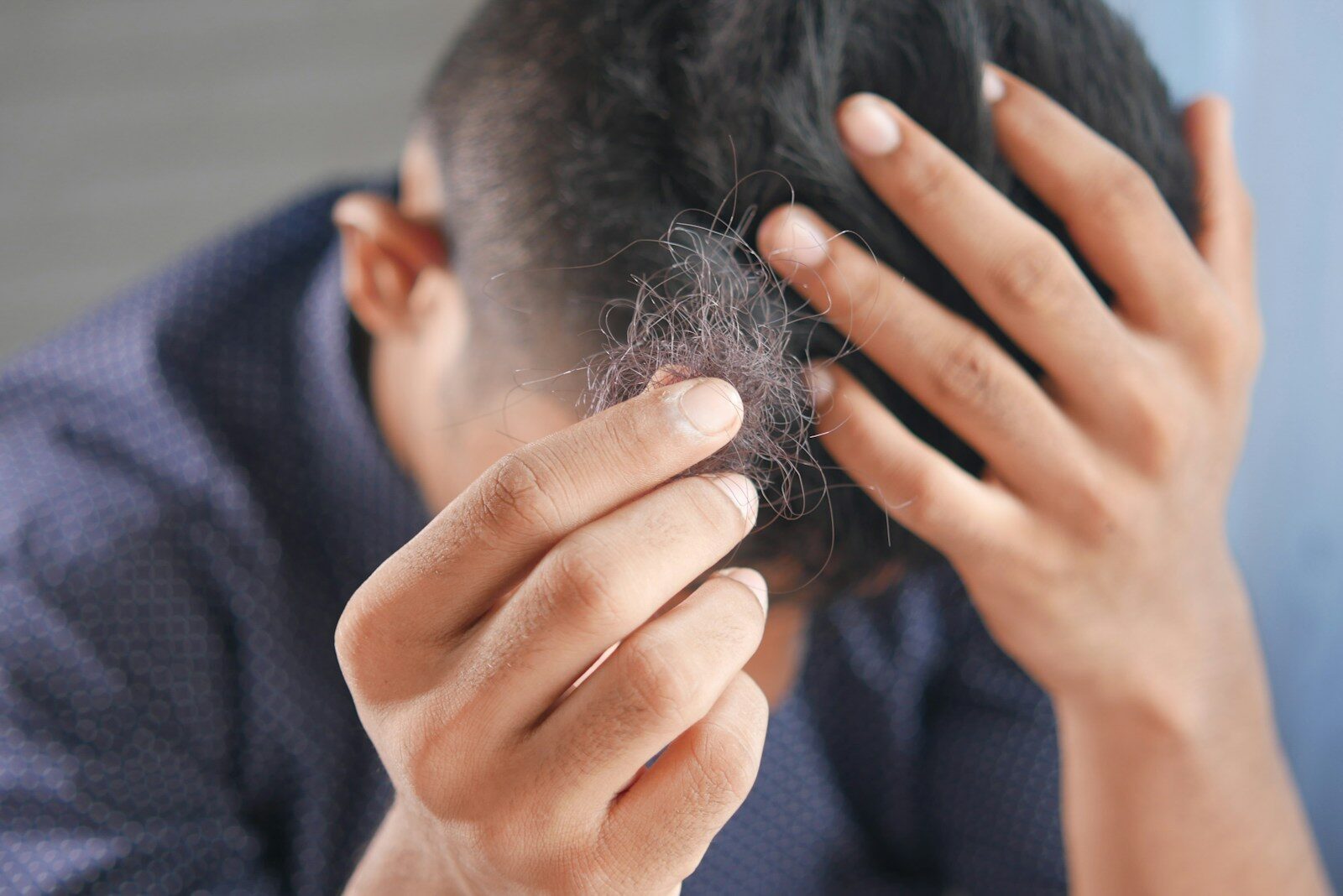
Seeing white flakes on your shoulders is annoying enough, but when you also start finding more hair on your pillow, comb, or bathroom floor, it is natural to wonder whether dandruff is causing your hair to fall.
The short answer is that dandruff itself is not usually a direct cause of permanent hair loss. However, an irritated, itchy, inflamed scalp can contribute to increased shedding and hair breakage, especially when you repeatedly scratch or damage the scalp.
There is also another important possibility: what looks like ordinary dandruff may actually be another scalp condition that needs different treatment.
Understanding what is happening on your scalp can therefore be much more useful than simply trying another home remedy.
Dandruff is a common scalp condition that causes flaking. It can be associated with oily skin, dry skin, sensitivity to hair products, or an overgrowth of a yeast called Malassezia that normally lives on the skin.
Some people have only mild flakes, while others experience significant itching, redness, greasy scaling, or recurring irritation.
The first thing to understand is that seeing hair in the shower does not automatically mean dandruff is causing hair loss.
Most people naturally shed hair every day. Washing your hair can make those already-shed hairs suddenly visible.
If you wash your hair after several days, you may see a larger collection of loose hairs at once.
This can look alarming, but the number of hairs visible during one shower does not necessarily represent the amount of hair your scalp is losing that day.
Dandruff becomes more relevant when itching and inflammation are involved.
When your scalp feels itchy, you may instinctively scratch it with your fingernails.
Repeated scratching can irritate the skin and can also physically damage fragile hairs near the scalp.
If the scratching is aggressive, it can cause small injuries and create more inflammation.
That can make the scalp feel even more uncomfortable, creating a cycle of itching and scratching.
Another problem is that people sometimes use harsh DIY treatments to remove flakes.
They may scrub the scalp aggressively, apply concentrated lemon juice, baking soda, vinegar, undiluted essential oils, or other irritating ingredients.
These approaches can make scalp irritation worse.
A flaky scalp does not need to be attacked.
It needs an appropriate, gentle approach based on the underlying cause.
Dandruff can also make the hair appear thinner because flakes and oil can affect how the hair sits.
When the scalp is greasy or heavily covered with scale, strands may clump together.
This can make more scalp visible and create the impression that the hair has suddenly become much thinner.
Once the scalp condition improves, the hair may look fuller again without any actual increase in follicle count.
This is one reason it is useful to distinguish appearance from true hair loss.
There is also an important difference between shedding and breakage.
Shedding occurs when a hair completes its growth cycle and leaves the follicle.
Breakage happens when the hair shaft snaps.
Dandruff-related scratching, rough washing, aggressive towel drying, and excessive styling can contribute to breakage.
You may notice short broken hairs around your scalp rather than complete strands.
If your hair is breaking, improving hair-care habits can make a meaningful difference.
If you are experiencing progressive thinning from the follicle, however, you need to consider other causes.
One of the most common causes of progressive thinning is hereditary pattern hair loss.
In men, it often appears as a receding hairline, temple recession, or thinning at the crown.
In women, it can appear as widening of the part or diffuse thinning over the top of the scalp.
Dandruff and genetic hair loss can occur at the same time.
Having dandruff does not mean that every change in your hair density is coming from your scalp flakes.
This is particularly important because treating dandruff may improve scalp comfort without stopping hereditary hair loss.
The reverse is also true.
Someone may have genetic hair loss and assume that dandruff is responsible because they happen to notice flakes at the same time.
The two conditions need to be considered separately.
One of the simplest ways to support a dandruff-prone scalp is to wash it appropriately.
How often you need to wash depends on your scalp, hair type, oil production, and the severity of your symptoms.
People with oily scalps may need more frequent washing than people with very dry or tightly curled hair.
Avoid the idea that washing less is always better for hair fall.
Shampooing does not normally cause hereditary hair loss.
It simply removes oil, flakes, styling products, and hairs that have already detached from the follicle.
The type of shampoo matters too.
If you have persistent dandruff, an anti-dandruff shampoo containing an appropriate active ingredient may be more useful than an ordinary cosmetic shampoo.
Different products work in different ways, and some people respond better to one active ingredient than another.
Common anti-dandruff ingredients include ketoconazole, selenium sulfide, zinc pyrithione, salicylic acid, and coal tar, depending on the product and where you live.
Follow the product instructions carefully.
Some medicated shampoos need to remain on the scalp for several minutes before rinsing so that the active ingredient has enough contact time.
Using more shampoo than recommended does not necessarily make the treatment work faster.
If your scalp becomes significantly irritated after using a product, stop and consider whether another approach is appropriate.
Some people rotate different anti-dandruff shampoos when one product stops being effective or does not adequately control their symptoms.
However, persistent or severe symptoms deserve professional advice rather than endless product experimentation.
You should also avoid scratching.
This sounds simple, but it can be difficult when the scalp is intensely itchy.
Instead of using your fingernails, try gently pressing or massaging the area with your fingertips.
Keep your nails short if you tend to scratch unconsciously.
The goal is to reduce mechanical damage while the underlying scalp problem is being addressed.
Be careful with scalp scrubs as well.
Physical exfoliation is heavily marketed as a way to “deep clean” the scalp, but aggressive scrubbing can cause irritation.
If you have active inflammation or severe dandruff, harsh exfoliation may make things worse.
Gentle cleansing is usually a safer approach.
Hair oils can also be tricky for people with dandruff.
Some people find oiling their hair lengths helpful for dryness, but applying heavy oils directly to a dandruff-prone scalp may not be appropriate for everyone.
If you notice that your scalp becomes greasier or more irritated after oiling, stop applying oil to the scalp.
Hair oil is not a treatment for every type of dandruff.
Another common mistake is using lemon juice on the scalp.
Lemon is acidic and can irritate sensitive skin, especially when used in concentrated form.
It is not necessary to burn or sting the scalp to remove flakes.
The same warning applies to baking soda.
Baking soda is alkaline and can disrupt the scalp’s normal environment while causing dryness or irritation in some people.
There is no advantage to making your scalp uncomfortable simply because a DIY remedy is popular online.
Apple cider vinegar is another frequently recommended remedy.
Although diluted vinegar is sometimes promoted as a scalp cleanser, it is not a universal dandruff treatment, and concentrated vinegar can irritate the skin.
If your dandruff is persistent, a properly formulated anti-dandruff product is generally more predictable than experimenting with kitchen ingredients.
Tea tree oil is also frequently discussed.
Some research has explored tea tree oil-containing preparations for dandruff, but concentrated tea tree oil can cause skin irritation or allergic reactions.
If you use a product containing it, choose a properly formulated product rather than applying undiluted essential oil directly to your scalp.
Aloe vera may feel soothing to some people, but it should not be treated as a guaranteed cure for dandruff or hair loss.
The key is to distinguish temporary comfort from treating the underlying condition.
If you have occasional mild flakes, improving your scalp-care routine may be enough.
If the flakes repeatedly return, become thick or greasy, or occur with significant itching and redness, you may need a more targeted treatment.
There are several scalp conditions that can resemble dandruff.
Seborrheic dermatitis can cause persistent flaking and inflammation, often affecting oily areas such as the scalp.
Psoriasis can cause thicker, well-defined scales and may extend beyond the hairline.
Eczema and contact dermatitis can also cause itching, redness, and scaling.
A fungal infection can sometimes cause scaling and hair loss in patches.
These conditions are not all treated in the same way.
This is why severe or unusual scalp symptoms should not simply be labelled “dandruff.”
One warning sign is patchy hair loss.
If you notice a clearly defined bald patch rather than general shedding, you should not assume dandruff is responsible.
Another warning sign is scalp pain or burning.
Persistent redness, swelling, crusting, bleeding, sores, or pus also deserves medical attention.
If you have significant scaling combined with hair loss, particularly if the hair is breaking close to the scalp, a professional examination can help identify the cause.
Children with scalp scaling and hair loss should receive medical evaluation because certain fungal scalp infections can require prescription treatment.
Adults can also develop scalp infections, so sudden patchy loss with scaling should not be ignored.
Stress can complicate the picture as well.
Stress does not necessarily cause dandruff directly, but stress can affect how people manage their scalp and may worsen scratching or disrupt healthy routines.
Major physical or emotional stress can also trigger a separate type of temporary shedding called telogen effluvium.
If you experienced an illness, major stress, surgery, or significant weight loss a few months before increased shedding, that history may be relevant.
This is another reason why timing matters.
If you have had dandruff for years but your hair suddenly started shedding heavily after a major illness, the flakes may not be the main explanation.
You could be dealing with temporary shedding alongside an existing scalp condition.
Nutrition is another factor worth considering.
A balanced diet provides the protein and nutrients needed for normal hair growth.
Severe dietary restriction or inadequate protein intake can contribute to hair shedding.
However, you should not assume that every case of dandruff-related hair loss is caused by a vitamin deficiency.
Taking large amounts of supplements without identifying a deficiency is unlikely to solve the underlying problem.
Biotin supplements are particularly overmarketed for hair growth.
Unless a person has a deficiency or another specific medical reason to take it, high-dose biotin is not a guaranteed solution for hair loss.
Some high-dose supplements can also interfere with blood test results.
If you are concerned about nutrition, a healthcare professional can help determine whether testing or supplementation is appropriate.
Sleep and stress management are also useful parts of a healthy routine.
They are not direct dandruff cures, but improving overall health can support your body’s normal functions.
Try to maintain a consistent sleep schedule and find realistic ways to manage ongoing stress.
Exercise can also be helpful for general health.
None of these habits should be marketed as replacements for treating a scalp condition.
They are supportive habits rather than specific dandruff medications.
Hair styling deserves attention too.
If you have an itchy scalp, avoid excessive heat and harsh chemical treatments while the scalp is irritated.
Bleaching, relaxing, and frequent high-heat styling can weaken the hair shaft.
If the hair is already fragile, these treatments can increase breakage.
A gentle routine gives your hair a better chance to remain intact.
When drying your hair, avoid aggressive towel rubbing.
Instead, gently squeeze out excess water and pat the hair dry.
Wet hair can be more vulnerable to stretching and mechanical damage.
Use a wide-tooth comb when appropriate and detangle gently.
These small habits may not treat dandruff directly, but they can reduce unnecessary breakage that adds to the appearance of hair loss.
You should also clean items that come into frequent contact with your scalp.
Wash pillowcases regularly and keep combs and brushes reasonably clean.
Do not share combs, brushes, hats, or other personal hair-care items if there is a possibility of a contagious scalp infection.
However, do not become obsessed with sterilizing everything.
Ordinary hygiene is generally sufficient for routine dandruff.
Another question people often ask is whether dandruff can cause permanent baldness.
Ordinary dandruff does not typically destroy hair follicles and cause permanent baldness.
The concern changes if severe inflammation, infection, or another scalp disease damages follicles.
Certain inflammatory or scarring scalp disorders can lead to permanent hair loss if not treated.
That is why unusual symptoms should be evaluated rather than repeatedly treated as ordinary dandruff.
If your hair is thinning at the temples or crown while you also have dandruff, consider the possibility of two separate issues.
Dandruff treatment can improve your scalp.
A separate hair-loss treatment may be needed for pattern hair loss.
Treating one does not necessarily treat the other.
If your hair loss is progressing, early evaluation can be valuable.
For some forms of pattern hair loss, treatments such as minoxidil may help slow progression or encourage regrowth in appropriate individuals.
The treatment needs to be used consistently and may take months before meaningful changes become visible.
It is not appropriate for every person or every cause of hair loss.
That is why diagnosis matters.
You should also be cautious about social-media claims that a particular dandruff shampoo will regrow all lost hair.
An anti-dandruff shampoo can help manage dandruff.
That does not mean it can reverse hereditary hair loss.
Likewise, a hair-growth serum may make the hair feel conditioned without treating an inflammatory scalp disorder.
Choose products according to the problem you are actually trying to solve.
If your main problem is flakes and itching, address the scalp.
If your main problem is progressive thinning, investigate the cause of the hair loss.
If your main problem is breakage, improve hair-shaft care.
Sometimes more than one problem is happening at the same time.
So, can dandruff cause hair fall?
It can contribute indirectly, particularly through itching, scratching, inflammation, and breakage, but persistent or significant hair loss should not automatically be blamed on dandruff.
The safest approach is to control the scalp condition while paying attention to the pattern and severity of the hair loss.
If the flakes are mild, start with gentle scalp care and an appropriate anti-dandruff routine.
If symptoms are persistent or severe, seek professional advice.
And if you notice sudden patchy hair loss, rapid thinning, scalp pain, burning, sores, crusting, bleeding, or significant inflammation, do not rely only on home remedies.
Healthy hair starts with understanding what is happening at the scalp and inside the hair follicle.
Instead of chasing every viral hair remedy, focus on simple habits that reduce irritation and breakage, use evidence-based treatments when necessary, and give your hair enough time to recover.
Dandruff may be uncomfortable, but it does not automatically mean that your follicles are being permanently damaged.
The sooner you identify whether you are dealing with ordinary dandruff, another scalp condition, temporary shedding, breakage, or hereditary hair loss, the easier it becomes to choose the right solution.