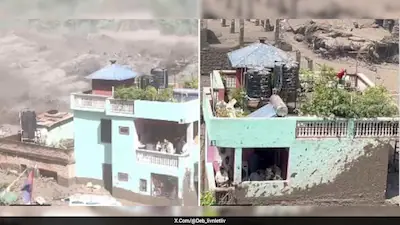
A small green-painted house that remained standing in the middle of Nepal’s devastating flash floods has become one of the most widely discussed images from the disaster. Videos showing the building surrounded by fast-moving water, mud and debris have spread rapidly across social media, leaving viewers asking one question: how did this particular house survive when so many nearby structures were destroyed?
The footage shows a terrifying scene. A powerful torrent carrying mud, rocks, uprooted trees and pieces of damaged buildings moves through the area, while several people can be seen sheltering on the upper part of the green house.
Buildings and other structures around it appear to have suffered severe damage, with some being swept away by the force of the flood. Yet the green house remained standing.
The survival of both the building and the people inside it quickly attracted widespread attention. The incident was not simply a case of a structure escaping floodwater. The available engineering analysis suggests that the building’s construction and its position relative to the main flow of debris both played important roles.
The house was reportedly located in Nuwakot in Nepal’s Bagmati Province, an area badly affected by the recent flash-flood disaster. The surrounding devastation made the building’s survival particularly striking.
In the viral footage, the floodwater appears to pass around the structure while the occupants remain on the upper level. The lower part of the building is exposed to the rushing water, but the main structure does not appear to collapse.
A later video reportedly showed the same house still standing and helped ease concerns about the people who had been seen sheltering there. Reports said the family survived the incident.
The explanation for the building’s survival begins with its structural design.
According to an engineering analysis circulated by Architecture Presentation and reported by NDTV, the house was built using a reinforced-concrete frame with steel reinforcement connecting the major structural elements.
This is an important difference from many traditional masonry structures found in Himalayan regions.
Traditional stone or masonry buildings can be effective at carrying loads from above, but their resistance to powerful sideways forces can be considerably lower if they lack a properly designed structural frame.
A flash flood containing large amounts of mud, rocks and debris creates forces that are very different from ordinary rainfall or a normal river rise.
Instead of water simply flowing around a building, a debris-laden torrent can strike walls with considerable lateral force. Large rocks, tree trunks and pieces of destroyed structures can also hit buildings directly.
When an unreinforced masonry structure is exposed to such forces, individual walls can crack, separate or collapse.
A reinforced-concrete frame works differently.
The green house reportedly had continuous steel reinforcement connecting its columns, beams and foundation. This creates a structural skeleton that allows the building to behave more like a single unit.
When a powerful force strikes the structure from the side, the load can be distributed through the frame instead of being absorbed entirely by individual walls.
In simple terms, the building’s strength was not dependent only on its walls. The columns, beams, reinforcement and foundation worked together to provide greater structural stability.
This does not mean that reinforced concrete makes a building completely flood-proof.
No ordinary building can be considered automatically safe against an extreme debris flow. The survival of this particular house resulted from several factors working together, including its structural system and its position.
The location of the house appears to have been another important factor.
The engineering analysis suggests that the building was not directly in the deepest part of the main debris channel. It was reportedly positioned slightly away from the strongest central flow and on somewhat higher ground.
This distinction can make a major difference during a debris flow.
Floodwater does not necessarily move with equal force across the entire affected area. The deepest section of a channel can carry the greatest concentration of water, mud, rocks and other heavy material.
Large boulders and other debris are often concentrated toward the strongest part of the flow.
A building positioned outside that main channel may therefore experience a different level of force from one directly in its path.
The green house appears to have benefited from precisely this kind of positioning.
Its relatively compact shape may also have helped the floodwater divide around it instead of striking the entire structure with maximum force from one direction.
As the torrent moved past the building, mud and debris accumulated around parts of the structure.
According to the engineering explanation, the deposited material may have helped redirect later surges around the house instead of allowing the strongest flow to hit it directly.
This means the survival of the house cannot be explained by concrete alone.
A similarly constructed building placed directly in the centre of a powerful debris flow could face a much greater risk of severe damage or collapse.
Likewise, a building in a favourable location but with a weak structural system could still fail under extreme conditions.
The green house appears to have benefited from both factors.
Its reinforced frame gave it greater resistance to lateral forces, while its position reduced the intensity of the direct impact.
The incident has therefore become an unexpected real-world example of how structural engineering and site selection can influence the outcome of a natural disaster.
The viral footage has also generated several claims on social media that require caution.
Some posts began describing the building as a “pastor’s house” and presented its survival as evidence of divine intervention.
There is no verified evidence establishing that the house belonged to a Christian pastor.
Fact-checking of the viral claims found no official report identifying the occupants as a pastor or confirming the religious narrative that spread online. The claim that this was the only building left standing in the area has also been described as inaccurate because other structures can be seen surviving in the wider surroundings.
The religious claims should therefore be separated from the confirmed facts surrounding the incident.
What can be established from the available footage and reporting is that a green house remained standing during a devastating flood and that people sheltering inside survived.
The engineering explanation provides a more practical reason for the building’s resilience.
The incident also highlights the difference between a conventional flood and a flash flood carrying heavy debris.
Ordinary floodwater can rise gradually, allowing people to evacuate and structures to experience relatively lower flow velocities.
A flash flood can behave very differently.
Water can move through narrow valleys at extremely high speeds while carrying rocks, mud, trees and other material. The resulting force can be closer to a moving mass of debris than to a normal river current.
This is why buildings located near river channels, drainage paths and steep mountain valleys can face serious risks during extreme rainfall or sudden upstream events.
The recent disaster in Nepal demonstrated this destructive potential on a huge scale.
Communities were struck by torrents that destroyed buildings, roads, bridges and other infrastructure. In some areas, the combination of water and debris left extensive destruction within a very short period.
Against that background, the survival of one building becomes especially striking.
The footage does not show that the house was completely untouched.
The floodwater reportedly damaged doors and windows and passed through the lower part of the structure. What made the incident remarkable was that the primary structural frame remained intact.
This distinction is important.
A building can suffer significant non-structural damage while its main load-bearing system remains stable.
Doors, windows, walls and interior fittings can be damaged without necessarily causing the entire building to collapse.
The survival of the green house appears to have followed this pattern.
The structural skeleton remained sufficiently stable to withstand the forces it experienced, even though the surrounding area was severely damaged.
The incident also raises questions about construction practices in areas vulnerable to floods and landslides.
In mountain regions, the location of a building can be just as important as its materials.
Constructing a strong building directly inside a known flood channel does not eliminate the risk.
Engineers therefore consider factors such as terrain, elevation, drainage paths, river behaviour, soil stability and potential debris-flow routes when assessing sites.
A building placed slightly higher or away from the primary flow path may have a much better chance of avoiding the strongest forces.
This is particularly important in Himalayan regions, where steep slopes can channel enormous quantities of water and debris into narrow valleys.
The recent disaster has also renewed attention on the need for better hazard mapping and early-warning systems in mountain communities.
Residents cannot rely solely on the strength of their homes for protection against extreme natural events.
Early warnings can provide people with valuable time to move to safer locations.
Even a well-engineered building has limits.
The green house survived this particular event, but its survival should not be interpreted as proof that reinforced-concrete houses are safe against all flash floods.
Structural design must be based on local hazards, expected loads and proper engineering standards.
The condition of foundations is also critical.
A strong superstructure can still fail if floodwater erodes the soil around the foundation or undermines the ground supporting the building.
Foundation stability is therefore a major consideration in flood-prone areas.
The green house appears to have retained its foundation despite the enormous forces around it.
That may have been one of the most important reasons the building remained standing.
If the foundation had been undermined, even a strong reinforced-concrete frame could have become unstable.
The shape of the terrain may also have influenced the flow.
Water and debris naturally follow paths of least resistance. Small changes in elevation can redirect a torrent, sometimes protecting one structure while exposing another nearby building to much greater force.
This helps explain why two buildings located relatively close to each other can experience completely different outcomes during the same flood.
One may be directly struck by the main debris flow, while another may sit just outside the strongest channel.
That appears to be one of the lessons from the viral Nepal house.
Its survival was not necessarily mysterious. It may have been the result of a combination of engineering, location and the unpredictable movement of the flood.
The incident has also generated discussion about whether the building was specially designed to resist floods.
There is currently no evidence that the house was constructed specifically as a flood-resistant structure.
Its reinforced-concrete frame may have been a standard structural choice rather than a specialised disaster-resistant design.
The fact that it survived does not necessarily mean the owners anticipated an event of this magnitude.
Instead, the building’s conventional structural features appear to have provided unexpected protection during an extreme event.
The story also illustrates why engineering standards matter in regions exposed to natural hazards.
Properly connected columns, beams and reinforcement can help a structure distribute forces more effectively.
However, workmanship is equally important.
The strength of reinforced concrete depends on factors such as reinforcement placement, concrete quality, connections, foundation design and adherence to construction standards.
A building that uses concrete but has poor structural detailing may not perform as expected during a disaster.
The green house therefore should not be viewed simply as a case of “concrete versus stone.”
The complete structural system matters.
Another important issue is the difference between reinforced masonry and unreinforced masonry.
Some masonry buildings can have strong structural performance when properly reinforced and designed according to seismic and flood-related requirements.
The risk depends on the construction system, materials, connections, foundation and environmental conditions.
The viral incident has nevertheless highlighted the vulnerability of traditional masonry buildings when subjected to extreme lateral forces.
For communities in flood-prone Himalayan valleys, improving building standards could be an important part of long-term disaster preparedness.
But construction improvements need to be combined with land-use planning.
People should ideally avoid building directly in areas known to be exposed to flash floods and debris flows.
Where relocation is not practical, authorities can consider protective infrastructure, improved drainage, retaining systems, early-warning networks and clearly marked evacuation routes.
The survival of the green house has attracted millions of views partly because it offers a rare moment of relief amid a disaster filled with devastating images.
The videos initially caused concern because people could see a family trapped on the upper part of the house while the flood moved around them.
Later footage reportedly showing the house still standing provided some reassurance.
For viewers, the image was extraordinary because the structure appeared almost isolated in a landscape of destruction.
Yet the incident also carries an important warning.
A house surviving one extreme flood does not mean the location is safe.
The same area may face another flood, landslide or debris flow in the future.
People living in mountain valleys need reliable warnings and evacuation plans regardless of how strong their homes appear.
The viral green house has therefore become more than an unusual social-media story.
It has provided a practical example of how buildings interact with extreme natural forces.
Its reinforced frame appears to have helped distribute lateral loads, while its position away from the deepest part of the debris flow reduced the direct impact.
The surrounding mud and debris may then have helped redirect subsequent flows.
Together, these factors appear to explain why the building survived while many nearby structures were damaged or swept away.
At the same time, the story should not be reduced to a simple claim that engineering alone saved the house.
The exact forces experienced by the building cannot be reconstructed completely from a viral video.
A detailed engineering assessment would require information about the building’s drawings, materials, foundation, soil conditions, flood depth, flow velocity and the exact path of the debris.
The publicly available explanation should therefore be understood as an informed structural analysis rather than a complete forensic investigation of the building.
What remains clear is that the house’s survival was remarkable.
While floodwater carried mud, rocks, trees and debris through the surrounding area, the green building remained standing long enough for the people inside to survive.
The incident has now become one of the most memorable images from Nepal’s devastating flash floods.
It has also demonstrated why structural design, site selection and disaster preparedness matter so much in areas exposed to extreme natural hazards.
The viral claims surrounding the house should be treated carefully, particularly claims about its ownership or religious significance.
The strongest evidence points toward a combination of reinforced construction and favourable positioning rather than an unverified explanation.
For the family that sheltered inside, however, the engineering details mattered less in those terrifying moments than simply surviving.
As the flood raged around them, their house remained standing.
That extraordinary outcome has now given engineers, disaster experts and the public a rare opportunity to examine how one structure resisted a force powerful enough to destroy much of what surrounded it.
The lesson is not that any particular type of house can withstand a catastrophic flash flood.
The more important lesson is that properly designed structures, safer building locations and effective disaster planning can all reduce risk.
In Nepal’s vulnerable Himalayan terrain, those lessons could become increasingly important as communities face the continuing threat of floods, landslides and other extreme events.
The green house survived when many nearby structures fell, but its story is ultimately a reminder of both the power of engineering and the limits of relying on a building alone when nature unleashes an extreme flash flood.