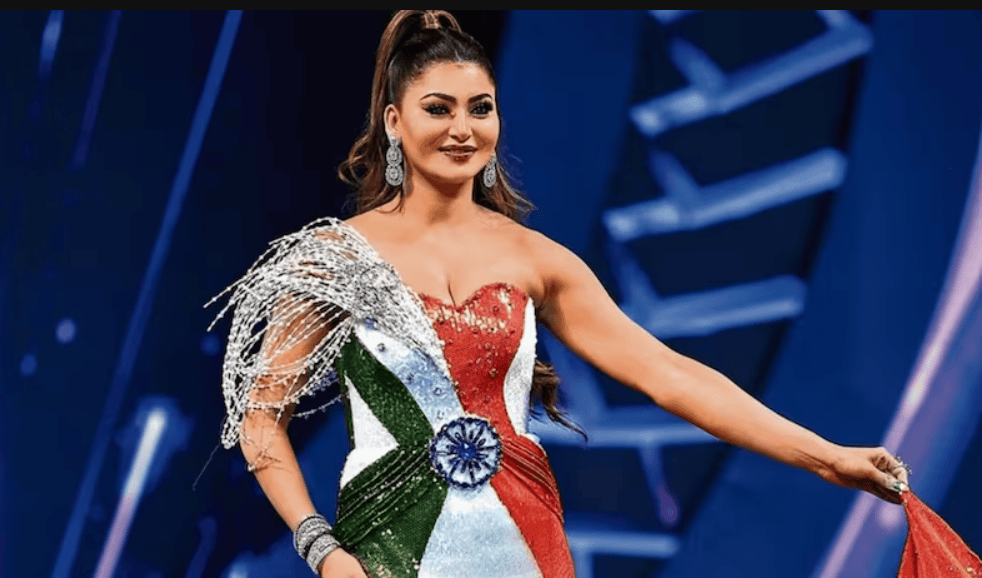
Urvashi Rautela has found herself at the centre of a fresh fashion controversy after wearing a Tiranga-inspired gown at the Miss Universe India 2026 grand finale in Jaipur. The actress and former beauty queen appeared as a jury member at the event, where her saffron, white and green outfit featuring an Ashok Chakra-inspired design quickly became a talking point on social media.
The strapless, floor-length gown was designed around the colours associated with India’s national flag. It featured saffron and green panels, a white section and a blue circular motif inspired by the Ashok Chakra. The outfit was further decorated with embellishments and detailing that gave it a couture-style appearance.
According to reports, the gown took approximately three months to create. Belarusian designer Darya Chermashentseva of Dasha Fashion Couture created the outfit, with the design intended to transform the visual elements associated with the national flag into a high-fashion presentation.
Rautela described the outfit as an artistic expression of her connection with India. She said the intention was not simply to place three colours on a dress but to represent what India means to her through couture and fashion.
The fashion statement, however, received mixed reactions. While some people appreciated the patriotic theme and the elaborate craftsmanship, others questioned whether using the colours and symbols associated with the national flag in a gown was appropriate.
The controversy became particularly focused on the Ashok Chakra-inspired element and the way the colours were incorporated into the lower portion of the gown. Some social media users argued that such use could conflict with provisions concerning the respectful treatment of the national flag.
Rautela subsequently defended the outfit and stressed that it was not a literal reproduction of the Indian National Flag. She pointed to differences in the placement of colours, materials, proportions, embellishments and overall construction of the gown.
The actress also explained that the design used the tricolour as inspiration rather than attempting to recreate the national flag itself. Her response came after the outfit generated criticism online and questions about whether fashion incorporating national symbols crosses a line between patriotic expression and disrespect.
The debate has also brought older examples of Indian fashion involving the national flag back into public discussion. One of the cases referenced in the latest controversy is Mandira Bedi’s tricolour-themed saree.
Bedi’s saree became widely discussed years ago because it incorporated the flags of countries participating in a cricket tournament. The outfit was worn in a sporting context and was subsequently criticised because of how one of the Indian flag elements appeared in relation to the garment.
Designer Puneet Nanda later apologised over the controversy surrounding the saree. Bedi also clarified that she had specifically chosen the design because it represented all 16 countries participating in the tournament, rather than intending to disrespect India’s national flag.
The older incident has resurfaced because it raises a question similar to the one being debated in Rautela’s case: where should fashion draw the line when national symbols are incorporated into clothing?
Another, much older example involves designer Malini Ramani. Her tricolour-inspired outfit has also been cited in discussions about fashion and the Indian flag.
Ramani reportedly wore an outfit consisting of an orange top, a central wheel-like motif and a green skirt during an event associated with India’s first fashion week. The outfit generated substantial controversy at the time and led to demands for action over what critics considered inappropriate use of the national flag’s imagery.
The controversy surrounding Ramani’s outfit reportedly became serious enough to generate calls for a public apology and wider action against the fashion event. The episode remained a notable example of how national symbols can become contentious when incorporated into fashion.
The three incidents are separated by years, but they share a common theme. Designers and celebrities have repeatedly used India’s national colours as a way of expressing patriotism, while critics have argued that national symbols should be treated with a level of dignity that may not always fit conventional fashion.
In Rautela’s case, the distinction between the national flag and a flag-inspired design has become central to the discussion. Her position is that the gown represents an artistic interpretation rather than an actual national flag.
The legal question is more complicated than simply identifying the colours used in a garment. India’s Flag Code contains rules concerning the display and use of the national flag, while the Prevention of Insults to National Honour Act, 1971, also addresses improper treatment of the national flag.
The Flag Code of India states that the national flag should not be used as a portion of costume or uniform. It also contains provisions concerning the use of representations of the flag on articles of clothing and other materials.
However, the precise legal status of a particular fashion design depends on whether it actually constitutes the national flag or an impermissible representation of it, along with the circumstances in which it is used. A gown merely containing saffron, white and green colours is not automatically identical to the national flag.
This distinction is important because the Indian flag has a specific design, proportions and arrangement. The national flag consists of three horizontal rectangular panels with the Ashoka Chakra positioned in the centre of the white band.
Rautela’s gown, by contrast, was presented as a stylised couture design with different colour placement, embellishments and construction. She has specifically relied on those differences in defending herself against criticism.
The controversy nevertheless demonstrates how sensitive the use of national symbols remains in India. The Tricolour has an emotional and symbolic significance that goes beyond its visual appearance, meaning that even artistic interpretations can generate strong reactions.
Rautela’s appearance at the Miss Universe India 2026 finale also gave the outfit a particularly high-profile platform. She was not attending an ordinary fashion event; she was part of the jury at a national beauty pageant and walked before an audience following the competition.
Her association with beauty pageants also added significance to the appearance. Rautela is a former beauty queen and has continued to remain involved with pageants after her own competition career.
At this year’s Miss Universe India event, she served on the jury alongside Sushmita Sen and Celina Jaitly. The occasion was therefore both a professional appearance and an important fashion moment for Rautela.
The event itself was also significant because the winner of Miss Universe India 2026 was selected to represent India at the international Miss Universe competition. Rautela’s presence as a judge placed additional attention on her appearance and comments.
Her outfit was initially praised by sections of the audience for its patriotic theme and elaborate styling. Images of the gown quickly circulated online, bringing both appreciation and criticism.
The controversy illustrates how social media can rapidly transform a celebrity fashion appearance into a national debate. A garment that might otherwise have been discussed primarily in terms of design, craftsmanship and styling instead became the subject of questions about patriotism, cultural sensitivity and legal rules.
Rautela has maintained that her intention was respectful. Her explanation focuses on the idea that the gown was designed as a tribute to India rather than as a replacement or replica of the national flag.
That distinction has not ended the debate. Some critics continue to believe that national colours and symbols should not be incorporated into clothing in a way that could diminish their dignity, while supporters argue that artistic interpretations can also represent national pride.
The older Mandira Bedi and Malini Ramani examples show that this tension is not new. Indian fashion has repeatedly experimented with the Tricolour, and each instance has raised questions about where patriotic expression ends and inappropriate use begins.
For designers, the challenge is particularly complex. The saffron, white and green combination is visually distinctive and naturally lends itself to patriotic themes, especially around national events, sporting occasions and international competitions.
At the same time, the Ashoka Chakra is not simply another decorative circular symbol. It is a central element of India’s national flag and therefore carries a significance beyond ordinary fashion design.
Rautela’s gown attempted to reinterpret that symbolism through couture, but the decision to include an Ashok Chakra-inspired motif inevitably drew attention to the relationship between the outfit and the national flag.
The discussion also highlights the difference between public perception and legal interpretation. An outfit may offend or upset some people without necessarily constituting a criminal offence, while questions of legality depend on the specific provisions that apply and the facts of the case.
No criminal finding against Rautela has been established in connection with the gown. The current controversy is primarily a public debate over the appropriateness of the design and questions raised about the Flag Code.
For now, Rautela’s explanation remains that the gown was intended as a high-fashion tribute to India. She has emphasised that the design was an interpretation rather than a literal reproduction of the national flag.
The incident has nevertheless reopened a much older conversation in Indian fashion. From Mandira Bedi’s cricket-themed saree to Malini Ramani’s controversial tricolour outfit and now Rautela’s couture gown, the use of national colours in clothing continues to occupy a complicated space between fashion, patriotism and national symbolism.
As the debate continues online, the larger question is not simply whether the colours saffron, white and green can be used in fashion. It is about how national symbols should be represented and what level of care should be exercised when designers and celebrities turn those symbols into public-facing fashion statements.
For Rautela, what was intended as a patriotic fashion moment has instead become one of the most discussed aspects of her recent public appearance. Her defence has made her position clear, but the debate over the limits of Tiranga-inspired fashion is likely to continue well beyond this particular gown.