
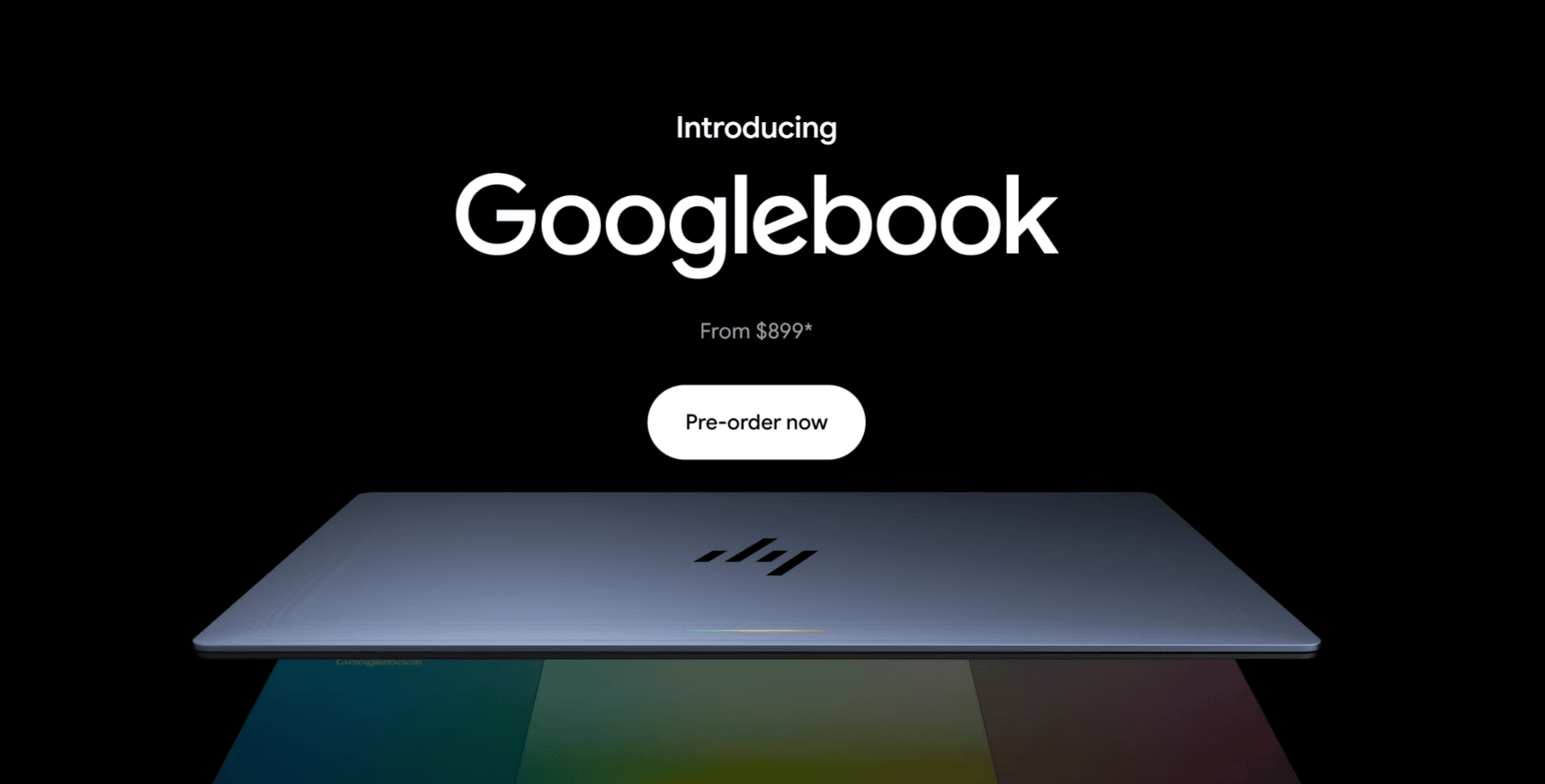
Google is entering a new phase of personal computing with Googlebook, a new category of Android-based laptops designed around Gemini Intelligence, native Android applications and deeper connectivity with smartphones.
Qualcomm has confirmed that its Snapdragon X Elite platform will power the first Googlebook laptops from Dell and HP. The collaboration combines Qualcomm’s Arm-based PC platform with Google’s Gemini AI experience and Android ecosystem, creating laptops designed to work more closely with the Android phones users already own.
The first Snapdragon-powered Googlebook models from Dell and HP are already available for pre-order, marking an important expansion of Qualcomm’s PC strategy beyond traditional Windows laptops.
What Is Googlebook?
Googlebook is Google’s new category of laptops built on an Android-based computing platform.
Unlike conventional Chromebooks, which are based around ChromeOS, Googlebook is designed to bring native Android apps, Gemini Intelligence and deeper Android phone integration into a laptop form factor. Qualcomm’s own Googlebook platform page describes it as an Android-based laptop category that combines native Android app support with premium performance and built-in Gemini AI experiences.
Google is not positioning Googlebook as a replacement for Chromebooks. Instead, both product categories are expected to coexist, with Googlebook targeting users who want a more connected Android-centric laptop experience.
That distinction is important because Googlebook is attempting to solve a problem that Android users have faced for years: the lack of the same deep laptop-and-phone integration that Apple offers between the iPhone and Mac.
Snapdragon X Elite Powers the First Googlebooks
Qualcomm’s Snapdragon X Elite is at the heart of the first generation of Googlebook devices.
The platform combines a high-performance CPU and GPU with Qualcomm’s Hexagon NPU, giving Googlebook hardware dedicated processing capabilities for AI workloads. Qualcomm says Snapdragon X Elite provides the performance, efficiency and NPU capabilities required for the new platform’s Gemini-powered experiences.
The Snapdragon X Elite is based around Qualcomm’s Oryon CPU architecture and is designed for high-performance, low-power computing.
For Googlebook, however, the NPU is particularly important because Google’s new software experience relies heavily on AI.
Googlebook Is Built Around Gemini Intelligence
Gemini is not being treated simply as another application on Googlebook.
Google and Qualcomm are positioning Gemini Intelligence as a core part of the laptop experience, with AI features designed to understand what’s happening on the device and provide contextual assistance.
The objective is to make AI useful during normal laptop workflows rather than requiring users to constantly open a separate chatbot.
Googlebook can use Gemini for tasks involving information on the screen, personal productivity and interactions between the laptop and connected Android devices.
Magic Pointer
One of the most interesting Googlebook features is Magic Pointer.
The feature allows users to interact with content on the screen and use Gemini to analyse, compare or create something based on what they have selected.
For example, a user could select content or an object on the screen and ask Gemini to help understand it or generate something related to it.
This type of contextual interaction could make AI considerably more useful than a traditional standalone chatbot because the user does not necessarily need to explain what is already visible on the screen.
Rambler
Googlebook also introduces Rambler, a voice-oriented Gemini feature designed to turn less structured thoughts into more organised text.
Qualcomm says Googlebook features such as Magic Pointer and Rambler are designed to keep users productive without forcing them to break their workflow.
The idea is particularly relevant for users who prefer speaking their ideas instead of typing everything manually.
Native Android Apps Are a Major Part of Googlebook
One of Google’s biggest advantages with this platform is its existing Android application ecosystem.
Googlebook supports native Android applications, meaning users can run apps from the Android ecosystem directly on the laptop rather than depending entirely on web versions.
Qualcomm says Googlebook supports thousands of native Android applications and games.
This could make the platform particularly attractive to Android users who already rely heavily on mobile applications.
Google Play Apps on a Laptop
Googlebook’s software experience is designed to make familiar Android applications available in a larger laptop environment.
Users can therefore potentially move between phone and laptop without having to find a completely different desktop application for every service.
Qualcomm’s Googlebook platform specifically highlights native Play Store applications as part of the experience.
This could be particularly useful for social applications, entertainment services, productivity tools and Android-first applications.
Googlebook Connects Closely With Android Phones
The biggest differentiator may ultimately be Google’s cross-device strategy.
Googlebook is designed to communicate closely with compatible Android smartphones, allowing users to move information, applications and tasks between devices.
This is one area where Qualcomm believes Snapdragon’s connectivity and computing capabilities can help create a more unified ecosystem.
Cast My Apps
Cast My Apps allows supported applications from an Android phone to be opened on the Googlebook without requiring a separate installation on the laptop.
The concept is straightforward.
Instead of searching for a desktop version of an application, users can bring supported phone applications into the laptop experience.
This could be particularly useful for apps that do not have full-featured desktop versions.
Quick Access
Googlebook also provides tools for accessing files stored on a connected Android smartphone.
Qualcomm highlights cross-device features that allow users to work with phone files and continue tasks across devices.
For people who regularly move photos, documents or other files between their phone and laptop, this could reduce the need for cables, manual uploads or third-party transfer services.
Snapdragon X Elite Focuses on Battery Life Too
Performance is only one part of the Snapdragon X Elite proposition.
Qualcomm is also emphasizing power efficiency and all-day battery life for Googlebook devices.
This is consistent with Qualcomm’s broader strategy for Arm-based PCs, where efficient processing is intended to deliver a balance between performance and battery endurance.
Actual battery life will vary considerably between Googlebook models because manufacturers can use different displays, batteries, cooling systems and power settings.
However, the underlying Snapdragon platform is designed to make long-running mobile-style computing possible in thin laptop designs.
Dell XPS Googlebook Announced
Dell is among the first manufacturers to bring Snapdragon X Elite to Googlebook.
The Dell XPS Googlebook combines Dell’s premium XPS hardware design with Google’s Gemini-focused software experience and Qualcomm’s Snapdragon X Elite platform.
Dell says its first XPS Googlebook has a 13-inch display, a premium aluminium chassis and a weight of approximately 2.2 pounds.
The laptop measures around 12.7mm thick and includes a 2.5K InfinityEdge touchscreen covering 100% of the DCI-P3 colour gamut. Dell rates the system for up to 16 hours of Netflix streaming on a single charge under its specified test conditions.
This makes the Dell model one of the clearest examples of the premium hardware Google appears to be targeting with the new platform.
HP Googlebook 14 Brings OLED and Snapdragon X Elite
HP is also launching a Snapdragon-powered Googlebook.
The HP Googlebook 14 combines Snapdragon X Elite with a 14-inch premium design and a 3K OLED touchscreen. HP says the display supports a variable refresh rate of up to 120Hz.
The laptop is approximately 10.91mm thin and HP claims up to 19 hours of battery life, depending on the usage scenario and configuration.
The HP machine also includes a 5MP IR camera, facial recognition support, quad speakers and support for up to two UHD external monitors.
HP is also highlighting sustainability features, including recycled metal, post-consumer recycled keyboard components, ocean-bound plastic and sustainably sourced packaging. The device carries an EPEAT Gold with Climate+ certification according to HP.
Googlebook Is Not Just a Budget Chromebook Alternative
The first Googlebook products suggest that Google is targeting a different part of the laptop market than traditional inexpensive Chromebooks.
The Dell XPS Googlebook and HP Googlebook 14 are premium machines with high-resolution displays, modern processors, substantial memory and premium construction.
The broader Googlebook ecosystem is expected to include multiple manufacturers, giving Google the opportunity to cover different price points and designs over time.
Current reports indicate that the first Googlebook generation spans manufacturers including Acer, ASUS, Dell, HP and Lenovo, with prices beginning around $899 in the US market.
Googlebook vs Chromebook
The arrival of Googlebook naturally raises a question: how is it different from a Chromebook?
Chromebook
Chromebooks run ChromeOS and are heavily focused on web applications, cloud services and Google’s existing Chrome ecosystem.
They are available across a very wide range of prices, from inexpensive education-focused machines to premium devices.
Googlebook
Googlebook takes a more Android-centric approach.
Its key characteristics include:
- Native Android applications
- Gemini Intelligence integrated into the experience
- Deeper Android smartphone connectivity
- Premium hardware requirements
- Local AI processing through compatible hardware
- Cross-device application and file functionality
Google itself says Googlebook and Chromebook will coexist rather than Googlebook replacing Chromebook.
What About Windows Applications?
Googlebook is not designed to be a conventional Windows PC.
That means users should not assume that traditional Windows desktop applications will run natively on the platform.
Qualcomm’s Googlebook information specifically explains that the platform is designed around native Android applications, AI experiences and modern productivity workflows. Windows applications such as Microsoft 365 can still be accessed through the web using Chrome or through cloud-based services, but the platform is not intended to provide native Windows software compatibility.
This could be an important consideration for professional users whose work depends on Windows-specific applications.
Gaming Gets Snapdragon Support
Googlebook is not limited to productivity.
Qualcomm says compatible Googlebook laptops will support Android games and Snapdragon Elite Gaming features, including enhanced graphics and faster frame rates.
The availability of particular games and their performance will depend on the hardware and software implementation.
Still, native Android gaming could become a meaningful advantage for Googlebook because many popular mobile games already have large Android user bases.
Why Qualcomm Is Important to Google’s Laptop Strategy
The Googlebook partnership is significant for Qualcomm because it expands Snapdragon’s PC presence into a new operating-system ecosystem.
Qualcomm has already established Snapdragon X as a major Arm-based Windows PC platform.
Googlebook gives the company another route into consumer computing.
Instead of competing exclusively with Intel and AMD in Windows laptops, Qualcomm can also supply the hardware platform for Google’s Android-focused laptop strategy.
This creates another potential market for Snapdragon X technology.
Googlebook Could Strengthen Android’s Ecosystem
For Google, the strategy is about more than selling laptops.
Android is already the dominant mobile operating system globally, but Android’s presence on traditional laptops has historically been limited.
Googlebook creates a new opportunity to connect smartphones and computers around a shared application and AI ecosystem.
If users can access their phone applications, files and tasks directly from a laptop, Android could become more relevant to personal computing beyond the smartphone.
The approach also gives Google greater control over the relationship between its AI services, mobile operating system and laptop hardware standards.
What Does Googlebook Mean for Laptop Buyers?
The new platform could appeal particularly to Android users who want their laptop and smartphone to work together more naturally.
A user who spends most of the day on an Android phone may find features such as Cast My Apps, Quick Access and cross-device task continuity more useful than a conventional laptop ecosystem.
AI-focused users could also benefit from Gemini features integrated throughout the operating system.
However, buyers should consider software compatibility carefully.
If your workflow depends on specialised Windows applications, enterprise software or professional tools without Android or web alternatives, Googlebook may not provide the same flexibility as a Windows laptop.
Googlebook Price and Availability
The first Snapdragon-powered Googlebook laptops from Dell and HP are currently available for pre-order, according to Qualcomm.
The broader Googlebook launch includes multiple manufacturers, with US pricing reportedly beginning at around $899, while premium configurations extend beyond $1,000.
The first devices are scheduled to become available in October 2026 according to reports, although availability can differ between manufacturers and markets.
Indian pricing and availability will be particularly important because Googlebook’s Android-centric approach could potentially appeal strongly to India’s large Android user base.
Will Googlebook Replace Chromebooks?
At least initially, that does not appear to be Google’s strategy.
Googlebook and Chromebook are being positioned as separate product categories.
Chromebooks can continue serving education, entry-level computing and cloud-first users, while Googlebook targets users looking for more powerful hardware, native Android applications, Gemini integration and deeper phone connectivity.
The two platforms could therefore occupy different parts of Google’s laptop ecosystem.
Final Thoughts
The arrival of Googlebook powered by Snapdragon X Elite represents a significant new direction for Google’s laptop ambitions.
Rather than simply creating another Chromebook generation, Google is building an Android-centric laptop experience around Gemini Intelligence, native Android apps and deeper smartphone integration.
Qualcomm’s Snapdragon X Elite provides the performance, efficiency and on-device AI capabilities required for this strategy, while Dell and HP are among the first manufacturers turning the concept into premium hardware.
Features such as Magic Pointer, Rambler, Cast My Apps and Quick Access show that Google is trying to make the laptop more context-aware while reducing the separation between a user’s phone and computer.
The biggest question will be software compatibility and how quickly the Googlebook ecosystem grows. Android users who already live inside Google’s ecosystem may find the concept compelling, while users dependent on traditional Windows software will need to evaluate compatibility more carefully.
For Qualcomm, Googlebook opens another major path for Snapdragon X in personal computing. For Google, it is an opportunity to turn Android from primarily a mobile operating system into the foundation of a broader connected computing ecosystem.
The first Snapdragon-powered Googlebooks from Dell and HP are therefore more than new laptops. They are an early look at how Google and Qualcomm envision the next generation of Android-connected personal computing.