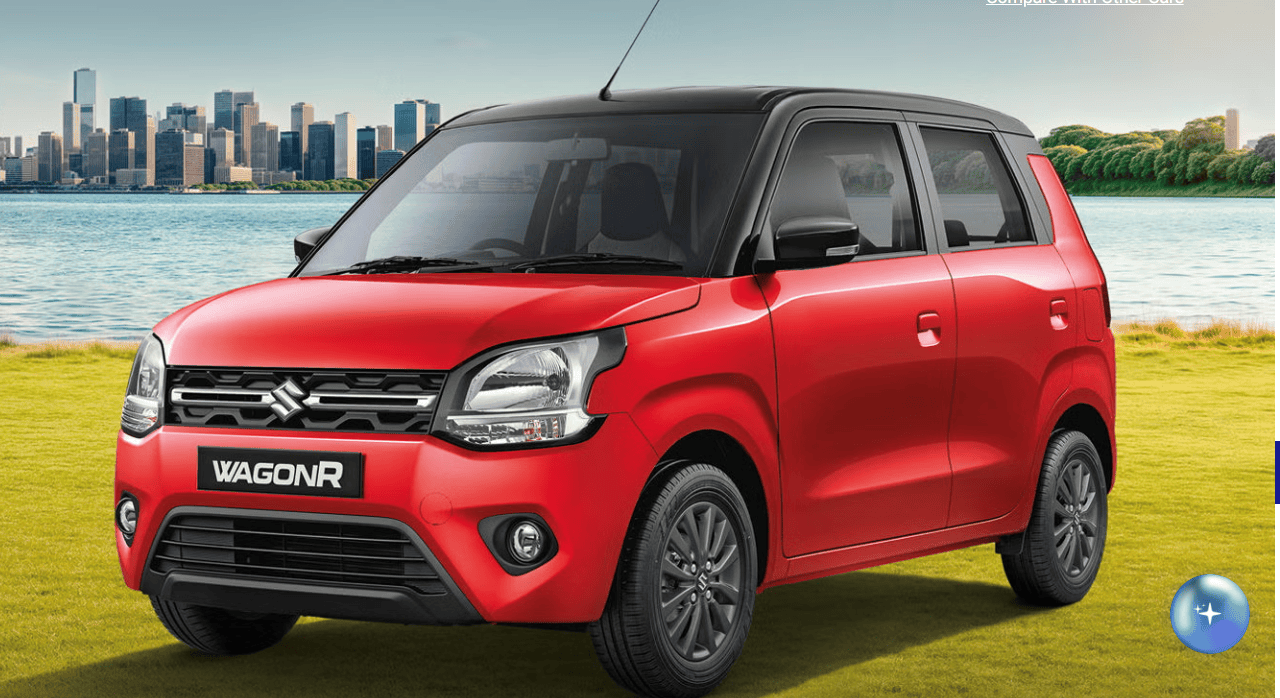
Maruti Suzuki appears to be preparing a significant update for one of its most familiar hatchbacks in India. A heavily camouflaged WagonR test vehicle has been spotted on public roads, indicating that development work on an updated model is underway. While the company has not officially announced the launch date or final specifications, the test car suggests that the next WagonR could focus more on mechanical efficiency than on a dramatic visual transformation.
The biggest potential change is under the bonnet. Reports indicate that Maruti Suzuki could replace the existing 1.2-litre four-cylinder petrol engine with its newer three-cylinder Z-Series engine. An updated CNG arrangement is also being discussed, potentially addressing one of the biggest compromises associated with CNG hatchbacks: reduced boot space.
For a car whose popularity is built around practicality, affordability, fuel economy and ease of ownership, these changes could be more important to WagonR buyers than an entirely new exterior design.
Updated Maruti WagonR Spotted During Road Testing
The latest WagonR test mule was seen wearing extensive camouflage, making it difficult to identify every exterior modification. However, its familiar tall-boy proportions remain clearly visible. Early reports suggest this is likely to be an evolutionary update rather than an all-new generation.
The basic silhouette appears largely unchanged, which would make sense considering that the WagonR’s boxy profile is closely connected to its practical character. The upright roof, tall cabin and relatively compact footprint help maximise usable passenger space while keeping the car manageable in congested urban environments.
Maruti Suzuki has not yet revealed the production model, so details such as the final grille, bumper, lighting elements, alloy-wheel designs and colour options remain unconfirmed.
WagonR’s Familiar Tall-Boy Design Is Likely to Continue
One thing buyers probably should not expect is Maruti Suzuki abandoning the WagonR’s traditional tall-boy formula.
The test vehicle retains the recognisable upright body shape. Reports suggest the overall proportions will remain similar to the current car, while changes could be concentrated around individual styling elements rather than the underlying body architecture.
Why Keeping the Tall-Boy Shape Makes Sense
The WagonR’s design has always prioritised interior usability rather than trying to look like a conventional sporty hatchback.
Its tall roof contributes to generous headroom, while the upright seating position can make entering and exiting the vehicle easier. The boxy shape also helps Maruti extract considerable cabin space from a relatively small vehicle.
Changing that formula too aggressively could compromise one of the WagonR’s strongest selling points.
A facelift therefore gives Maruti an opportunity to modernise the car without fundamentally changing what buyers already appreciate about it.
New Z-Series Engine Could Be the Biggest Upgrade
The most interesting development surrounding the updated WagonR is the possibility of a new engine.
The current model has been offered with 1.0-litre and 1.2-litre petrol engine choices. Reports surrounding the test vehicle indicate that the existing 1.2-litre four-cylinder unit could eventually make way for Maruti Suzuki’s newer Z12E three-cylinder engine.
This is particularly significant because Maruti Suzuki has increasingly been using its newer-generation Z-Series engine technology across important small-car models.
Rather than chasing outright performance, the newer engine family places considerable emphasis on efficiency and lower fuel consumption.
Why Maruti Could Move From Four Cylinders to Three
For many WagonR customers, maximum horsepower is unlikely to be the first consideration.
Running costs, fuel economy, maintenance, reliability and drivability in everyday traffic tend to matter more.
A modern three-cylinder engine can help manufacturers reduce internal losses and optimise efficiency. If Maruti successfully tunes the new powertrain for the WagonR’s relatively lightweight platform, it could result in improved real-world economy without significantly changing the everyday character of the car.
However, buyers should wait for official figures before drawing conclusions about mileage, power and torque. Maruti Suzuki has not yet announced the final engine specifications for the upcoming WagonR.
Better Mileage Could Become the New WagonR’s Main Selling Point
Fuel efficiency has historically been one of the strongest reasons Indian buyers choose Maruti Suzuki’s smaller cars.
The possible introduction of the Z-Series engine indicates that improving mileage could be one of the central objectives of the WagonR update. Reports around the prototype specifically point toward better efficiency as an expected benefit of the newer powertrain.
That could prove particularly valuable for buyers who drive frequently in cities.
Even a relatively modest improvement in fuel consumption can make a noticeable difference over several years of ownership, particularly for high-mileage users.
It could also help the WagonR remain competitive as buyers become increasingly conscious of fuel costs and total ownership expenses.
Petrol and CNG Versions Are Expected to Continue
Another reason behind the WagonR’s widespread appeal is the availability of factory-fitted CNG.
The updated model is expected to continue offering both petrol and CNG powertrain choices. Reports also suggest that manual and AMT gearbox options could remain part of the range, although Maruti Suzuki has not yet officially confirmed the complete variant structure.
The petrol version should continue to target private urban buyers seeking a simple and practical hatchback, while the CNG version could remain especially attractive to customers who prioritise lower running costs.
But the CNG model could receive an even more meaningful improvement.
Underbody CNG Tank Could Solve a Major WagonR Problem
One of the most intriguing possibilities is an underbody-mounted CNG tank.
Traditional factory-CNG hatchbacks generally place a large cylindrical tank inside the luggage compartment. While this is functional, the tank occupies a substantial amount of boot space.
For families using the vehicle for longer trips, that can be inconvenient.
Reports suggest Maruti Suzuki may be evaluating an underbody CNG arrangement for the updated WagonR. If introduced on the production model, it could free up considerably more usable luggage space than a conventional boot-mounted cylinder arrangement.
Why This Could Matter More Than a New Touchscreen
A bigger infotainment screen or redesigned dashboard can make a car feel more modern, but additional boot space directly improves everyday practicality.
Consider a family travelling with suitcases, shopping bags or children’s luggage. A conventional CNG cylinder can leave very little usable space behind the rear seats.
Moving the CNG storage underneath the vehicle could make the CNG WagonR significantly more versatile.
There are still unanswered questions, including the final tank configuration, capacity, ground clearance and packaging. Until Maruti Suzuki reveals the production specification, the underbody setup should be considered a reported possibility rather than a confirmed feature.
What About the Interior and Features?
The interior of the prototype has not been comprehensively revealed, leaving room for speculation about equipment upgrades.
A facelift would give Maruti Suzuki an opportunity to refresh the dashboard, upholstery and infotainment experience while introducing additional convenience features.
However, there is currently insufficient official information to confirm major cabin changes.
Maruti could also reconsider the feature distribution across variants, particularly as entry-level hatchback customers increasingly expect smartphone connectivity, touchscreen infotainment and useful convenience equipment.
Safety is another area that has become increasingly important. The WagonR received six airbags as standard in an earlier update, strengthening its basic safety equipment.
For the upcoming model, the more interesting question will be whether Maruti adds further active-safety or convenience technologies beyond the essentials.
WagonR Update Comes as Maruti Refreshes Its Hatchback Portfolio
The timing of the WagonR prototype is noteworthy.
Maruti Suzuki has recently been refreshing other important hatchbacks as well. The 2026 Baleno facelift, for example, arrived with substantial upgrades including new technology and safety equipment.
Despite the Indian market’s growing preference for SUVs, hatchbacks continue to represent an important part of Maruti Suzuki’s business.
Company executives have also emphasised that strong SUV demand does not mean every Indian buyer wants an SUV. Models such as the WagonR and Swift continue to generate substantial volumes.
That makes continued investment in the WagonR strategically important.
Rather than turning it into a more expensive or complicated product, Maruti appears likely to preserve its basic strengths while improving efficiency and practicality.
Expected Price of the New Maruti WagonR
Pricing has not been officially announced.
The currently available WagonR is positioned as one of Maruti Suzuki’s affordable mass-market hatchbacks, and the new model is expected to remain within the same broad segment.
The source report lists the existing WagonR range at approximately ₹4.99 lakh to ₹7.24 lakh, ex-showroom.
A facelift incorporating a new engine, updated styling, additional equipment and potentially revised CNG technology could result in some increase in pricing.
There is another factor worth considering. Maruti Suzuki announced a price increase of up to ₹20,000 on select models in September 2026, citing inflationary pressures and higher operational costs. It was the company’s third price increase since May.
Consequently, predicting the exact starting price of an upcoming WagonR before its official launch would be premature.
When Will the New Maruti WagonR Launch?
Maruti Suzuki has not officially confirmed a launch date for the updated WagonR.
Current reports suggest the facelift could reach the Indian market toward the end of 2026, but this timeline remains unofficial.
The fact that a camouflaged vehicle is already undergoing public-road testing indicates that development has reached a visible stage, but manufacturers often test vehicles for months before launch.
More prototypes could appear in the coming weeks, potentially revealing additional details about the exterior, cabin and powertrain.
What Buyers Should Expect From the 2026 WagonR
Based on what has emerged so far, the new WagonR is shaping up as a practical evolution rather than a radical reinvention.
The familiar tall-boy body is expected to continue, possibly accompanied by modest styling revisions. The bigger story could be underneath the bodywork, where a newer three-cylinder engine may improve efficiency.
An underbody CNG arrangement could be equally significant if it reaches production because it would address the luggage-space compromise traditionally associated with CNG hatchbacks.
Maruti’s challenge will be balancing these improvements against price.
WagonR buyers generally expect a straightforward car with manageable ownership costs. Adding too much technology could push the price upward, while too few improvements could make the facelift less compelling.
A combination of better mileage, usable CNG boot space, essential modern features and competitive pricing could therefore be the most effective formula.
Should You Wait for the New WagonR?
For someone who needs a car immediately, the current WagonR continues to provide the qualities for which the nameplate is known: compact dimensions, a spacious cabin and petrol/CNG options.
However, buyers who are not in a hurry may find it worthwhile to watch developments around the facelift.
The potential Z-Series engine is particularly relevant for buyers who intend to keep their car for many years, because even incremental efficiency gains can accumulate into meaningful fuel savings.
CNG buyers have an even stronger reason to monitor the upcoming model. If the underbody CNG arrangement is confirmed, the improvement in luggage capacity could substantially change the ownership experience.
At this stage, however, buyers should avoid making decisions based purely on leaked specifications. Final mileage figures, CNG packaging, features, variants, prices and the launch schedule remain subject to official confirmation.
New WagonR Could Focus on What Indian Buyers Value Most
The next Maruti Suzuki WagonR may not be trying to reinvent one of India’s best-known hatchbacks. Instead, the company appears to be refining the formula around efficiency and everyday practicality.
A newer three-cylinder Z-Series engine could potentially deliver improved mileage, while an underbody CNG solution could make the CNG version considerably more family-friendly. The familiar tall-boy design, meanwhile, appears likely to survive because spaciousness remains central to the WagonR’s identity.
The prototype has created plenty of interest, but several important details are still unconfirmed. Maruti Suzuki has yet to disclose the production model’s specifications, prices or official launch date.
If the company manages to combine better fuel economy, improved CNG practicality and sensible pricing, the updated WagonR could strengthen its appeal without abandoning the simple formula that made the car successful in the first place.