
Coaching institutes operating along Jaipur’s Gopalpura Bypass are facing possible action from the Jaipur Development Authority after authorities began the process of implementing directions concerning the relocation of coaching centres from the busy area.
The development has triggered concern among coaching operators, with the coaching institute association announcing a shutdown in protest against the proposed action. The issue has become a major point of discussion in Jaipur because Gopalpura Bypass has developed into a prominent coaching and student hub over the years.
The Jaipur Development Authority is preparing to issue notices to coaching institutes operating along Gopalpura Bypass. According to reports, around 130 coaching institutes have been identified in the area and are expected to receive notices as part of the process.
The action follows directions from the Supreme Court concerning coaching institutes and paying guest accommodations operating in the Gopalpura Bypass area. The court directed that coaching centres and PG accommodations in the area be shifted to a dedicated coaching hub developed by the Rajasthan Housing Board at Pratap Nagar.
The proposed relocation has become a contentious issue for coaching operators. They have raised concerns about the availability and suitability of alternative premises at Pratap Nagar and have sought a solution that would allow coaching businesses to continue operating without disrupting students.
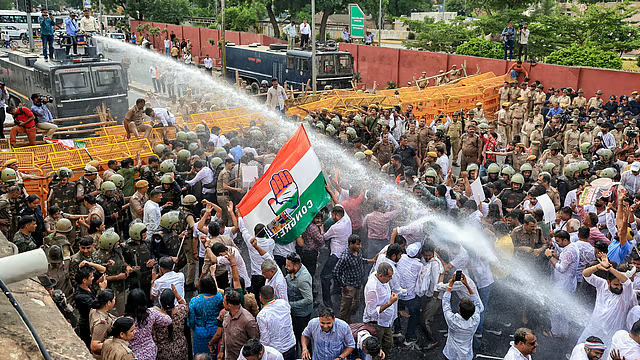
Following the JDA notice process, the coaching association announced that coaching institutes located on Gopalpura Bypass would remain closed in protest. Social media posts circulating about the decision stated that the shutdown was being organised in response to the notices issued by the authorities.
The dispute comes against the backdrop of long-standing concerns raised by residents living around Gopalpura Bypass. Residents have complained about traffic congestion, parking problems, commercial use of residential properties and the growth of hostels and PG accommodations around coaching centres.
According to residents, the large concentration of students and coaching-related activity has placed significant pressure on neighbourhood infrastructure. Complaints have included vehicles parked on roads, congestion in narrow residential lanes and difficulties for emergency vehicles accessing some areas.
Residents have also alleged that some residential buildings have been converted for commercial activities or PG accommodation without adequate permissions. These allegations have added another dimension to the dispute because the issue is not limited to coaching institutes themselves but also involves the wider ecosystem of student accommodation and commercial activity.
The Supreme Court’s intervention came amid concerns about the impact of coaching centres and related activities on residents. Authorities have consequently been directed to work towards corrective measures and relocation rather than allowing the situation to continue without regulation.
The JDA has said that implementing the relocation plan will require coordination between several government agencies. Officials have discussed working with the Rajasthan Housing Board, police and the municipal corporation to determine how the relocation and enforcement process will be carried out.
A joint survey of coaching centres has also been planned to determine compliance with various requirements. The inspection is expected to examine issues such as building-use permissions, parking arrangements and fire-safety clearance.
Authorities have indicated that institutes found violating applicable rules will first be issued notices and given an opportunity to respond. Further action could follow if the irregularities are not addressed within the prescribed period.
The proposed relocation destination, the Rajasthan Housing Board’s coaching hub in Pratap Nagar, was developed specifically to accommodate coaching activities. The housing board spent around Rs 300 crore on the project, which includes 243 units. However, the facility has not attracted coaching operators on the scale originally expected.
According to officials cited by The Times of India, only a small number of units at the Pratap Nagar hub have ultimately been sold or are currently being used by coaching institutes. This has raised questions about whether the existing facility can immediately accommodate the large number of institutes operating around Gopalpura Bypass.
The coaching sector has also raised concerns about the terms under which alternative premises would be provided. The Rajasthan Housing Board has stated that its existing rules do not provide for renting out the coaching-hub buildings. Officials have indicated that future requests from coaching operators to purchase larger numbers of properties could be considered under applicable rules.
The All Coaching Institute Federation has meanwhile sought concessions from the government. The organisation has demanded that plots or premises in the coaching hub be made available at concessional rates and has also sought provisions allowing coaching operators to rent premises rather than being required to purchase them.
The association’s protest reflects the tension between two competing concerns. On one side, residents and authorities want to address congestion, unauthorised commercial activity and pressure on residential infrastructure. On the other, coaching operators argue that sudden relocation could affect their businesses, employees and thousands of students who depend on the institutes.
Students are likely to be closely affected by any prolonged closure or relocation process. Gopalpura Bypass is used by a large number of students preparing for competitive examinations and other academic courses. Any disruption could create logistical challenges for students who have already enrolled in coaching programs and arranged accommodation nearby.
For the authorities, the challenge will be to implement the court’s directions while ensuring that the transition does not create additional problems for students and residents. A coordinated approach involving the JDA, municipal authorities, police and the Rajasthan Housing Board is expected to be necessary.
The controversy also highlights the rapid growth of coaching infrastructure in Jaipur. Areas such as Gopalpura Bypass have attracted large numbers of institutes because of their accessibility and established student ecosystem. Over time, coaching centres have been accompanied by hostels, PG accommodations, food outlets, transport services and other businesses.
This concentration has created economic opportunities but has also increased pressure on local infrastructure. Residents have argued that roads and residential areas were not designed to handle the volume of traffic and population generated by the coaching industry.
The Supreme Court’s directions have therefore brought the broader issue of planned urban development and regulation of coaching centres into focus. The objective of relocation is not simply to move businesses from one neighbourhood to another but to create a more organised environment for educational activities.
The authorities’ next steps will be important. Notices to coaching institutes are expected to provide details of the alleged violations or the requirements that operators must meet. The subsequent responses will determine whether institutes can continue operating, need to make changes or face further action.
The coaching association’s decision to protest indicates that the dispute is unlikely to be resolved immediately. Dialogue between the administration and coaching operators could become important in determining how the relocation is implemented and whether a phased transition is possible.
Residents, meanwhile, are seeking visible action rather than further surveys and administrative discussions. They have previously accused authorities of repeatedly surveying the area without resolving the underlying problems.
The issue has consequently reached a critical stage, with authorities under pressure to comply with the Supreme Court’s directions and coaching institutes preparing to oppose measures they believe could disrupt their operations.
For now, the immediate focus is on the notices, the proposed closure announced by the coaching association and the government’s plan for relocation to Pratap Nagar. The final outcome will depend on further administrative action, discussions with coaching operators and compliance with the Supreme Court’s directions.
The Gopalpura Bypass dispute is therefore not merely a conflict between the JDA and coaching institutes. It is a wider issue involving students, residents, property owners, local businesses and government agencies. How Jaipur manages the transition could determine the future of one of the city’s largest coaching clusters while also addressing the long-standing concerns of residents living around the area.