
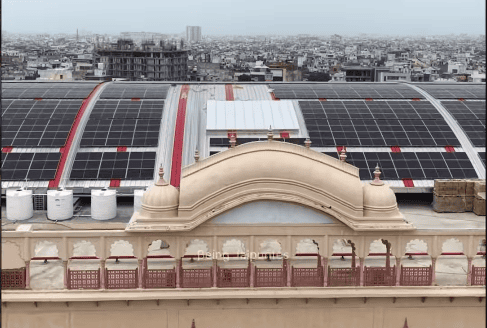
Jaipur’s Gandhi Nagar railway station has taken a major step towards becoming a greener railway facility with the installation of a 1,376-kilowatt solar power plant on its rooftops. The project is expected to generate around 25 lakh units of clean electricity every year and significantly reduce the station’s dependence on conventional power.
The solar installation is part of the Indian Railways’ broader efforts to increase the use of renewable energy across railway stations and operational facilities. By generating electricity directly at the station, the project can help reduce conventional electricity consumption while also lowering the environmental impact associated with power generation.
The 1,376 kW rooftop solar plant is designed to produce approximately 25 lakh units of electricity annually under suitable operating conditions. The electricity generated can be used for several day-to-day operations at the railway station.
This includes essential facilities such as lighting, fans, lifts and escalators. These systems consume electricity throughout the day, making a rooftop solar installation particularly useful for offsetting a portion of the station’s regular power demand.
The project is also expected to generate substantial financial savings. Based on the estimated annual electricity generation and applicable electricity costs, the station could save more than Rs 1.5 crore every year.
The exact annual savings can vary depending on electricity tariffs, actual solar generation, maintenance requirements and the amount of power consumed directly by the station. Nevertheless, the project has the potential to provide long-term operational savings while producing renewable energy.
Gandhi Nagar railway station is one of Jaipur’s important railway facilities and is located in a densely developed part of the city. Installing solar panels on existing rooftops allows the railway facility to use available space for power generation without requiring additional land.
Rooftop solar projects are increasingly being adopted at railway stations because they can generate electricity close to the point where it is consumed. This can help reduce transmission-related losses and lower the requirement for electricity from conventional sources during periods of solar generation.
The project also supports the broader objective of increasing renewable energy use within the railway network. Indian Railways has been working on solar power installations at stations, workshops, service buildings and other railway properties as part of its efforts to reduce its carbon footprint.
For passengers, the most visible benefit of the project may not be immediately noticeable because the solar panels operate largely as part of the station’s electrical infrastructure. However, the electricity produced can support everyday passenger facilities and railway operations.
Lighting is one of the most important uses. Railway stations require extensive lighting across platforms, waiting areas, concourses, stairways, entrances and other public spaces. During daylight hours, solar generation can help offset a portion of this electricity requirement.
Fans and ventilation systems are another regular electricity demand, particularly during Jaipur’s hot weather. Solar power can help meet some of this daytime demand when sunlight is available.
The electricity can also support lifts and escalators, which are increasingly important at modern railway stations for passenger accessibility and movement between different levels.
The installation is therefore not simply an environmental project. It can also contribute to reducing the recurring electricity expenditure associated with operating a busy railway station.
The estimated generation of 25 lakh units a year means that the plant could produce an average of roughly 6,850 units of electricity per day over a full year, although actual daily production will fluctuate depending on sunlight, weather, season, panel performance and other operating conditions.
Jaipur receives substantial sunlight for much of the year, providing favourable conditions for solar power generation. However, dust, monsoon clouds, high temperatures and maintenance can affect the actual output of rooftop solar panels.
Regular cleaning and maintenance are therefore important for maintaining efficient electricity generation. Dust accumulation on panels can reduce the amount of sunlight reaching the photovoltaic cells and consequently lower output.
The project also has an environmental benefit because electricity generated from sunlight does not require direct combustion of coal, gas or other fossil fuels at the point of generation.
By replacing part of the station’s conventional electricity requirement with solar power, the railway can reduce associated carbon emissions. The overall environmental benefit depends on how much conventional electricity is displaced by the solar generation.
The move comes at a time when renewable energy is becoming an increasingly important component of India’s infrastructure development. Large public facilities such as railway stations provide significant opportunities for rooftop solar because they often have large, relatively unobstructed roof areas.
Railway stations also operate for long hours and have continuous electricity requirements. This makes them suitable locations for renewable-energy projects that can supply power during periods of high daytime demand.
Gandhi Nagar station’s solar project is therefore significant not only for Jaipur but also as an example of how existing public infrastructure can be used to support clean-energy generation.
The project can also help raise awareness among passengers about renewable energy. Thousands of travellers passing through the station can see the solar infrastructure and understand how clean energy can be integrated into everyday public facilities.
The financial savings are another important aspect. An estimated saving of more than Rs 1.5 crore annually could translate into several crores of rupees over the operating life of the solar installation, although the actual figure will depend on future electricity prices, system performance and maintenance costs.
Solar panels generally have a long operational life, making rooftop solar a long-term infrastructure investment rather than a short-term electricity-saving measure.
The project can also provide protection against some future increases in electricity costs. When a facility generates part of its own electricity, it becomes less dependent on purchasing the entire requirement from the grid.
However, the solar plant does not mean that Gandhi Nagar railway station will become completely independent of the conventional electricity grid. Solar generation varies throughout the day and is unavailable from the panels at night without an appropriate energy-storage system.
The station will therefore continue to require grid electricity or other power arrangements when solar generation is insufficient. The rooftop plant should instead be viewed as a major supplementary source of clean electricity.
The 1,376 kW capacity is nevertheless substantial for a single railway facility. With annual generation estimated at around 25 lakh units, the installation can make a meaningful contribution to the station’s overall electricity requirements.
The project also demonstrates the potential of combining railway infrastructure with renewable-energy technology. Instead of constructing separate solar farms requiring additional land, rooftop installations can make use of existing buildings.
For a rapidly growing city such as Jaipur, this approach can be particularly useful. Large public buildings have significant electricity requirements, while land availability within the urban area is limited.
Railway stations, therefore, can become important locations for decentralised renewable-energy generation.
The Gandhi Nagar station project also fits into the wider transition towards cleaner transportation infrastructure. Railways are already one of the more energy-efficient modes of mass transportation, and increasing renewable electricity use can further reduce the environmental footprint of railway operations.
The project is expected to support the station’s regular electricity requirements while simultaneously reducing its electricity expenditure. Over time, the combination of lower grid consumption and renewable generation could provide both environmental and economic benefits.
For passengers, the installation is unlikely to change the basic functioning of the station. Trains, platforms and passenger services will continue to operate normally, but some of the electricity used to power station facilities will increasingly come from sunlight.
The project is also a reminder that renewable energy can be deployed at existing infrastructure without major changes to the surrounding urban environment.
With a capacity of 1,376 kW and estimated annual generation of around 25 lakh units, Gandhi Nagar railway station is taking a significant step towards cleaner energy use.
The expected annual saving of more than Rs 1.5 crore adds a strong financial incentive to the environmental benefits. If the plant performs close to its projected generation over its operating life, the railway facility could reduce both electricity expenditure and its dependence on conventional power.
Jaipur’s Gandhi Nagar station is therefore emerging as an example of how public infrastructure can combine operational efficiency with renewable energy. The solar panels installed across its rooftops are not merely an addition to the station’s architecture but a long-term investment in cleaner electricity and lower operating costs.
As more railway stations and public facilities adopt similar systems, rooftop solar could become an increasingly visible part of India’s transition towards renewable energy. For Gandhi Nagar railway station, the immediate goal is clear: use Jaipur’s abundant sunlight to generate electricity, power essential passenger facilities and save money while reducing the environmental impact of everyday railway operations.