The India Pakistan Navy Ship Collision in the North Arabian Sea has triggered fresh diplomatic tensions between the two nuclear-armed neighbours after naval vessels from India and Pakistan came into contact on September 15, 2026. The incident occurred in waters where both countries maintain military and maritime interests, with India saying the collision took place in international waters, while Pakistan has claimed that the Indian warship entered its exclusive economic zone (EEZ).
The India Pakistan Navy Ship Collision involved Pakistan Navy vessel PNS Hunain and an Indian Navy warship whose identity has not been officially disclosed. Indian officials said the Pakistani vessel approached the Indian warship at high speed and conducted unsafe manoeuvres, eventually resulting in a minor collision. India said its warship did not suffer major damage and continued its routine mission.
Pakistan has presented a different account of the India Pakistan Navy Ship Collision. According to Pakistan’s position, the incident occurred while its navy was conducting the SEASPARK-26 exercise inside Pakistan’s exclusive economic zone. Islamabad accused the Indian vessel of carrying out aggressive manoeuvres close to the Pakistani ship and described the incident as a violation of international law and existing bilateral arrangements.
The disagreement over the location of the India Pakistan Navy Ship Collision is particularly important because the two countries have different interpretations of what happened at sea. India maintains that the collision occurred in international waters, while Pakistan says the Indian ship entered its EEZ during the naval exercise. Neither side’s account has been independently established in full.
India responded to the India Pakistan Navy Ship Collision by summoning Pakistan’s Charge d’Affaires in New Delhi on September 16. The Ministry of External Affairs lodged a strong protest and described the conduct of Pakistani naval units as unacceptable and unprofessional. India also instructed its Charge d’Affaires in Islamabad to lodge a similar protest with Pakistan’s foreign ministry.
The India Pakistan Navy Ship Collision has also brought attention to a 1991 bilateral agreement between the two countries. Article 10 of the agreement states that naval ships and submarines belonging to India and Pakistan should not come within three nautical miles of each other while operating in international waters, with the stated purpose of preventing accidents. India said the conduct leading to the collision was contrary to this provision.
Pakistan, meanwhile, has rejected India’s characterisation of the India Pakistan Navy Ship Collision. Islamabad has accused the Indian vessel of aggressive manoeuvring and called the incident provocative and unacceptable. Pakistan also summoned India’s Charge d’Affaires to formally communicate its protest. This means both governments have now taken diplomatic action over the same maritime incident.
The India Pakistan Navy Ship Collision occurred against a particularly sensitive regional backdrop. Indian naval vessels have been operating in the Arabian Sea and waters around the Gulf of Oman amid heightened security concerns linked to regional conflicts and disruptions around major energy and shipping routes. Indian officials have said naval deployments have included missions to protect critical energy supplies and Indian commercial shipping.
The location of the India Pakistan Navy Ship Collision also adds strategic importance to the episode. Reports place the incident roughly 120 nautical miles from the Gulf of Oman, in the northern Arabian Sea. The Gulf of Oman connects the Arabian Sea with the Persian Gulf through the Strait of Hormuz, making the surrounding waters important for international energy and commercial shipping.
According to Indian officials, the India Pakistan Navy Ship Collision caused no major damage to the Indian warship, which remained operational and continued its surveillance mission. Reports have said that PNS Hunain suffered damage and later returned toward port, although the precise extent of damage to the Pakistani vessel has not been independently established from the official information available.
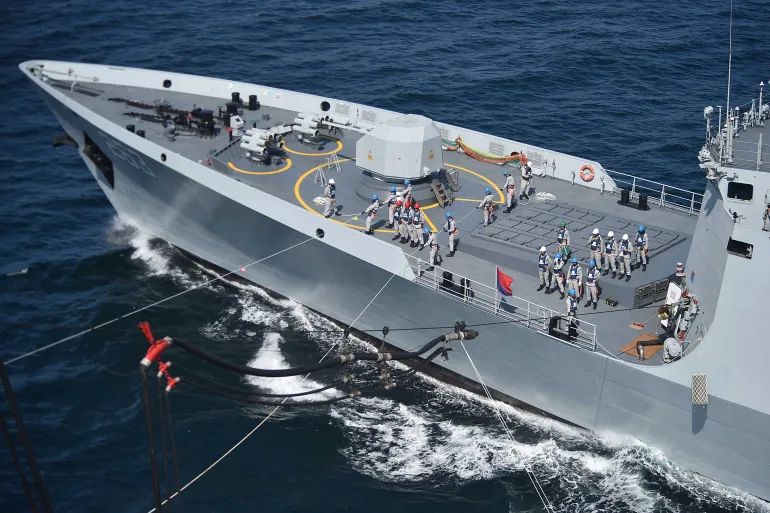
PNS Hunain is a relatively new Pakistan Navy vessel. Reports identify it as a Yarmook-class offshore patrol vessel commissioned in 2024. The ship is designed for maritime patrol and related operations, and its involvement in the India Pakistan Navy Ship Collision has drawn attention because of the close-range interaction between a smaller Pakistani patrol vessel and a larger Indian frontline warship.
The incident has also revived memories of an earlier India Pakistan Navy Ship Collision in 2011. In that episode, Pakistani naval vessel PNS Babur came into contact with India’s INS Godavari while the Indian frigate was involved in an anti-piracy mission in the Gulf of Aden. The earlier incident caused minor damage and also led to an Indian diplomatic protest.
The latest India Pakistan Navy Ship Collision is nevertheless different from the 2011 episode because it comes after a period of significantly heightened military tensions between the two countries. The incident is the first reported direct military confrontation involving their naval forces since the four-day hostilities in May 2025, making the management of the current dispute particularly important.
The possibility of unintended escalation is one reason the India Pakistan Navy Ship Collision has received considerable attention. Naval vessels operating close to each other have limited time to respond to sudden changes in course or speed. Even when an incident begins as a navigational or operational mishap, conflicting accounts and military deployments can turn it into a diplomatic dispute.
The 1991 agreement is therefore an important confidence-building measure in the context of the India Pakistan Navy Ship Collision. Maintaining separation between naval vessels is intended to reduce the possibility of accidents and miscalculations. The current dispute over whether that understanding was breached shows why such mechanisms remain relevant when military ships operate in proximity.
The India Pakistan Navy Ship Collision also highlights the importance of communication between military forces. Maritime encounters can become particularly sensitive when ships are carrying out exercises, surveillance missions or security operations. Clear notification of military activities, safe navigation practices and established communication channels can help reduce the risk of misunderstandings.
Pakistan’s reference to the SEASPARK-26 exercise is central to its explanation of the India Pakistan Navy Ship Collision. Pakistan says its naval vessel was participating in the exercise when the Indian warship approached the area. India disputes Pakistan’s account of the location and says its vessel was carrying out a routine surveillance mission in international waters.
The India Pakistan Navy Ship Collision therefore involves not only the physical contact between two ships but also competing interpretations of maritime activity. India’s account focuses on the alleged high-speed approach and unsafe manoeuvring by the Pakistani vessel, while Pakistan’s account focuses on what it describes as the Indian vessel’s entry into its EEZ and aggressive manoeuvres. Both claims remain contested.
The diplomatic response following the India Pakistan Navy Ship Collision has so far centred on protests rather than additional military action. India summoned Pakistan’s senior diplomat in New Delhi, while Pakistan summoned India’s representative in Islamabad. Both sides have communicated their objections through established diplomatic channels.
This diplomatic handling is significant because the India Pakistan Navy Ship Collision comes between countries with a long history of military confrontation. India and Pakistan have fought multiple wars since independence in 1947, including conflicts linked to Kashmir. The two countries also possess nuclear weapons, making the management of military incidents particularly sensitive.
The India Pakistan Navy Ship Collision has also generated misinformation online. At least one video being circulated as footage of the September 2026 incident has been identified as old footage from a 2011 naval encounter involving PNS Babur and INS Godavari. The footage is unrelated to the current collision.
The circulation of old footage makes verified information about the India Pakistan Navy Ship Collision especially important. Images and videos shared on social media may not necessarily represent the latest incident, and fact-checkers have already identified misleading material. Official statements and independently verified reporting remain more reliable sources for understanding what occurred.
For maritime security analysts, the India Pakistan Navy Ship Collision demonstrates the risks created when military vessels from rival countries operate in the same strategic waters. The Arabian Sea has become increasingly important for naval surveillance, commercial shipping protection and energy security, increasing the number of situations in which vessels from different countries may operate relatively close to one another.
The India Pakistan Navy Ship Collision may also influence future naval operating procedures. Both countries have an interest in avoiding accidental encounters that could trigger wider diplomatic or military complications. The 1991 agreement provides an existing framework for maintaining distance, but the latest incident could prompt renewed attention to communication and safety procedures at sea.
For now, the India Pakistan Navy Ship Collision remains primarily a diplomatic and maritime-security dispute. India says the incident occurred in international waters and resulted from unsafe Pakistani manoeuvring, while Pakistan says the Indian vessel entered its EEZ and behaved aggressively. The competing claims mean that the exact sequence of events remains disputed.
The incident is also a reminder that military tensions do not always begin with deliberate attacks. A navigational error, unexpected manoeuvre or failure to maintain adequate distance can create a potentially serious situation when two military vessels belonging to rival countries meet at sea. The India Pakistan Navy Ship Collision illustrates how quickly such an incident can move from an operational event to a diplomatic confrontation.
Overall, the India Pakistan Navy Ship Collision has added a new point of tension between New Delhi and Islamabad after an Indian warship and Pakistan’s PNS Hunain came into contact in the North Arabian Sea on September 15. Both countries have lodged diplomatic protests and offered sharply different accounts of the incident. With no major damage reported to the Indian vessel and the Pakistani ship reportedly returning toward port, the immediate focus is on establishing the circumstances of the collision and preventing further escalation.