
India Nuclear Weapons 2026 have come under renewed international attention following a new assessment by nuclear weapons researchers that estimates India may have assembled up to 190 nuclear warheads. The assessment, published in the Bulletin of the Atomic Scientists, also says India continues to modernise the aircraft, land-based missiles and submarine systems that form its nuclear deterrent.
The discussion around India Nuclear Weapons 2026 is based largely on independent estimates because the Indian government does not publicly disclose the exact size of its nuclear stockpile. The researchers therefore rely on open-source information, government statements, satellite imagery, defence-related publications and other available evidence to assess India’s nuclear forces.
According to the latest assessment, India may have produced enough military plutonium for between 140 and 225 nuclear warheads and may have assembled as many as 190. The researchers estimate that more than 160 warheads could be available for operational nuclear forces, while additional warheads may be produced for newer delivery systems. These figures remain estimates rather than officially confirmed numbers.
A key feature of India Nuclear Weapons 2026 is the continued development of a nuclear triad. A nuclear triad refers to the ability to deliver nuclear weapons through three broad platforms: aircraft, land-based missiles and sea-based systems. The researchers assess India’s triad as operational, although the exact deployment status and readiness of individual systems remain difficult to establish because of the country’s strategic secrecy.
India’s nuclear doctrine has traditionally emphasised credible minimum deterrence and a stated No First Use policy. The country’s nuclear posture is therefore generally presented around the concept of maintaining sufficient capability to deter nuclear attack and preserve the ability to retaliate if nuclear weapons are used against India.
The land-based component is centred largely around the Agni family of ballistic missiles. The latest assessment identifies six operational nuclear-capable ballistic missile systems: Prithvi II, Agni I, Agni II, Agni III, Agni IV and Agni V. The Agni-P, also known as Agni Prime, is described as nearing broader operational deployment.
The development of the Agni series represents a long-term effort by India to build indigenous strategic missile capabilities. Different versions of the missile family provide different ranges and capabilities, giving India’s strategic forces a range of options for maintaining deterrence.
Agni I is generally associated with a shorter range within the Agni family, while subsequent systems such as Agni II, Agni III and Agni IV provide progressively greater range. Agni V represents the longest-range system among the currently identified operational Agni missiles and has attracted particular attention because of its technology and potential strategic reach.
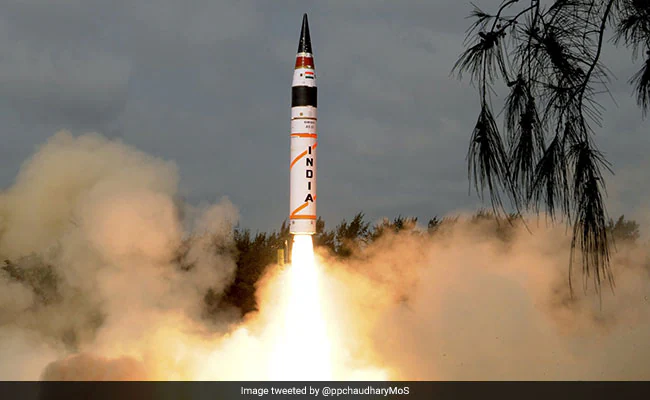
The India Nuclear Weapons 2026 assessment also highlights the evolution of Agni V. The missile is a road-mobile, solid-fuel intermediate-range ballistic missile and has been tested with technology associated with multiple independently targetable re-entry vehicles, or MIRVs. MIRV technology allows a missile to carry multiple independently directed re-entry vehicles, although the researchers caution that there is no credible public information establishing the exact number of nuclear warheads India currently deploys on individual missiles.
Another important characteristic of Agni V is its canister-based launch configuration. According to the researchers, the canister system can reduce preparation time and allows the missile to be maintained in a more ready configuration. The longer range also potentially allows strategic missile units to be positioned farther from vulnerable border areas.
India has also continued developing the Agni-P, a newer-generation ballistic missile. The researchers describe Agni-P as a shorter-range nuclear-capable system incorporating newer propulsion, avionics and navigation technologies. India’s government has previously described the system as a new-generation ballistic missile, and the system has undergone multiple tests.
The Agni-III is another important part of India Nuclear Weapons 2026. India successfully conducted an Agni-III test in February 2026 from the Integrated Test Range in Odisha under the supervision of the Strategic Forces Command. According to Akashvani, the test was conducted to validate the missile’s operational and technical readiness, with the system described as capable of carrying conventional or nuclear warheads.
The sea-based component of India’s nuclear capability has also expanded. The latest nuclear assessment notes the commissioning of India’s third indigenous nuclear-powered ballistic missile submarine, INS Aridhaman, in April 2026. It joins INS Arihant and INS Arighaat as part of India’s developing sea-based nuclear deterrent.
Submarine-based nuclear forces are considered an important part of a country’s second-strike capability because submarines can potentially remain concealed at sea. This survivability is central to nuclear deterrence, as it provides a country with a retaliatory capability even if other strategic forces were attacked.
India’s development of nuclear-powered ballistic missile submarines therefore represents an important stage in the evolution of India Nuclear Weapons 2026. The country is also developing and deploying submarine-launched ballistic missile systems, including longer-range systems such as the K-4.
The air-based component provides another layer of India’s nuclear deterrent. The latest assessment identifies the Mirage 2000 and Jaguar aircraft as having nuclear delivery roles. The Rafale fighter is also discussed as a platform that could increasingly take on such a role as older aircraft are eventually retired.
This combination of aircraft, land-based missiles and sea-based systems gives India a diversified strategic force. The purpose of maintaining multiple delivery platforms is linked to survivability and deterrence rather than relying on a single type of weapon system.
The latest assessment also highlights India’s strategic opacity. Unlike countries that publicly disclose extensive information about their nuclear arsenals, India does not officially publish detailed figures covering its stockpile, deployment patterns or operational readiness. This makes independent estimates necessary but also means that specific numbers should be treated with caution.
The estimated figure of 190 warheads is therefore not an official Indian government figure. It is an assessment produced by nuclear weapons researchers using publicly available evidence. Other organisations have also arrived at estimates around the same level. The Stockholm International Peace Research Institute, for example, estimated India’s nuclear arsenal at approximately 190 warheads in its 2026 assessment.
SIPRI also reported that India had slightly expanded its arsenal and assessed, for the first time, that a limited number of Indian nuclear warheads may have been deployed. Such assessments highlight the continuing evolution of India’s nuclear posture, although the precise status of individual warheads and delivery systems remains classified.
The growth of India’s nuclear delivery systems has wider implications for regional security. India shares strategic competition with both Pakistan and China, two other nuclear-armed states. India’s longer-range missile development is therefore viewed by analysts in the context of maintaining deterrence across a broader geographical area.
The India Nuclear Weapons 2026 assessment notes that newer long-range systems allow India to consider strategic deployment options farther from its borders. This is particularly relevant for systems such as Agni V, whose estimated range is substantially greater than earlier generations of India’s ballistic missiles.
At the same time, India’s nuclear posture should be distinguished from its conventional missile capabilities. India operates several conventional long-range systems, including missiles designed for precision conventional strikes. Not every long-range missile is nuclear-capable, and the nuclear role of a particular delivery system can depend on its configuration and operational assignment.
India’s strategic force modernisation is therefore not limited to increasing the number of nuclear weapons. It also involves improving the survivability, mobility, reliability and technological sophistication of delivery platforms.
The researchers’ assessment indicates that India currently operates nine different nuclear-capable systems, including aircraft, land-based ballistic missiles and sea-based ballistic missiles. At least two additional systems are described as being under development and approaching deployment.
The continuing development of these systems suggests that India’s nuclear policy is focused on maintaining a credible deterrent while modernising older platforms. Modernisation does not necessarily mean that India is pursuing an unlimited expansion of its nuclear arsenal. Rather, the assessment points to improvements in delivery systems, survivability and technological capabilities alongside a gradually increasing stockpile estimate.
The concept of credible minimum deterrence remains important in understanding India Nuclear Weapons 2026. India has historically argued that it needs a sufficient nuclear capability to deter nuclear threats rather than an arsenal designed around numerical parity with another nuclear power.
Its No First Use policy is another central part of the country’s stated nuclear doctrine. Under this policy, India has declared that it will not initiate the use of nuclear weapons, while retaining the ability to respond if subjected to nuclear attack. India’s official nuclear doctrine has evolved over time, and discussions about possible changes have periodically emerged, but the country’s publicly stated position continues to include No First Use.
The modernisation of the nuclear triad also creates new challenges for strategic stability. Improvements in missile accuracy, mobility, submarine capabilities and multiple-warhead technologies can influence how nuclear-armed states assess each other’s capabilities.
For India, maintaining secure and survivable strategic forces is closely connected to its deterrence objectives. For neighbouring nuclear powers, however, improvements in India’s delivery systems can influence their own strategic planning.
This dynamic is one reason independent assessments of India Nuclear Weapons 2026 receive international attention. Such reports do not necessarily represent official positions, but they provide estimates that help researchers understand how nuclear arsenals and delivery systems are evolving.
India’s nuclear capability has developed over several decades, beginning with its nuclear testing programme and later expanding into a broader system of land, air and sea-based deterrence. The development of the Agni family and nuclear-powered ballistic missile submarines represents a major technological transformation from India’s earlier nuclear posture.
The latest assessment suggests that transformation is continuing. Newer missile systems are entering service, existing systems are being modernised, and submarine-based capabilities are becoming more established. At the same time, India continues to maintain a degree of secrecy around its nuclear forces.
The India Nuclear Weapons 2026 picture is therefore best understood as a combination of estimated stockpile size, delivery-system modernisation and development of a survivable nuclear triad. The estimated 190-warhead figure is significant, but the delivery systems and their operational status are equally important to understanding India’s strategic posture.
The country’s missile development also demonstrates the increasing importance of indigenous defence technology. The Agni family has been developed largely through India’s domestic defence research and development ecosystem, with the Defence Research and Development Organisation playing a central role in missile development.
Recent missile tests, including the February 2026 Agni-III test, demonstrate that India continues to conduct exercises intended to validate the operational readiness and technical performance of its strategic systems.
However, public reporting cannot provide a complete picture of India’s nuclear forces. The government does not publish the exact number of warheads, their locations or detailed deployment patterns. Consequently, figures reported by research organisations should be interpreted as estimates rather than confirmed inventories.
As India continues modernising its strategic forces, the focus is likely to remain on survivability, reliability and the ability to maintain a credible deterrent. New missile technologies, submarine capabilities and modern aircraft are contributing to that broader strategic architecture.
The latest India Nuclear Weapons 2026 assessment ultimately presents a picture of a country continuing to modernise its nuclear forces while maintaining its stated deterrence-based doctrine. With an estimated stockpile of up to 190 warheads, a developing nuclear triad and a growing family of nuclear-capable delivery systems, India remains a significant nuclear power in the Indo-Pacific region.
The exact future size and composition of India’s nuclear arsenal remain uncertain because the country does not publicly disclose detailed information about its strategic forces. What can be established from available assessments is that India is continuing to invest in land-based missiles, aircraft and submarine-based systems, while newer technologies are gradually entering its strategic inventory.
For international security analysts, India Nuclear Weapons 2026 is therefore not simply a question of how many warheads India possesses. It also concerns how those weapons are supported by delivery systems, how survivable those systems are and how India’s nuclear doctrine shapes their intended role. These factors together provide a more complete picture of India’s evolving nuclear deterrent.