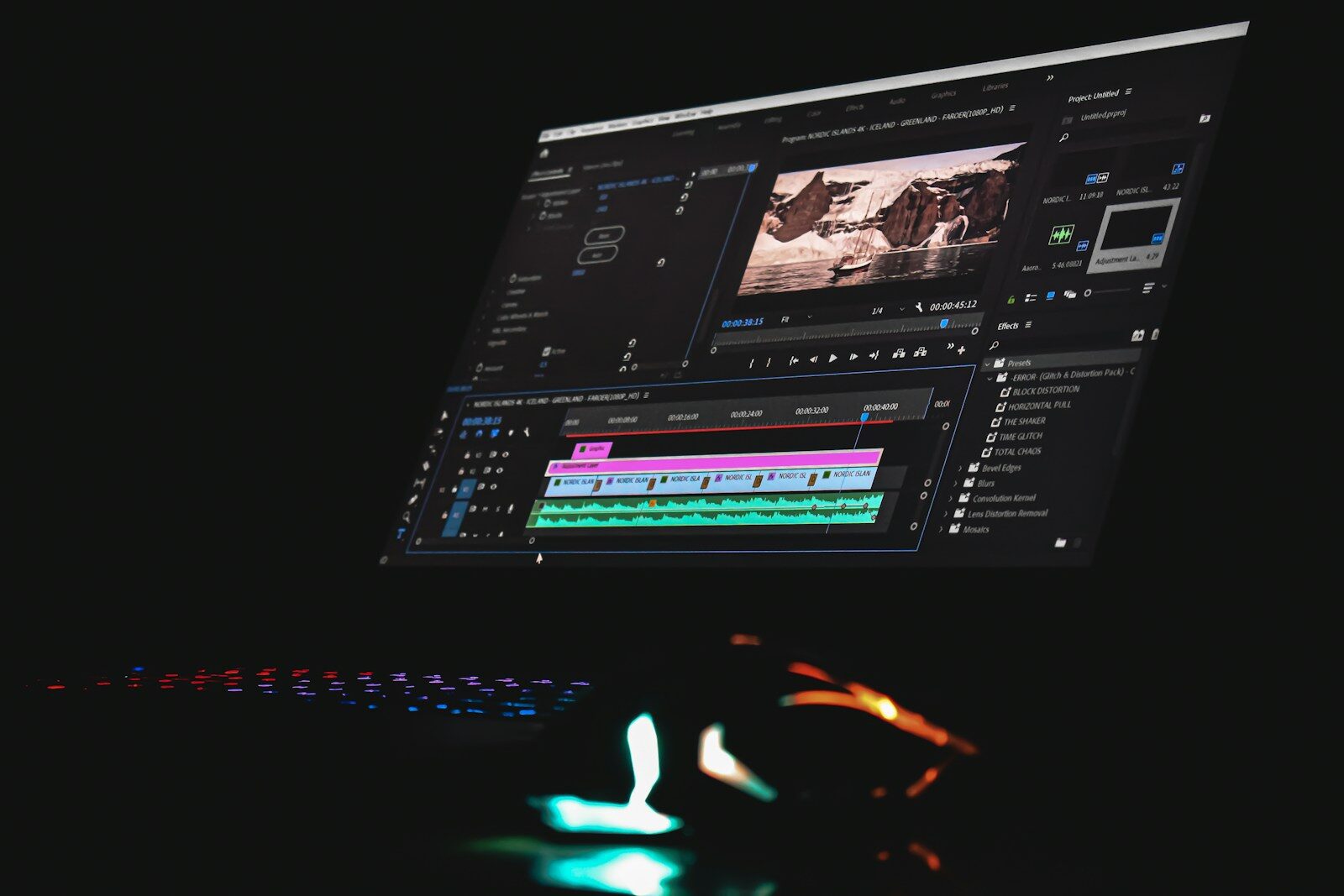
Choosing the best laptop for video editing is very different from choosing a laptop for ordinary office work. Video editing can put sustained pressure on the processor, graphics card, memory, storage and cooling system at the same time.
A laptop that feels extremely fast while browsing or opening documents can struggle when you start working with 4K footage, multiple video tracks, colour correction, effects, transitions and long exports.
That is why video editors need to look beyond processor branding. A capable GPU can accelerate supported editing workloads, while sufficient RAM helps when working with large projects and multiple applications. Fast SSD storage also matters when importing footage, generating previews and moving large project files.
Display quality is equally important. If you are editing videos for YouTube or social media, a decent IPS panel may be enough. If you are doing serious colour work, however, colour accuracy and gamut become much more important.
Current 2026 Indian laptop listings include RTX-equipped gaming and creator machines from Lenovo, ASUS, Acer, HP, Dell and other brands. Current market data also shows RTX 4050-equipped laptops appearing below ₹1 lakh, while premium creator machines can cost considerably more.
This guide focuses on laptops that make sense for different types of video editors, from students and YouTubers to professionals working with demanding 4K projects.
Best Laptops for Video Editing in India at a Glance
| Laptop | Best For | Processor | GPU | RAM / Storage |
|---|---|---|---|---|
| Lenovo LOQ 15 | Best performance/value | Intel Core i5-class H/HX | RTX 4050 | 16GB / 512GB SSD |
| ASUS TUF Gaming A15 | Editing + gaming | AMD Ryzen 7 | RTX 4050/RTX-class GPU depending on configuration | 16GB / 512GB SSD |
| Acer Nitro V / Nitro Lite | Budget creators | Intel Core i5/i7 | RTX 3050/RTX-class GPU | 16GB / 512GB SSD |
| HP Victus 15/16 | Beginner creators | Intel Core i5/i7 or Ryzen 7 | RTX-class GPU | 16GB / 512GB SSD |
| HP OMEN 16 | Serious Windows editing | Intel Core i5/i7 | RTX 4050-class GPU | 16GB / 512GB SSD |
| ASUS ProArt series | Professional creators | High-end Intel/AMD/AI processors | NVIDIA RTX | 16GB–32GB+ |
| MacBook Pro | Professional Apple workflow | Apple M-series Pro | Integrated Apple GPU | 18GB+ / 512GB+ |
Exact configurations and prices vary substantially. Current September 2026 listings show Lenovo LOQ RTX 4050 configurations around ₹83,690, while HP OMEN 16 RTX 4050 configurations appear around ₹87,890.
1. Lenovo LOQ – Strong Performance for Video Editing
The Lenovo LOQ is one of the most interesting choices for editors who want substantial performance without moving immediately into premium creator-laptop pricing.
Current Indian listings include LOQ configurations with Intel Core i5 processors, NVIDIA RTX 4050 graphics, 16GB RAM and 512GB SSD storage. One current listing places a LOQ configuration at approximately ₹83,690.
The combination is important.
The RTX 4050 provides dedicated GPU resources for compatible editing applications, while the high-performance Intel processor handles CPU-heavy tasks.
This makes the LOQ particularly interesting for editors working with:
- YouTube videos
- 1080p projects
- 4K projects
- Motion graphics
- Effects
- Gaming footage
- Screen recordings
- Social media content
The dedicated GPU also makes the laptop useful for gaming, which can be a bonus for creators who want one machine for both work and entertainment.
Why the LOQ makes sense for editors
A video-editing laptop needs sustained performance.
Exporting a project can take several minutes or longer, depending on the footage and effects.
A machine designed around performance and cooling can be more suitable for these workloads than an ultra-thin laptop designed primarily around portability.
Current gaming-laptop listings also show the LOQ with an RTX 4050, 24GB RAM and an IPS display in the under-₹1-lakh category.
2. ASUS TUF Gaming A15 – Editing and Gaming in One Laptop
The ASUS TUF Gaming A15 is another practical choice for creators who also want gaming performance.
The TUF series is primarily marketed as a gaming family, but its hardware can also be useful for video editing.
A high-performance Ryzen processor, dedicated NVIDIA graphics and 16GB RAM can provide the kind of hardware acceleration and multitasking capability useful for Premiere Pro and DaVinci Resolve.
Who should buy it?
The TUF Gaming A15 makes sense for:
- YouTubers
- Gaming creators
- Students learning video editing
- Freelancers
- Streamers
- Editors who also play PC games
The compromise
The biggest disadvantage is portability.
Gaming laptops are generally heavier than creator-focused ultrabooks.
If you edit at home or in an office, this may not matter.
If you travel frequently for shoots, a lighter creator laptop may be more convenient.
3. Acer Nitro V / Nitro Lite – Good Starting Point for Creators
Acer’s Nitro family provides another route into dedicated-GPU video editing.
Current September 2026 listings show the Acer Nitro Lite 16 with an Intel Core i5-13420H processor, 16GB DDR5 RAM, 512GB SSD and an NVIDIA GeForce RTX 3050 6GB GPU at approximately ₹94,990.
This type of configuration is useful for creators who need more GPU performance than an ordinary integrated-graphics laptop can provide.
Why dedicated graphics matter
Modern editing applications can use the GPU for various accelerated tasks.
Depending on the software and codec, the GPU can contribute to effects, playback, encoding and rendering.
DaVinci Resolve in particular can make significant use of GPU resources for many workloads.
That does not mean the CPU is unimportant.
The best editing laptops balance both.
Who should consider Nitro?
- Students
- Beginner editors
- YouTubers
- Freelancers
- Gaming creators
- Users moving from basic laptops to dedicated-GPU machines
4. HP Victus – Good for Beginner and Intermediate Editors
The HP Victus family sits between mainstream laptops and more premium gaming machines.
Current 2026 market coverage includes Victus configurations with dedicated NVIDIA graphics and Ryzen or Intel processors in the creator-friendly price range.
A configuration with Ryzen 7, RTX 4050, 16GB RAM and a 144Hz display is currently listed by one Indian source around ₹62,990, although configurations and retail pricing can vary.
For a beginner creator, this combination can be particularly attractive.
You get:
- A modern high-performance CPU
- Dedicated graphics
- 16GB RAM
- Fast SSD storage
- High-refresh-rate display
- Windows compatibility
The display, however, deserves careful consideration.
A high refresh rate is useful for gaming and smooth motion, but it does not automatically mean the panel is ideal for professional colour grading.
If your work is heavily colour-sensitive, check the panel’s colour coverage and accuracy before purchasing.
5. HP OMEN 16 – More Premium Windows Option
The HP OMEN series sits above Victus in HP’s gaming lineup and can also work well as a creator machine.
A current listing shows an HP OMEN 16-wd0770TX with a 13th-generation Intel Core i5-13420H processor, RTX 4050 6GB graphics, 16GB DDR5 RAM and 512GB PCIe Gen4 SSD at approximately ₹87,890. It also has a 16.1-inch Full HD 144Hz display.
This is a more performance-oriented configuration than a conventional office laptop.
The RTX 4050 gives creators dedicated GPU resources, while the 16GB DDR5 memory is appropriate for many mainstream editing workflows.
Who should consider it?
The OMEN 16 is suitable for:
- Professional freelancers
- YouTube creators
- Gaming creators
- Video editors
- Students studying media production
- Users who want gaming and editing in one machine
6. ASUS ProArt – Designed Around Creative Workflows
ASUS ProArt laptops are designed specifically with creative professionals in mind.
That makes them different from gaming laptops.
A gaming laptop typically prioritizes frame rates, cooling and gaming performance.
A creator-focused laptop puts considerably more emphasis on:
- Display quality
- Colour accuracy
- Creator controls
- Professional connectivity
- Sustained creative workloads
- Portability
- High-end CPU/GPU combinations
Current 2026 creator-laptop coverage includes ASUS ProArt models among premium options for professional creative workflows.
If you are editing professionally and your income depends on your laptop, this category deserves attention.
The downside is price.
Premium creator laptops can cost considerably more than gaming laptops with similar raw specifications.
You are paying for the complete creator-oriented package rather than simply the fastest possible GPU.
7. MacBook Pro – Professional Editing on macOS
For editors who prefer macOS, the MacBook Pro remains an important option.
Apple’s professional MacBook models combine powerful Apple silicon processors with unified memory and hardware acceleration designed around Apple’s media ecosystem.
Current 2026 creator-laptop testing includes the MacBook Pro M5 Pro among professional creator machines.
It can be particularly attractive if your workflow involves:
- Final Cut Pro
- ProRes
- Motion
- Professional photography
- Audio production
- Mobile editing
- Apple ecosystem integration
Why MacBook Pro is different
Apple’s hardware and software are tightly integrated.
The result is not directly comparable with a Windows gaming laptop based solely on CPU and GPU specifications.
The MacBook Pro can also provide a quieter, more portable professional editing experience than many high-performance gaming laptops.
The limitation
The biggest issue is price.
Professional MacBook Pro configurations can become significantly more expensive as you increase memory and storage.
If your budget is limited, a Windows laptop with an RTX GPU may provide more raw GPU hardware for the money.
What Makes a Good Video Editing Laptop?
A common mistake is to focus almost entirely on the processor.
Video editing is a multi-component workload.
You need to evaluate at least six major areas.
1. Processor
The CPU handles many important tasks, including:
- Timeline operations
- Encoding
- Decoding
- Application responsiveness
- Effects processing
- General multitasking
A modern high-performance processor is therefore important.
For heavier workloads, H-series, HX-series or comparable high-performance processors can be more appropriate than low-power U-series chips.
But the fastest CPU is not always the best choice.
Thermal performance matters.
A laptop that can sustain high performance for a long export can be more useful than one that produces excellent short benchmark results but reduces performance after heating up.
2. Graphics Card
For serious video editing, a dedicated GPU can be extremely useful.
NVIDIA RTX GPUs are particularly relevant because many creator applications can take advantage of CUDA and other GPU acceleration technologies.
The RTX 4050 is an interesting starting point for more demanding editors because it offers dedicated graphics and 6GB of VRAM in many laptop configurations.
Current Indian listings show RTX 4050 laptops available below ₹1 lakh, although exact prices vary by model.
Is a dedicated GPU mandatory?
No.
Basic 1080p editing can be performed on laptops without dedicated graphics.
But as your workload becomes more demanding, the benefits of dedicated GPU hardware increase.
3. RAM
For video editing, RAM is extremely important.
8GB RAM
Suitable mainly for:
- Basic editing
- Short 1080p projects
- Simple social media content
It is not what I would target for a new serious editing laptop.
16GB RAM
A good starting point for:
- 1080p editing
- YouTube
- Social media
- Basic 4K projects
- Multitasking
32GB RAM
Better for:
- Heavy 4K editing
- Large projects
- After Effects
- Multitasking
- Motion graphics
- Professional workflows
64GB RAM
Useful for:
- Complex professional projects
- Heavy After Effects work
- Large 4K/6K timelines
- 3D workflows
- Advanced multitasking
You do not need 64GB simply because more RAM exists.
Choose based on your actual workload.
4. SSD Storage
Video files are large.
A single project can easily occupy tens or hundreds of gigabytes.
For this reason, 512GB should be considered a practical minimum rather than an ideal amount for serious creators.
A 1TB SSD is considerably more comfortable.
Professional editors working with large footage libraries may eventually need 2TB or external storage.
Why SSD speed matters
Fast storage helps with:
- Importing footage
- Generating previews
- Loading projects
- Scrubbing files
- Exporting
- Moving media
However, SSD speed is only one part of the equation.
Capacity matters just as much.
5. Display
The display becomes more important as your editing becomes more professional.
For basic YouTube editing, a decent Full HD IPS display can be enough.
For colour-critical work, look for:
- High colour coverage
- Accurate colour reproduction
- Good factory calibration
- High resolution
- Adequate brightness
- Good viewing angles
OLED displays can provide excellent contrast and image quality, but OLED alone does not guarantee professional colour accuracy.
Always check the complete panel specification.
6. Cooling
Video editing can create long periods of sustained processor and GPU usage.
This means cooling matters.
Poor cooling can lead to:
- Higher temperatures
- Fan noise
- Thermal throttling
- Lower sustained performance
This is one reason gaming laptops can be surprisingly good editing machines.
Their cooling systems are designed around sustained high-power CPU and GPU workloads.
The downside is that they can be heavier and louder.
Best Laptop for 1080p Video Editing
You do not need a ₹2 lakh laptop to edit 1080p video.
A good configuration with:
- Modern Core i5/Ryzen 5 or better
- 16GB RAM
- 512GB SSD
- Dedicated RTX graphics
can provide a solid starting point.
HP Victus, Acer Nitro, ASUS TUF and Lenovo LOQ configurations are worth considering in this category.
For basic YouTube content, such a laptop can provide considerably more performance than a typical office notebook.
Best Laptop for 4K Video Editing
4K editing increases the hardware requirements significantly.
You should ideally target:
- High-performance CPU
- Dedicated GPU
- 6GB or more GPU memory where possible
- 32GB RAM for heavier workflows
- 1TB SSD
- High-quality display
A 16GB system can still edit 4K footage, particularly with optimized workflows and proxies, but 32GB provides more breathing room.
The RTX 4050 class is a useful starting point for editors who need dedicated GPU acceleration without immediately moving into very expensive workstation hardware.
What Are Proxy Files?
Proxy editing can make a major difference on less powerful hardware.
Instead of editing the original high-resolution footage directly, the software generates lower-resolution proxy files.
You edit the lightweight files and the software uses the original footage during the final export.
This reduces the performance required for real-time timeline playback.
As a result, you do not necessarily need an extremely expensive laptop just because your camera records 4K or 6K footage.
Best Laptop for Premiere Pro
Adobe Premiere Pro benefits from a balanced system.
A good Premiere Pro laptop should ideally have:
- Strong CPU
- Dedicated GPU
- 16GB–32GB RAM
- Fast SSD
- Good display
- Efficient cooling
For serious editing, an RTX 4050 or better can be an attractive option in Windows laptops.
However, GPU requirements vary depending on the effects, codecs, resolution and project complexity.
Best Laptop for DaVinci Resolve
DaVinci Resolve can make substantial use of GPU resources, particularly for colour grading and effects.
This makes NVIDIA RTX-equipped laptops particularly interesting for Windows users.
A laptop with:
- RTX GPU
- 16GB–32GB RAM
- Strong CPU
- Fast SSD
can be a good Resolve workstation.
For advanced colour grading and heavy Fusion workflows, additional GPU memory and system RAM become increasingly important.
Best Laptop for After Effects
Adobe After Effects has somewhat different requirements from basic video editing.
It can be heavily dependent on CPU performance and system memory, particularly when working with complex compositions.
If After Effects is a major part of your workflow, consider:
- 32GB RAM or more
- Strong CPU
- Fast SSD
- Dedicated GPU
- Good cooling
Do not buy a laptop solely because it has a powerful graphics card.
RAM and CPU performance can be equally important.
MacBook vs Windows Laptop for Video Editing
This is one of the most common questions among creators.
MacBook Advantages
MacBooks can offer:
- Excellent battery efficiency
- Strong media acceleration
- High-quality displays
- Quiet operation
- Good portability
- Excellent Final Cut Pro integration
Windows Advantages
Windows laptops offer:
- More hardware variety
- NVIDIA RTX GPUs
- More price points
- Better gaming support
- Upgradeable configurations on many models
- Broader hardware selection
For Adobe Premiere Pro and DaVinci Resolve, both platforms can work extremely well.
The best choice depends on software preference, budget and workflow.
How Much Should You Spend on a Video Editing Laptop?
Under ₹50,000
Suitable mainly for:
- Basic 1080p editing
- Short videos
- Social media
- Learning video editing
Try to target 16GB RAM if possible.
₹50,000–₹75,000
This is an interesting segment for beginner and intermediate creators.
You can start finding laptops with:
- Dedicated RTX graphics
- 16GB RAM
- High-performance CPUs
- 512GB SSDs
Current Indian creator-laptop coverage identifies this range as an important value segment for editors.
₹75,000–₹1,00,000
This is where you can start looking seriously at:
- RTX 4050
- Better displays
- Stronger CPUs
- 16GB–32GB RAM
- Larger SSDs
Current listings show RTX 4050 laptops from Lenovo and HP within or around this range.
Above ₹1,00,000
You gain access to:
- Higher-end RTX GPUs
- Better creator displays
- Larger memory configurations
- Premium builds
- MacBook Pro configurations
- Professional creator laptops
This is where professional editors who earn directly from their work may find the additional investment more justifiable.
Should You Buy a Gaming Laptop for Video Editing?
Yes, in many cases.
A gaming laptop can actually be one of the most cost-effective ways to get:
- High-performance CPU
- NVIDIA GPU
- Good cooling
- 16GB RAM
- Fast SSD
The main compromises are usually:
- Weight
- Battery life
- Fan noise
- Design
- Display colour accuracy
If you primarily edit at a desk, these compromises may be acceptable.
If you travel frequently for client shoots, a creator laptop may be more practical.
Is OLED Better for Video Editing?
OLED can be excellent for editing because of its high contrast and image quality.
However, you should not buy a laptop just because it says “OLED.”
Check:
- Colour gamut
- Colour accuracy
- Brightness
- Resolution
- Calibration
- Refresh rate
For professional colour work, accurate colour reproduction matters much more than the marketing term used for the display technology.
Do You Need 32GB RAM for Video Editing?
Not always.
For 1080p YouTube videos, 16GB can be enough.
For 4K editing, 32GB becomes more attractive.
For After Effects, large timelines, multicamera editing and professional workloads, 32GB or more can significantly improve the working experience.
If the laptop allows a RAM upgrade, starting with 16GB can be reasonable.
What Storage Setup Is Best for Editors?
A practical editing setup is:
1TB internal SSD + external SSD
The internal drive can contain:
- Windows/macOS
- Editing software
- Current projects
- Cache
The external SSD can contain:
- Raw footage
- Completed projects
- Archive files
- Backup media
Avoid relying on a single drive for everything.
Important video projects should always have a backup.
Common Mistakes When Buying a Video Editing Laptop
Choosing the CPU and Ignoring the GPU
Modern editing software can benefit significantly from GPU acceleration.
Buying 8GB RAM
Eight gigabytes can quickly become restrictive for serious editing.
Buying a Beautiful Display With Weak Hardware
An OLED display does not compensate for insufficient processing performance.
Buying a Powerful GPU With a Poor Display
The opposite is also true.
If you need colour-critical work, the display matters.
Ignoring Storage
Video files are huge.
A 512GB drive can become full very quickly.
Ignoring Cooling
Sustained rendering is much more demanding than short benchmark tests.
Believing Every Manufacturer Battery Claim
Video editing is a demanding workload and can drain batteries quickly.
Buying Without Checking Software Compatibility
This is particularly important when considering ARM-based Windows laptops.
Frequently Asked Questions
Which is the best laptop for video editing in India in 2026?
The right choice depends on budget and workload. For Windows users, RTX-equipped laptops such as Lenovo LOQ, ASUS TUF, HP Victus and HP OMEN provide strong options across different price segments. Premium creators can consider dedicated creator laptops or MacBook Pro models.
Is RTX 4050 good for video editing?
Yes. RTX 4050 laptops provide dedicated GPU resources and 6GB of VRAM in common configurations, making them a useful starting point for more demanding editing workloads. Current Indian listings show RTX 4050 laptops available below ₹1 lakh.
Is 16GB RAM enough for Premiere Pro?
For many 1080p workflows, yes. For demanding 4K projects, After Effects and heavy multitasking, 32GB is more comfortable.
Is 16GB RAM enough for DaVinci Resolve?
It can be sufficient for many projects, particularly 1080p editing. More complex 4K colour-grading and Fusion workflows can benefit from additional RAM.
Is a gaming laptop good for video editing?
Yes. Gaming laptops often provide powerful CPUs, dedicated GPUs and strong cooling. Their main disadvantages for editing are weight, battery life, fan noise and sometimes mediocre colour accuracy.
Is MacBook better than Windows for video editing?
Both can be excellent. MacBooks are particularly attractive for users invested in Final Cut Pro and Apple’s media ecosystem, while Windows provides more hardware choices and NVIDIA GPU options.
How much RAM is recommended for 4K video editing?
16GB can work with optimized workflows, but 32GB is a more comfortable target for regular 4K editing.
Is 512GB SSD enough for video editing?
It is workable for software and smaller projects, but 1TB or more is preferable for editors who regularly handle large footage libraries.
Do I need an RTX GPU for Premiere Pro?
No. Premiere Pro can run without a dedicated RTX GPU. However, a capable dedicated GPU can improve performance in supported GPU-accelerated workloads.
Is OLED necessary for video editing?
No. OLED can provide excellent image quality, but a good IPS display with accurate colour reproduction can also be suitable for editing.
Final Verdict
The best video-editing laptop is not necessarily the laptop with the highest benchmark score.
For most creators, the ideal system is a balance of CPU performance, dedicated GPU capability, RAM, fast SSD storage, display quality and sustained cooling.
For beginners editing YouTube videos and social-media content, a 16GB laptop with a modern processor and dedicated RTX graphics can provide plenty of performance without requiring a massive budget.
For serious 4K editors, moving toward 32GB RAM, a stronger RTX GPU and a 1TB SSD makes more sense.
For Windows users, models such as the Lenovo LOQ, ASUS TUF, Acer Nitro and HP Victus provide several performance-oriented configurations, while the HP OMEN and creator-focused ASUS ProArt machines target users willing to spend more for a more premium experience. Current Indian listings confirm RTX 4050-equipped systems from Lenovo and HP in the sub-₹1-lakh region.
For professional editors who prefer macOS, the MacBook Pro remains a major option, particularly for workflows built around Apple’s media technologies. Current creator testing continues to include MacBook Pro models among professional editing machines.
The most important point is to match the laptop to your editing workload.
A student editing short 1080p videos does not need the same hardware as a filmmaker working with 4K footage, and a colourist has different priorities from a gaming YouTuber.
Before buying, check the exact CPU, GPU, VRAM, RAM, SSD, display colour coverage, upgradeability and cooling system. Prices and configurations change frequently in India, so verify the exact model before making the final purchase.