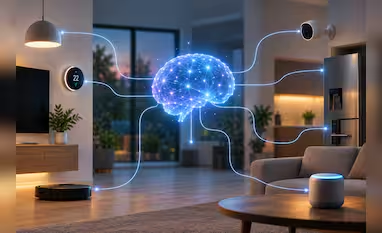
The AI Smart Home is entering a new phase as major technology companies move beyond simple voice commands and begin connecting artificial intelligence agents directly with household devices. Google, Amazon, Samsung and Apple are developing systems that allow AI to understand what is happening inside a home, access information from connected devices and, in some cases, take actions on behalf of users. The shift is turning the smart home from a collection of connected gadgets into an interface between AI software and the physical world.
The AI Smart Home concept is becoming more important because the competition is no longer limited to which company has the best smart speaker, thermostat or connected appliance. The emerging competition is over the control layer that connects an AI agent with the physical devices inside a home. That layer determines what information an AI can access, which devices it can see and what actions it is permitted to perform.
Google has taken a significant step in the AI Smart Home space by opening its Google Home platform to external AI agents through Model Context Protocol, or MCP. The technology allows compatible AI applications to connect with Google Home, discover supported devices, monitor their current states, review historical events and perform supported controls. This means an AI agent does not necessarily have to be Google’s own Gemini system to interact with a connected home.
The development of the AI Smart Home through Google is notable because the company is pursuing two approaches simultaneously. Google has its own Gemini for Home assistant, while its Home MCP system allows other compatible AI applications to access the Google Home ecosystem. This creates separate routes through which AI can interact with the same household devices.
Google’s AI Smart Home approach effectively turns Google Home into a bridge between AI software and physical devices. An external agent could potentially inspect device information, analyse historical activity and execute supported controls through the platform. Google describes its MCP server as a proxy between smart-home infrastructure and AI applications, creating a software interface through which an agent can interact with the physical environment.
The current Google implementation of the AI Smart Home concept is still in early access and requires a Google Home Premium Advanced subscription in the United States. The company has not announced when the feature will be expanded more broadly. Even so, the architecture indicates how smart-home platforms could increasingly become infrastructure for multiple AI agents rather than remaining tied to a single assistant.
Amazon is approaching the AI Smart Home from a different direction with Alexa+. The generative AI assistant launched in India on September 16 and can understand natural-language instructions, control compatible smart-home devices and coordinate multiple actions. Instead of requiring users to issue individual commands, the system is designed to understand broader requests and determine which connected devices should respond.
For example, an AI Smart Home powered by Alexa+ could respond to a statement that a room is too hot by activating an air conditioner rather than requiring the user to identify the specific device and command. Amazon is also giving Alexa+ access to household context, including preferences, routines, household members and factors such as time of day and location within the home.
Samsung has developed another model for the AI Smart Home, centred around its SmartThings platform and connected appliances. Samsung’s ecosystem links products including air conditioners, televisions, refrigerators and washing machines. Its AI-enabled appliances and SmartThings platform can use information from different devices to understand household routines and automate certain activities.
The Samsung approach means the AI Smart Home does not necessarily depend on one standalone assistant. Instead, intelligence is distributed across appliances, Bixby, SmartThings and other parts of Samsung’s ecosystem. SmartThings increasingly acts as the layer connecting these products, allowing information from different areas of the home to be combined.
Apple is also moving toward an AI Smart Home model by connecting Apple Intelligence and Siri with the company’s Home ecosystem. Apple’s approach places greater emphasis on personal context and information generated by devices. Home cameras, thermostats, door sensors and lights can generate data that gives an AI system a more detailed picture of what is happening inside the home.
This information is particularly important for the AI Smart Home because the value of an AI agent increases when it can understand multiple signals at the same time. A traditional smart-home system might tell a user that a camera detected movement or that a thermostat registered a temperature change. An AI agent could potentially combine those signals and provide a more contextual explanation or take an appropriate supported action.
The emergence of the AI Smart Home is also connected to two different technology standards: Matter and MCP. Matter focuses primarily on interoperability between smart-home devices, allowing products from different manufacturers to communicate with compatible ecosystems. MCP addresses a different problem by allowing AI applications to interact with external systems, data and tools.
In simple terms, the AI Smart Home could use Matter to help devices communicate with one another while MCP provides a way for an AI agent to interact with the systems controlling those devices. This creates a layered architecture in which hardware interoperability and AI access can operate together rather than requiring every AI company to develop a separate connection for every individual appliance.
The biggest change in the AI Smart Home is therefore not simply that an AI can switch a light on or off. The more important development is that an AI agent can potentially understand the broader state of a home. It could examine connected-device information, review historical events, identify patterns and then use available controls to respond to a user’s request.
For example, an AI Smart Home could eventually allow users to ask questions about household activity in natural language. Instead of manually checking different applications, a user could ask an AI to analyse security-camera events, determine how often a particular appliance was used or explain unusual activity based on information stored across connected devices. Google has highlighted examples involving cross-camera analysis, device history and custom home-control dashboards.
The growing capabilities of the AI Smart Home also raise important questions about permissions. Giving an AI access to lights or entertainment devices is relatively low risk, but allowing it to interact with door locks, heating systems, security equipment or other critical infrastructure creates a different level of responsibility. The AI needs to know not only what it can do but also what it should not do.
Security and privacy will therefore become central to the development of the AI Smart Home. A connected home generates a large amount of sensitive information about household routines. Device states can reveal when people are at home, when they sleep, when doors open and close and how rooms are used. Giving AI systems access to that information creates new possibilities but also increases the importance of strong permission and data-protection mechanisms.
Google has acknowledged these concerns around its AI Smart Home integration. Its Home MCP documentation warns that connecting a real home to an AI agent gives that agent access to device information and control capabilities. Google has also placed restrictions on certain sensitive actions, including preventing the system from allowing agents to unlock doors.
The permission layer could become one of the most important elements of the AI Smart Home market. Different platforms can decide whether users control permissions device by device or whether the platform itself determines which actions are allowed. Home Assistant, for example, allows users to select which individual devices and entities are exposed to an AI client, while Google’s approach applies restrictions at the platform level.
This means the future AI Smart Home may be shaped as much by permission architecture as by AI intelligence. Consumers will need to understand what information their AI can access, which devices it can control and whether actions require confirmation. The companies controlling these interfaces will effectively determine how much authority AI agents receive inside people’s homes.
Another important development is the possibility of multiple AI agents operating within the same AI Smart Home. Google’s decision to allow external agents to connect to Google Home means users may eventually be able to choose different AI systems depending on the task. One agent could handle general questions, another could analyse security footage and another could help manage complex household automation.
This could change the relationship between consumers and smart-home platforms. Instead of being locked into a single assistant, users could potentially choose the AI agent they prefer while continuing to use the same underlying device ecosystem. The platform that controls the home would then become the infrastructure layer through which different AI services operate.
The AI Smart Home could also become more proactive. Traditional smart-home systems generally depend on predefined automations such as turning lights on at a particular time or adjusting a thermostat when a specific temperature is reached. AI agents could potentially analyse several factors simultaneously and respond to changing circumstances rather than following only fixed rules.
However, greater autonomy also creates greater risk. An AI Smart Home system that misunderstands a user’s request could activate the wrong device or make an unwanted change. This is especially important when AI systems are connected to physical equipment. A mistake involving a light may be inconvenient, while a mistake involving heating, security or other equipment could have more serious consequences.
The wider AI industry is also moving toward physical-world integration beyond homes. Anthropic, for example, has been developing its Model Hardware Standard for AI agents operating physical equipment in areas such as scientific laboratories and robotics. This broader development shows how AI systems are increasingly being designed to observe physical environments, make decisions and interact with machines.
The AI Smart Home could become one of the most accessible examples of this transition because millions of households already have connected devices. Smart cameras, thermostats, televisions, appliances, lighting systems and sensors provide the physical infrastructure that AI agents need in order to move beyond purely digital tasks.
For consumers, the practical value of the AI Smart Home will ultimately depend on reliability. People may welcome an AI that can understand household context and reduce repetitive tasks, but they are unlikely to trust a system that frequently misunderstands instructions or performs unexpected actions. As a result, accurate device control and predictable behaviour will be just as important as sophisticated language capabilities.
The next stage of the AI Smart Home is therefore likely to focus on combining intelligence, interoperability and safety. Matter can help devices communicate, while systems such as MCP can provide AI applications with access to external tools and information. Platforms such as Google Home, Alexa, SmartThings and Apple Home can then serve as the control infrastructure connecting those capabilities with physical devices.
Overall, the AI Smart Home is evolving from a collection of remotely controlled gadgets into an environment that AI agents can potentially understand and interact with. Google is opening its Home platform to external agents, Amazon is expanding Alexa+ across services and connected devices, Samsung is integrating AI throughout SmartThings and appliances, while Apple is connecting intelligence with the context generated by its Home ecosystem.
The biggest question for the future of the AI Smart Home may therefore not be which company has the smartest AI. It may be which company controls the layer between AI and the physical world. That layer determines what an AI can see, what it can understand and what it is allowed to do. As AI agents become more capable, the smart home could become one of the first places where software intelligence and the physical environment are directly connected at scale.