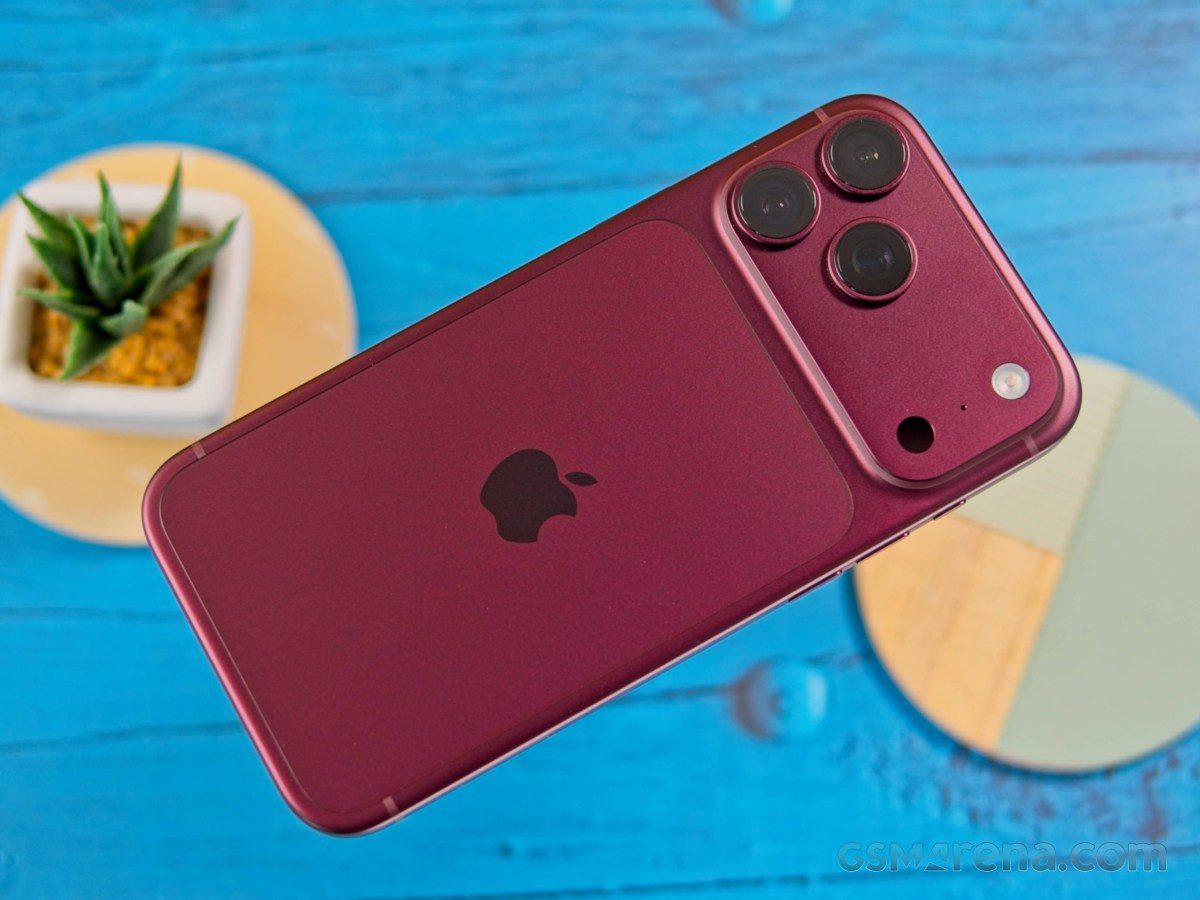

Apple has finally entered the foldable smartphone market with the iPhone Duo, but Xiaomi has already arrived with a device that could make Apple’s first attempt look surprisingly familiar. The Xiaomi 18 Fold is a new wide-format foldable that closely resembles Apple’s passport-style approach while offering several hardware advantages, including a much larger battery, faster charging and a more advanced camera system.
The timing could hardly be more interesting. Xiaomi unveiled the 18 Fold just days before Apple’s iPhone Duo announcement, giving consumers a direct look at two competing interpretations of the same emerging foldable design. The Xiaomi phone was announced in China on September 7 and went on sale shortly afterward, while Apple’s iPhone Duo is scheduled to reach customers on October 23.
At first glance, the similarities are difficult to ignore.
The Xiaomi 18 Fold has a 5.38-inch outer display and a 7.58-inch inner folding display, while Apple’s iPhone Duo uses a 5.4-inch outer display and a 7.6-inch inner screen. Both phones use a wide, short design that resembles a passport when folded rather than the taller, narrower shape associated with some earlier book-style foldables.
That makes Xiaomi one of the closest hardware competitors to Apple’s new foldable.
The difference is that Xiaomi is not simply competing on appearance. The company has packed the 18 Fold with specifications that could appeal strongly to users who care about cameras, battery life and charging speed.
The Xiaomi 18 Fold uses a 6,000mAh silicon-carbon battery, supporting 67W wired charging and 50W wireless charging. Those numbers are substantially more aggressive than what Apple is offering with the iPhone Duo. Xiaomi’s battery technology could therefore become one of the biggest practical advantages for people who use a foldable phone heavily throughout the day.
Apple’s iPhone Duo, meanwhile, takes a different approach. Apple has built the phone around two batteries integrated into the folding body and claims up to 31 hours of video playback on the inner display and up to 44 hours when using the outer display.
The real-world comparison will ultimately depend on software optimization, screen brightness, network usage and individual workloads, but Xiaomi’s larger battery gives it an obvious hardware advantage on paper.
The camera system is another area where Xiaomi appears to have gone much further.
The Xiaomi 18 Fold features a Leica-branded triple-camera system, including a 200MP main camera and a 50MP telephoto camera. The configuration gives Xiaomi a dedicated telephoto option that the iPhone Duo does not have.
Apple’s iPhone Duo instead has a dual 48MP rear-camera system consisting of a main camera and an ultra-wide camera. Apple has added computational photography features such as Smart Take and Duo Preview, but there is no dedicated telephoto lens in the Duo’s rear camera setup.
That could become one of the most significant differences between the two devices for photography enthusiasts.
Apple has built its reputation around computational photography, image processing and tight integration between hardware and software. Xiaomi, however, is attacking the problem with high-resolution sensors, Leica tuning and a dedicated zoom camera.
So while the Xiaomi 18 Fold looks stronger on the specification sheet, the iPhone Duo could still deliver excellent photographs through Apple’s processing and imaging algorithms.
The displays are also remarkably close in size.
Xiaomi’s inner screen measures 7.58 inches and supports a 120Hz LTPO refresh rate, while its outer display measures 5.38 inches and also supports 120Hz. The displays can reportedly reach up to 4,000 nits of peak brightness.
Apple’s inner display is 7.6 inches, while its outer screen measures 5.4 inches. Both support ProMotion with adaptive refresh rates up to 120Hz and peak brightness of up to 3,000 nits. Apple also uses a nano-texture finish on the inner display to reduce reflections and make the fold less visually distracting.
The crease is another area where both companies have focused considerable engineering effort.
Xiaomi uses a redesigned Dragon Bone hinge, which the company says went through 492 structural optimizations. Apple has developed its own custom hinge system and has focused heavily on minimizing the appearance of the crease.
Apple’s approach appears particularly focused on making the inner display look as close to a conventional flat screen as possible. The nano-texture finish is designed to reduce glare and make the fold line less noticeable.
This matters because the crease remains one of the most visible reminders that a foldable phone is using flexible display technology.
Both companies therefore appear to be moving toward the same goal: making the folding screen feel increasingly similar to a normal premium display.
The design philosophy is where the comparison becomes even more interesting.
Apple has described the iPhone Duo as a pocketable device that opens into a larger workspace and entertainment screen. Its software has been redesigned around different orientations and positions, allowing the phone to behave differently depending on how it is opened or positioned.
Xiaomi’s approach is more firmly rooted in the Android foldable ecosystem. The 18 Fold runs Xiaomi’s HyperOS and uses its large inner screen for multitasking and content consumption.
The Xiaomi phone can therefore offer many of the familiar advantages Android foldables have developed over several generations, while Apple’s software is attempting to introduce its own interpretation of the category.
This could ultimately be where the two phones differ most.
Apple has an enormous advantage in ecosystem integration. An iPhone Duo can connect directly into the broader iPhone, Mac, Apple Watch, AirPods and iCloud ecosystem. For someone already invested in Apple products, moving to a foldable iPhone does not require changing the way they use their digital life.
Xiaomi cannot replicate that exact ecosystem.
However, Xiaomi has another advantage: Android has already spent years adapting applications and system interfaces to foldable screens.
Samsung, Google, Xiaomi and other manufacturers have collectively helped establish foldable multitasking conventions. Apple is entering a category where many of those software challenges have already been explored by competitors.
That is why the iPhone Duo’s software could be more important than its hardware.
Recent hands-on analysis has noted that Apple’s hardware is not dramatically ahead of existing Android foldables, with similar designs already appearing from Samsung, Huawei and Xiaomi. The more distinctive aspect of the Duo is Apple’s effort to integrate the folding design deeply into iOS 27.
Apple has introduced fold-aware interface changes, new multitasking experiences and layouts designed to make the inner and outer displays feel like parts of the same device rather than two separate screens.
That could be Apple’s biggest weapon.
Price, however, gives Xiaomi another major advantage.
The Xiaomi 18 Fold starts at 10,999 yuan in China, equivalent to roughly $1,638 before taxes and other market adjustments. The iPhone Duo starts at $1,999 in the United States, making Apple’s device considerably more expensive.
In India, the difference becomes even more significant.
Apple has officially priced the iPhone Duo from ₹2,99,900, with the phone scheduled to become available on October 23.
Xiaomi, however, has not announced an Indian launch for the 18 Fold. The phone’s China-only availability currently limits its direct competition with Apple in markets such as India, Europe and North America.
That may be one of the most important limitations of the Xiaomi 18 Fold.
A phone can have outstanding specifications, but if consumers cannot officially buy it in their country, its impact on the market remains limited.
Apple, on the other hand, is launching the iPhone Duo across more than 70 countries and regions, including India, where it will be available through Apple’s online store and selected partners.
This gives Apple a massive distribution advantage.
The iPhone Duo is also entering the market with the A20 Pro chip, Apple’s latest high-end processor. Xiaomi uses its own XRING 03 3nm chipset, which is designed to provide flagship performance and AI capabilities.
It is too early to declare a definitive performance winner without extensive independent testing.
On paper, however, Xiaomi’s strategy is clear: offer aggressive hardware specifications, a huge battery and powerful camera system, while Apple is emphasizing custom silicon, software integration and ecosystem features.
The two companies are effectively taking opposite approaches to the same category.
Xiaomi is saying: look at how much hardware we can fit into this foldable.
Apple is saying: look at what the entire iPhone experience can become when it folds.
That distinction could determine which phone consumers ultimately prefer.
For photography enthusiasts, Xiaomi’s 200MP Leica camera and dedicated telephoto system could be extremely attractive.
For heavy users who dislike frequent charging, the 6,000mAh silicon-carbon battery and 67W wired charging could make the Xiaomi 18 Fold particularly compelling.
For Apple ecosystem users, however, the iPhone Duo’s integration with iOS, Apple Intelligence, Siri AI and Apple’s wider ecosystem could be worth paying substantially more.
The physical design also creates an interesting choice.
The Xiaomi 18 Fold weighs around 260 grams, while the iPhone Duo weighs 254 grams. Both are therefore relatively substantial devices, although their compact folded dimensions make them easier to carry than some larger foldables.
Apple has also used a titanium frame and emphasizes durability, while Xiaomi’s Dragon Bone hinge is intended to improve structural reliability and reduce the physical compromises traditionally associated with foldables.
The biggest question now is whether Xiaomi’s hardware advantage can compensate for its limited availability.
If the Xiaomi 18 Fold remains exclusive to China, the iPhone Duo could still dominate the premium foldable conversation internationally despite having weaker specifications in several areas.
But if Xiaomi eventually expands the 18 Fold to more markets, Apple could face a much more serious challenge.
The foldable market is already changing rapidly. Samsung remains a major global player, and the Galaxy Z Fold 8 has also moved toward the wider passport-style design.
That means Apple did not arrive in an empty market.
Instead, Apple entered a category that has already been evolving for years.
Samsung has developed multiple generations of folding hardware. Chinese manufacturers have pushed battery technology, charging speeds, camera hardware and thinness. Xiaomi’s latest device is a clear demonstration of how mature the technology has become.
Apple’s challenge is therefore not simply to create a good foldable.
It has to convince millions of existing iPhone users that a foldable iPhone is worth nearly $2,000.
The company may have an advantage because of its enormous customer base and brand loyalty. Analysts cited by Reuters have even predicted that Apple could capture as much as 40% of the foldable market by the end of next year if production meets demand.
That would represent a major shift in a category currently led by Samsung and Chinese manufacturers.
And this is where Xiaomi 18 Fold becomes especially important.
It demonstrates that Apple is not automatically setting the hardware standard simply by entering the market. In areas such as battery capacity, charging speed and camera hardware, Xiaomi is already pushing beyond what Apple is offering.
Apple’s advantage is instead concentrated in software, ecosystem integration, global availability and the enormous appeal of the iPhone brand.
The final verdict will therefore depend heavily on what consumers value.
If specifications are the priority, the Xiaomi 18 Fold looks extremely difficult to ignore.
If software experience and ecosystem integration matter more, the iPhone Duo becomes much more compelling.
And if availability matters most, Apple’s global launch gives it an enormous advantage over Xiaomi’s China-focused strategy.
For now, the Xiaomi 18 Fold is arguably the most interesting hardware rival to Apple’s first foldable iPhone. Its 5.38-inch outer screen and 7.58-inch inner display closely mirror Apple’s concept, while its 6,000mAh battery, 200MP Leica camera system, dedicated telephoto lens and faster charging give it several advantages on paper.
Apple’s iPhone Duo counters with its A20 Pro chip, titanium construction, 7.6-inch inner display, custom hinge, iOS 27 foldable experience and deep integration with Apple’s ecosystem. It will launch in India at ₹2,99,900 from October 23.
The fascinating part is that both companies have arrived at almost the same physical idea at almost exactly the same moment.
The question is no longer whether foldable phones can become mainstream.
With Apple finally joining Xiaomi, Samsung and other manufacturers, the real question is which company’s version will convince consumers that a foldable phone is worth the premium.
And if Xiaomi ever brings the 18 Fold to global markets, Apple could find itself facing a competitor that challenges the iPhone Duo not with a cheaper imitation, but with more aggressive hardware.