The Rajasthan government is preparing a new Standard Operating Procedure (SOP) for handling protests and demonstrations involving students from Generation Z and Generation Alpha. Under the proposed approach, officials will be encouraged to reach protest sites, listen directly to students and attempt to resolve their concerns through dialogue instead of immediately resorting to force.
The move comes amid a noticeable change in the nature of student protests across Rajasthan. Students in different districts have recently taken to the streets over issues such as inadequate school facilities, teacher shortages, unsafe buildings and other education-related problems.
The proposed SOP is being prepared by the Home Department and is expected to provide officials with a structured response mechanism for dealing with such demonstrations.
One of the key ideas behind the proposed guidelines is that officials should reach the location of a student protest and communicate directly with the protesters. The objective is to understand the specific problem, assess whether it can be resolved immediately and prevent a local grievance from escalating into a larger confrontation.
The proposed approach would place greater emphasis on communication before any coercive action is considered.
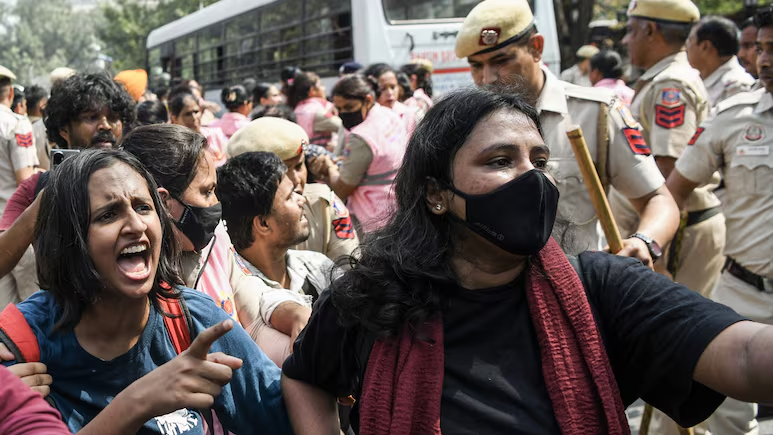
According to reports, the government does not want police action or lathi-charge to become the first response when young students gather to raise genuine grievances. Instead, administrative officials from the concerned departments could be sent to the spot to speak with students and understand their demands.
The change comes at a time when Gen Z and Gen Alpha students have increasingly become visible in public protests.
In Rajasthan, several recent demonstrations have involved school students demanding basic facilities that directly affect their education and safety.
In one incident, students reportedly raised concerns about the condition of their school building and demanded action after finding the structure unsafe. Officials reached the location, spoke with the students and subsequently steps were taken regarding the damaged building.
In another case in Jodhpur, students locked the gates of a government school after raising concerns over an inadequate number of teachers.
Such incidents have highlighted a broader issue for the state administration. Many student protests are not necessarily driven by traditional political demands. Instead, students are often demanding basic facilities such as teachers, classrooms, safe buildings, drinking water and other essential services.
This has made the government’s response particularly important.
A protest involving schoolchildren presents a different administrative challenge from a conventional political demonstration involving organised adult groups.
Officials must consider the age of the protesters, their safety and the possibility that aggressive action could escalate the situation.
The proposed SOP appears to recognise this difference.
The government is considering a response in which officials would first engage with students and attempt to understand the problem.
If the issue falls within the responsibility of another department, the concerned officer could potentially be involved in the discussion so that the students receive a clear response rather than being asked simply to end their protest.
The emphasis on direct communication could also help officials identify whether a protest is based on a genuine administrative problem.
For example, if students are demanding additional teachers, authorities can verify the sanctioned strength and vacancies at the school.
If the complaint concerns an unsafe building, engineers or education officials can inspect the structure.
If students are demanding basic facilities, officials can assess the availability of drinking water, toilets, electricity, classrooms or other infrastructure.
This approach could allow the government to address the underlying issue rather than focusing only on controlling the demonstration.
The development comes against the backdrop of a wider increase in student activism across India.
Generation Z students have become increasingly comfortable using social media to organise, communicate and publicise their grievances.
Generation Alpha, the younger generation now entering secondary school, has also begun appearing in protests over basic educational needs.
Unlike traditional political movements, these student-led demonstrations can spread rapidly through videos, photographs and social-media posts.
A small protest at a school can therefore attract attention beyond the local area within a short period.
This makes early administrative engagement even more important.
If officials reach the location quickly and communicate clearly with students, there may be less opportunity for misinformation, rumours or external political intervention to intensify the situation.
The proposed SOP could therefore become a preventive mechanism rather than simply a set of instructions for managing protests.
The idea is to address the grievance at its source before the situation turns into a confrontation between students and police.
The approach also reflects concerns about the use of force against young protesters.
A police lathi-charge can have serious consequences when children or teenagers are involved.
Even if authorities believe that a protest has become disruptive, using force against young students can generate public anger and further escalate the issue.
The proposed policy does not mean that police intervention would necessarily be eliminated in every situation.
If a demonstration becomes violent, threatens lives or causes serious damage to public property, authorities would still have responsibilities to maintain public safety and law and order.
However, the proposed framework would encourage officials to use dialogue and administrative intervention before reaching that stage.
This distinction is important because not every protest should be treated as a law-and-order problem.
A group of students demanding teachers or safer classrooms may require an administrative solution rather than a policing response.
The government appears to be moving toward recognising this difference.
The proposal also places greater responsibility on departmental officials.
Education officers, district administration officials and other relevant authorities may need to respond more quickly when students raise complaints.
Instead of waiting for a protest to become large enough to attract police attention, officials could potentially intervene when the first signs of dissatisfaction appear.
This could also improve communication between schools and district administrations.
Many student protests begin after repeated complaints fail to produce visible action.
If students believe that their complaints are being ignored, they may eventually choose demonstrations as a way of attracting attention.
A faster grievance-resolution system could therefore reduce the need for protests in the first place.
The issue of school infrastructure has become particularly significant in Rajasthan.
Students in several areas have raised concerns about damaged buildings, inadequate classrooms, teacher shortages and other basic facilities.
These problems can directly affect attendance, learning outcomes and student safety.
The Rajasthan High Court has also recently taken suo motu cognisance of issues concerning Gen Z, Gen Alpha and Gen Beta, directing attention toward areas including school infrastructure, paper leaks, education, nutrition, mental health and the impact of technology on students. (indianexpress.com)
The court’s intervention has added further attention to the challenges facing younger generations in Rajasthan.
The High Court has stressed that government schools, particularly in rural and village areas, need better infrastructure and stronger educational systems.
The judicial focus and the government’s proposed protest-handling SOP are therefore emerging against a similar background: growing concern over the conditions in which young people study and develop.
Student activism is also changing in character.
Recent protests across Rajasthan have shown that students can organise around very specific local issues.
In some cases, the demands concern teachers.
In others, students have complained about unsafe buildings, lack of basic facilities or problems with examination systems.
These demonstrations may not always have a conventional political leadership structure.
Social media and messaging platforms can help students communicate quickly, share information and mobilise support.
This creates a different environment for administrators.
Authorities cannot necessarily rely on traditional methods of negotiation because the people leading or participating in a protest may be young students without established political organisations.
Direct and respectful communication can therefore become more effective.
The proposed SOP could also help officers understand the difference between genuine student concerns and situations in which outside groups may be attempting to use students for political purposes.
Officials would need to verify the issue independently and ensure that the students’ safety remains the priority.
The government will also need to ensure that the new guidelines do not discourage legitimate student expression.
The right to raise grievances is an important part of a democratic society.
Students should be able to communicate concerns about their education and safety without fearing unnecessary punishment.
At the same time, demonstrations must remain peaceful and should not put students or other members of the public at risk.
A well-designed SOP could attempt to maintain that balance.
It could provide officers with clear instructions about when to initiate dialogue, which departments should be contacted, how quickly grievances should be assessed and what steps should be taken if a protest continues.
It could also establish procedures for recording student demands and monitoring whether promised action is actually taken.
That last point could be particularly important.
A protest may end after an official promises to examine a problem, but if the underlying issue remains unresolved, students may return to the streets.
Creating a mechanism for follow-up could help build trust.
For example, if students demand additional teachers and officials promise to review the issue, the concerned department could be required to provide a status update within a specified period.
Similarly, complaints about dangerous buildings could trigger an inspection and a written report.
This would transform dialogue from a temporary method of ending a protest into part of a formal grievance-resolution process.
The proposed SOP could therefore have implications beyond protest management.
If implemented effectively, it could encourage government departments to become more responsive to student complaints.
However, its success will ultimately depend on implementation.
A document alone cannot change the relationship between students and authorities.
Officials will need training in communication, conflict resolution and dealing with young protesters.
They will also need sufficient authority to coordinate with different departments.
If officers arrive at a protest but cannot provide any information or take meaningful action, students may become more frustrated.
The government will therefore need to combine dialogue with actual administrative capacity.
The timing of the proposal is significant because student protests have become a visible issue in Rajasthan.
Teachers themselves have recently adopted protest tactics influenced by Gen Z demonstrations, including symbolic forms of protest intended to avoid police action. (ndtv.in)
This shows how protest culture is evolving across different sections of society.
Younger generations are using new methods to attract attention while attempting to avoid direct confrontation.
Social media also means that images of police action can spread rapidly, potentially turning a local incident into a statewide controversy.
A government that responds calmly and transparently may therefore be better positioned to prevent escalation.
For Rajasthan, the proposed SOP could become a significant experiment in managing youth-led demonstrations.
The state has a large student population spread across urban and rural areas, and education-related grievances can arise in schools with very different circumstances.
A standard response framework could help ensure that students in different districts receive a broadly consistent administrative response.
At the same time, the guidelines will need enough flexibility to account for local circumstances.
A protest over an unsafe building requires a different response from one concerning teacher vacancies or examination irregularities.
The concerned department should therefore be involved quickly.
The Home Department’s role in preparing the SOP could provide the law-and-order framework, while departments such as Education and local administration would need to play a central role in resolving the actual grievances.
The approach could also reduce pressure on local police.
Police officers are often called to demonstrations because authorities need to maintain public order.
If administrative officials are able to resolve a dispute before it becomes confrontational, police can focus on maintaining safety rather than becoming the primary face of the government’s response.
This may also improve the relationship between young people and law-enforcement agencies.
For students, seeing officials arrive to listen to their concerns rather than immediately confronting them could create greater trust in the administrative system.
The proposed approach also sends a broader message about how governments respond to younger citizens.
Gen Z and Gen Alpha are growing up in an environment where information is available instantly and where young people are more willing to publicly question institutions.
Government departments may therefore need to adapt their communication methods.
Ignoring a complaint may no longer keep the issue local.
A student can record a video, share it online and potentially attract widespread attention within hours.
This makes responsive governance increasingly important.
The Rajasthan government’s proposed SOP could be an attempt to adapt to that new reality.
Instead of treating every student demonstration as a potential law-and-order threat, authorities would first examine whether the protest reflects a legitimate administrative failure.
If the complaint is genuine, resolving it quickly may be the most effective way to end the protest.
If the complaint requires more time, officials could communicate a clear timeline rather than simply asking students to leave.
Such an approach could reduce confrontation and improve accountability.
However, the final details of the SOP will determine how effective it becomes.
Questions remain about which officers will be responsible for reaching protest sites, how quickly they must respond, what authority they will have and how grievances will be tracked.
The government will also need to clarify what happens if dialogue fails or if a protest becomes disruptive.
A clear escalation process will be necessary.
The objective should not be to prevent students from protesting but to ensure that peaceful grievances are handled before they turn into serious conflicts.
The recent student protests across Rajasthan demonstrate why such a mechanism may be necessary.
From demands for teachers to concerns about unsafe school buildings, young people are increasingly willing to publicly highlight problems affecting their education.
Their methods may be different from traditional protest movements, but their underlying demands are often basic and directly connected to their everyday lives.
The proposed SOP could provide the government with an opportunity to respond to these concerns in a more structured way.
If officials consistently listen, investigate and follow up, student protests could become an early-warning mechanism for administrative problems rather than simply a law-and-order challenge.
For now, the Home Department is working on the proposed guidelines, and the exact framework will become clearer once the SOP is finalised.
The move reflects a broader recognition that Rajasthan’s younger generations are becoming increasingly active in raising questions about governance and education.
The government’s decision to emphasise dialogue could mark a significant shift in how student demonstrations are handled.
The real test, however, will come when the next protest takes place.
If officers reach the spot quickly, listen to students respectfully and take concrete steps toward solving their problems, the new approach could help reduce confrontations.
If promises are made without follow-up action, the policy may have limited impact.
For students, the message is equally important: peaceful protest and dialogue can coexist with effective administration.
For the government, the challenge is to ensure that every genuine grievance receives a timely response.
As Gen Z and Gen Alpha continue to find new ways to raise their voices, Rajasthan’s proposed SOP could become an important test of whether government institutions can adapt to a new generation of citizens who expect faster communication, greater accountability and visible action on the issues that affect them.