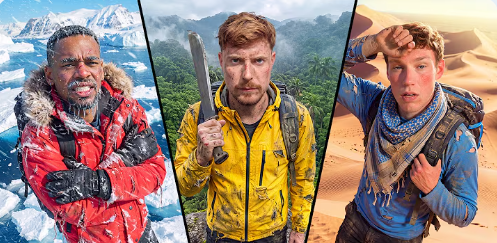
MrBeast has returned with another large-scale YouTube challenge, this time sending teams into some of the most extreme environments on Earth. Titled “We Survived The Most Extreme Places On Earth,” the video was released on September 5, 2026, and quickly became one of the most-watched new videos on YouTube.
The latest production follows six participants divided into three teams and placed in very different environments. The teams must race toward evacuation helicopters, with the first team to reach its destination winning the challenge.
The three locations featured in the challenge are the Amazon rainforest, a desert environment and Antarctica. Each location creates a different set of problems, forcing the participants to deal with heat, cold, difficult terrain, water crossings and limited resources.
The concept gives the video a different structure from some of MrBeast’s traditional giveaway-focused challenges. Instead of competing primarily for a massive cash prize, the participants are placed in a survival-style race where reaching the finish point becomes the central objective.
According to the video’s description, the teams race through extreme locations to determine who can reach the finish line first. The production also uses Google’s Gemini AI as part of the challenge, with the technology helping the participants plan, solve problems and deal with challenges during their journey.
The Amazon team faces one of the most difficult environments in the competition. The dense rainforest creates problems involving heat, water and difficult navigation, while the team also has to find a way across a river.
The participants reportedly construct a makeshift raft using bamboo and inflatable mattresses in an attempt to cross the water. Instead of providing an easy shortcut, the river pushes the team significantly away from its intended route.
The challenge becomes even more demanding as the participants continue hiking through the rainforest.
MrBeast himself struggles with the physical demands of the journey. The combination of heat, humidity and continuous hiking puts considerable pressure on the team as it attempts to reach its evacuation point before the other competitors.
The desert team faces a completely different set of challenges.
Rather than dealing with dense vegetation and strong river currents, the desert competitors have to manage extreme heat and the weight of their equipment. Reports about the video indicate that the participants were carrying additional water because staying hydrated was essential to completing the journey.
The extra water provides an important advantage in terms of survival but also makes the physical journey more difficult.
As the race approaches its conclusion, the desert team makes a dramatic decision. With the finish line getting closer, the participants leave their backpacks behind and sprint toward the evacuation helicopter.
The decision allows them to move faster after carrying their equipment for much of the challenge.
Meanwhile, the Antarctica team faces perhaps the harshest weather conditions of the three locations.
Strong winds and extremely cold conditions slow the participants down considerably. The Antarctic team struggles to maintain its progress as the weather becomes increasingly difficult.
The contrast between the three environments is one of the main attractions of the video. Each team faces a completely different survival problem, making it difficult to determine which environment will ultimately prove the most challenging.
The competition eventually comes down to the race toward the helicopters.
Nolan and Tareq, who are competing in the desert, spot their evacuation helicopter and make a final push toward the aircraft. They manage to reach it before the other teams.
Their victory gives them the opportunity to take home a $100,000 prize intended for their mothers.
The other teams continue their journeys, but the desert pair’s faster final sprint gives them the decisive advantage.
MrBeast and Thea, competing through the Amazon, reach their helicopter later. The Antarctic team arrives after the race has already been decided.
The ending provides a clear conclusion to the challenge while maintaining the competitive structure that has become a defining feature of MrBeast’s long-form videos.
One of the more notable aspects of the new production is the integration of artificial intelligence.
Google Gemini is presented as a tool that can help participants with planning and problem-solving. Rather than appearing as a separate advertisement disconnected from the story, the technology is incorporated into the challenge itself.
The partnership demonstrates how AI companies are increasingly using major creators to showcase their products to huge global audiences.
MrBeast’s channel has more than 500 million subscribers, making it one of the largest creator platforms in the world. Current channel tracking data places the channel at roughly 515 million subscribers, while other public trackers show slightly different figures depending on update timing.
Because of that enormous audience, even a single sponsored integration can potentially introduce an AI product to millions of viewers within hours.
The video’s early performance reflects the scale of MrBeast’s audience.
Public tracking services showed the video reaching tens of millions of views shortly after its release. It also appeared at the top of rankings tracking the most-viewed new YouTube videos over the previous 24 to 48 hours.
The performance is significant because MrBeast’s videos routinely attract massive audiences shortly after publication.
His previous uploads have also demonstrated the ability of the channel to generate tens of millions of views in a short period. Recent examples include “Escape 100 Cops, Win $500,000” and “Last To Leave Mansion, Keeps It,” which accumulated substantial audiences after their releases.
However, the new video is different from a traditional MrBeast giveaway.
The central attraction is the environment and survival challenge rather than simply the amount of money involved.
That shift allows the production to create tension through physical difficulty, unpredictable weather and the possibility of teams falling behind.
It also gives viewers three parallel stories to follow.
The Amazon team represents heat, jungle terrain and water obstacles. The desert team has to balance speed against hydration and physical exhaustion, while the Antarctica team faces cold, wind and a much slower pace.
This structure helps maintain suspense because viewers can compare the progress of the three teams throughout the video.
The production also demonstrates the increasing scale of modern YouTube entertainment.
A challenge involving the Amazon, Antarctica and a desert requires extensive logistics, filming crews, transportation, safety planning and coordination. The finished video therefore represents more than a simple creator recording a challenge with a camera.
MrBeast’s production model has increasingly moved toward television-scale entertainment while continuing to distribute the final product primarily through YouTube.
The latest challenge also highlights how brand partnerships have become integrated into this production model.
Besides the Gemini partnership, the video description includes a Pedialyte promotion. The description also explains that equipment left behind near the end of the challenge was recovered by the production team so that the environment would be left clean.
The environmental clarification is notable because filming in sensitive locations can attract scrutiny. The production team specifically addressed the backpacks shown being abandoned during the final sprint, explaining that they were left only temporarily and subsequently recovered.
The use of AI within the challenge is also part of a much broader trend.
Technology companies increasingly need ways to demonstrate what AI can actually do beyond generating text or images. Putting an AI assistant into a real-world survival challenge provides a more entertaining way to show how the technology can be used for planning and problem-solving.
For viewers, this creates a mixture of entertainment and product demonstration.
At the same time, the video does not suggest that AI replaces the physical effort required from the contestants. The participants still have to hike, navigate difficult terrain and deal with environmental conditions themselves.
AI becomes another tool within the challenge rather than the solution to every problem.
The video’s format also demonstrates why extreme-environment challenges remain attractive to online audiences.
Unlike conventional studio competitions, survival-style videos introduce natural uncertainty. Weather can change, terrain can slow down a team and unexpected obstacles can completely alter the strategy.
That unpredictability creates opportunities for dramatic moments that cannot be fully scripted.
The race format adds another layer of tension because every delay can affect the final result.
A team that appears to be winning early can lose its advantage after a difficult river crossing or weather interruption. Conversely, a team that falls behind can potentially recover by making a faster final push.
This makes the helicopter finish particularly important to the overall story.
The winning team does not necessarily dominate the entire journey. Instead, the final stage rewards the participants who can preserve enough energy and move quickly when the finish becomes visible.
The video is also another example of MrBeast’s ability to turn a relatively simple premise into a large-scale spectacle.
At its core, the concept is straightforward: three teams start in different extreme locations and race toward helicopters.
The production expands that basic idea through international locations, elaborate logistics, AI technology, professional filming and a substantial prize.
That combination has become a major part of the MrBeast formula.
The September 5 release also arrived during a period of strong activity on the channel. MrBeast had released several major videos in the weeks before the new challenge, including a massive tennis event and an “Escape 100 Cops” competition.
The new upload therefore continues a consistent pattern of large-scale challenges rather than representing an isolated experiment.
For YouTube, the video’s early performance is another demonstration of how creator-led entertainment can compete for attention on a global scale.
MrBeast’s enormous subscriber base provides an immediate audience, but the continued success of individual uploads depends on the ability to create new concepts that viewers have not seen repeatedly.
The extreme-location race gives the channel another format that can combine competition, adventure, technology and storytelling.
The integration of Gemini may also become an important part of the video’s long-term significance.
As AI companies compete for consumer attention, collaborations with major creators can introduce artificial intelligence tools to audiences that may not normally seek out technology demonstrations.
Instead of explaining an AI product through a traditional commercial, the technology becomes part of an entertaining story.
For MrBeast, meanwhile, the partnership adds another commercial dimension to a production that already relies heavily on sponsorships and brand integrations.
The result is a video that functions simultaneously as entertainment, a competition and a large-scale marketing platform.
“We Survived The Most Extreme Places On Earth” ultimately shows how far YouTube productions have evolved. What begins as a simple race between teams becomes a global production involving some of the planet’s harshest environments, advanced technology and a six-figure prize.
With millions of viewers already watching shortly after its release, the video has quickly become one of the biggest new entertainment uploads of September 2026.
Its combination of extreme environments, survival challenges, AI-assisted problem-solving and MrBeast’s familiar competitive format gives the video a broad appeal while also showing how creator content continues to evolve into increasingly ambitious forms of entertainment.