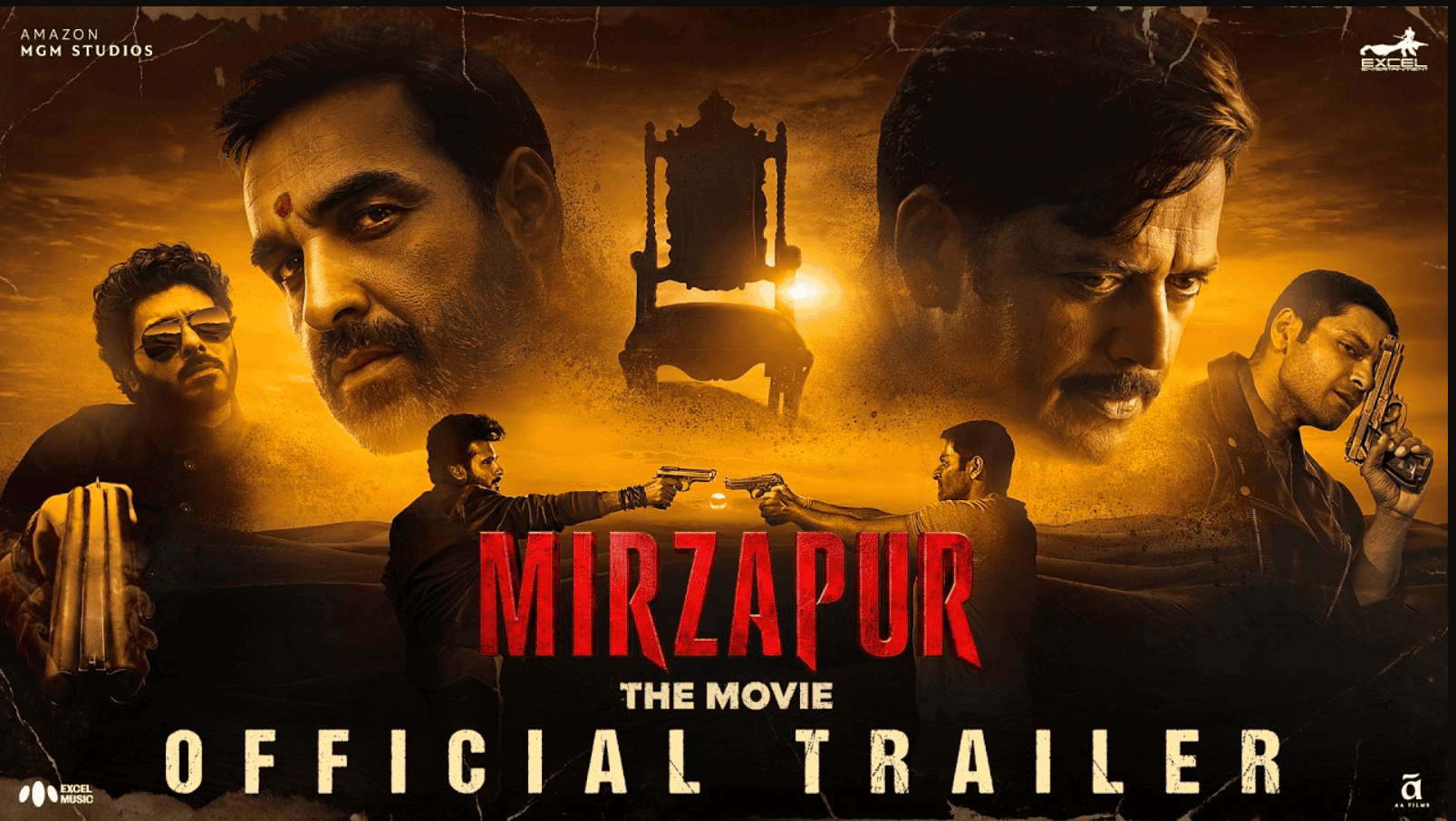
Mirzapur: The Movie has finally arrived in theatres, bringing one of India’s most popular streaming crime franchises to the big screen. Directed by Gurmmeet Singh, the film brings back several familiar faces from the series, including Pankaj Tripathi as Kaleen Bhaiya, Ali Fazal as Guddu Pandit and Divyenndu as Munna Tripathi.
The film released theatrically on September 4, 2026, after generating substantial anticipation among fans of the Prime Video series. The franchise had already completed three seasons on streaming, and the decision to continue its story through a theatrical film created considerable curiosity about whether the characters and their trademark violence would work on a much larger canvas.
Mirzapur: The Movie carries the same broad identity that made the original series popular. Power, revenge, family rivalries, political influence and the struggle for control remain at the centre of the story.
The biggest attraction is naturally the return of the franchise’s most recognizable characters. Pankaj Tripathi once again steps into the role of Kaleen Bhaiya, while Ali Fazal returns as Guddu Pandit. Divyenndu’s return as Munna Bhaiya is among the elements that have generated the most excitement around the movie.
Jitendra Kumar is also part of the film, while Ravi Kishan appears in a significant role as Babban Babua. The supporting cast includes several actors who have previously been associated with the Mirzapur universe.
Rasika Dugal, Shweta Tripathi, Shriya Pilgaonkar, Harshita Gaur, Abhishek Banerjee, Rajesh Tailang, Sheeba Chaddha, Kulbhushan Kharbanda and other familiar performers also feature in the movie.
The presence of so many returning actors gives the film an immediate sense of familiarity. For viewers who have followed the series from its first season, seeing these characters together again is one of the strongest reasons to experience the film in a theatre.
The transition from a streaming series to cinema is nevertheless a challenging one. A television or streaming season can spend hours developing characters and storylines, while a theatrical film has to compress its central conflict into a significantly shorter running time.
Mirzapur: The Movie has a reported runtime of more than three hours, giving the filmmakers considerable space to develop the story. The film has also received an A certificate, reflecting its mature crime and violence-driven content.
The theatrical format allows the makers to increase the scale of the franchise. Action sequences, confrontations and dramatic moments are designed to benefit from the larger screen and sound system of a cinema hall.
The film’s visual presentation attempts to preserve the gritty atmosphere associated with Mirzapur while making the world feel more cinematic. The locations, characters and action are presented with a bigger scale than what audiences generally experience on a streaming screen.
At the centre of the story remains the familiar battle for power. Guddu Pandit has already established himself as a dominant force, but the return of old rivals and the emergence of new threats create fresh complications.
Kaleen Bhaiya’s presence remains equally important. Pankaj Tripathi has made the character one of the most memorable crime figures in recent Indian screen entertainment, largely because of the controlled manner in which he portrays authority and menace.
His performance continues to depend more on presence and dialogue delivery than exaggerated physical aggression. Even when the character is not involved in an action sequence, Tripathi’s restrained performance gives Kaleen Bhaiya an imposing quality.
Ali Fazal, meanwhile, continues to play Guddu as a character driven by ambition, anger and the desire to maintain his position. His transformation over the course of the franchise has been one of the central character arcs of Mirzapur.
The movie gives Fazal another opportunity to play a character who is constantly balancing personal relationships with the demands of power.
Divyenndu’s return as Munna Bhaiya is arguably one of the film’s most discussed elements. The character became a fan favourite during the series because of his unpredictable behaviour, distinctive dialogue delivery and volatile personality.
His presence in the movie naturally raises questions about how the character fits into the continuation of the Mirzapur story. Rather than treating the return simply as nostalgia, the film uses the character as part of its larger dramatic setup.
Ravi Kishan adds another layer to the story through Babban Babua. His character brings a different energy to the power struggle and expands the universe beyond the established Guddu and Kaleen Bhaiya rivalry.
The movie also continues the franchise’s tradition of giving its female characters important positions within the power structure. Beena Tripathi, played by Rasika Dugal, remains one of the more strategically complex personalities in the story.
Dugal has previously spoken about Beena’s understanding of power and patriarchy, and the character’s role continues to revolve around control, survival and personal agency.
The women in the Mirzapur universe have never been completely removed from its central conflicts. Their decisions often influence the direction of the story even when the most visible battles are fought by male characters.
That element helps prevent the movie from becoming solely a succession of action scenes between rival gangs.
At the same time, fans expecting the trademark Mirzapur style will find plenty of violence, confrontations and dark humour. The film does not attempt to transform the franchise into a conventional family-friendly action drama.
Its A certification reinforces the fact that the movie is aimed at the mature audience that has followed the series.
One of the biggest questions before release was whether Mirzapur could successfully translate its streaming popularity into theatrical success. The early numbers suggest that there is strong interest, although the eventual performance will depend on how well the movie holds its audience after the opening weekend.
Advance bookings had already indicated significant demand before release. Industry reports said more than two lakh tickets had been sold in advance, with advance gross collections crossing ₹9 crore before the film reached cinemas.
The strongest response was reported from regions including Uttar Pradesh, Delhi, Bihar, Gujarat and Madhya Pradesh. This is particularly relevant for Mirzapur because the franchise’s North Indian setting and Hindi-language identity have always been central to its appeal.
The film’s opening-day prospects were therefore closely watched by the industry.
However, strong advance bookings alone do not guarantee a successful theatrical run. The movie needs positive audience word of mouth and repeat interest to maintain momentum beyond the first few days.
The early social media reaction has been largely focused on the returning cast and the cinematic presentation. Fans have especially highlighted the performances of Ali Fazal, Pankaj Tripathi and Divyenndu.
The franchise’s loyal fan base appears to be responding to the opportunity to experience its familiar characters in a theatre. The big-screen presentation also gives long-time viewers a sense of occasion that a routine streaming release would not necessarily create.
Still, viewers approaching the movie without knowledge of the original series may have a different experience.
Mirzapur: The Movie is built heavily around an existing universe and its established characters. Understanding the relationships, rivalries and history between the principal figures can make the film considerably easier to follow.
For that reason, the movie is likely to work best for audiences who already know the Mirzapur world.
The film is also unusual in the current Hindi entertainment landscape because it represents a direct move from a major streaming franchise to cinema. Indian audiences have previously seen television properties adapted into films, but the migration of a successful streaming crime series to theatres remains comparatively uncommon.
The makers are clearly betting on the strength of the franchise’s existing audience.
The decision also reflects how streaming platforms have changed the relationship between viewers and characters. A character who becomes popular through several seasons can develop a fan following comparable to that of a traditional film franchise.
Mirzapur’s characters have achieved exactly that kind of recognition.
Kaleen Bhaiya, Guddu Pandit and Munna Bhaiya became part of Indian pop culture through dialogue clips, memes and social media discussions. Their theatrical return was therefore always likely to attract attention.
The challenge for the film is to provide something beyond nostalgia.
A successful theatrical continuation needs a compelling story rather than simply bringing popular characters together again. The movie attempts to expand the franchise’s central conflict while retaining the tone that viewers associate with the series.
Gurmmeet Singh, who has directed episodes of the original series, returns behind the camera for the movie. His familiarity with the franchise helps maintain continuity in the visual and narrative style.
The screenplay comes from Puneet Krishna, the creator and writer associated with the original Mirzapur universe. That connection gives the film a direct link to the storytelling foundation of the series.
The combination of familiar creators and actors is clearly designed to reassure existing fans that the theatrical version remains connected to the world they know.
The movie’s biggest strength is arguably this continuity. It does not completely reinvent Mirzapur to appeal to a new audience. Instead, it takes the established personalities and power struggles and places them in a larger cinematic framework.
Pankaj Tripathi remains one of the film’s strongest performers. His ability to communicate authority without excessive theatricality continues to suit Kaleen Bhaiya perfectly.
Ali Fazal also remains convincing as Guddu. His performance carries the emotional weight of a character who has travelled a long way from the person audiences encountered at the beginning of the series.
Divyenndu brings the same unpredictable energy that made Munna Bhaiya such a memorable character. His presence gives the movie an additional layer of nostalgia and unpredictability.
Ravi Kishan adds considerable screen presence as well, while the returning supporting cast helps make the film feel like an extension of the larger Mirzapur universe rather than a completely separate project.
The action is another important component. On the big screen, the violence and confrontations naturally have greater visual impact than they did on smaller screens.
However, the movie’s long runtime means pacing becomes important. A story that revolves around multiple characters and competing power centres can occasionally feel crowded if every storyline receives equal attention.
The large ensemble is both an advantage and a potential limitation. Fans appreciate seeing familiar characters return, but the film has to balance their screen time without allowing the central narrative to lose focus.
This is especially difficult when a franchise carries several seasons of history.
Nevertheless, the theatrical format gives the makers an opportunity to create set pieces that feel larger than television episodes. The scale of the action and the sound design are aimed at delivering a more immersive experience.
For fans, the cinema environment itself may become part of the appeal. Mirzapur has developed a strong fan culture around its dialogue and characters, and a theatrical release creates opportunities for collective audience reactions that are different from watching alone at home.
The film’s commercial prospects will ultimately depend on whether that fan enthusiasm extends beyond the opening day.
The competition at the box office is another factor. Mirzapur: The Movie arrives during a period when several Hindi and regional releases are competing for audience attention.
Its advantage is the strength of its existing franchise. Unlike a completely new film, Mirzapur begins with an established audience that already understands its characters and world.
The disadvantage is that fans have high expectations. After three successful seasons, viewers are familiar with the tone, performances and storytelling style of the franchise.
Any significant departure from those expectations could generate criticism, while simply repeating familiar elements could make the film feel less fresh.
That balance between familiarity and novelty is therefore central to the movie’s success.
Overall, Mirzapur: The Movie is primarily a film for the franchise’s existing audience. Its greatest attractions are the returning characters, established actors and the opportunity to see the Mirzapur world on the big screen.
Pankaj Tripathi continues to make Kaleen Bhaiya compelling, Ali Fazal maintains Guddu’s intensity, and Divyenndu’s return as Munna Bhaiya provides one of the movie’s biggest crowd-pleasing elements.
The film’s extended runtime, mature content and complex ensemble mean that it is not designed as a casual family entertainer. It is firmly rooted in the crime-drama identity that made Mirzapur popular in the first place.
The theatrical transition is also significant beyond the film itself. If Mirzapur: The Movie performs strongly, it could encourage other major Indian streaming franchises to explore theatrical continuations or adaptations.
For now, the movie’s first task is to satisfy the audience that has followed the franchise for years.
The initial response indicates that the return of Guddu, Kaleen Bhaiya and Munna Bhaiya has generated substantial excitement. The real test will come over the next several days, when audience word of mouth begins to determine whether that excitement translates into sustained box-office momentum.
Mirzapur: The Movie ultimately succeeds by understanding what made its source material popular: powerful characters, an unforgiving struggle for control, memorable performances and a world where loyalty can change quickly.
For long-time fans, watching these characters return on the big screen is the film’s biggest attraction. Whether the movie becomes a major theatrical success will depend on whether its expanded scale can deliver a story strong enough to justify moving the Mirzapur universe from streaming to cinemas.