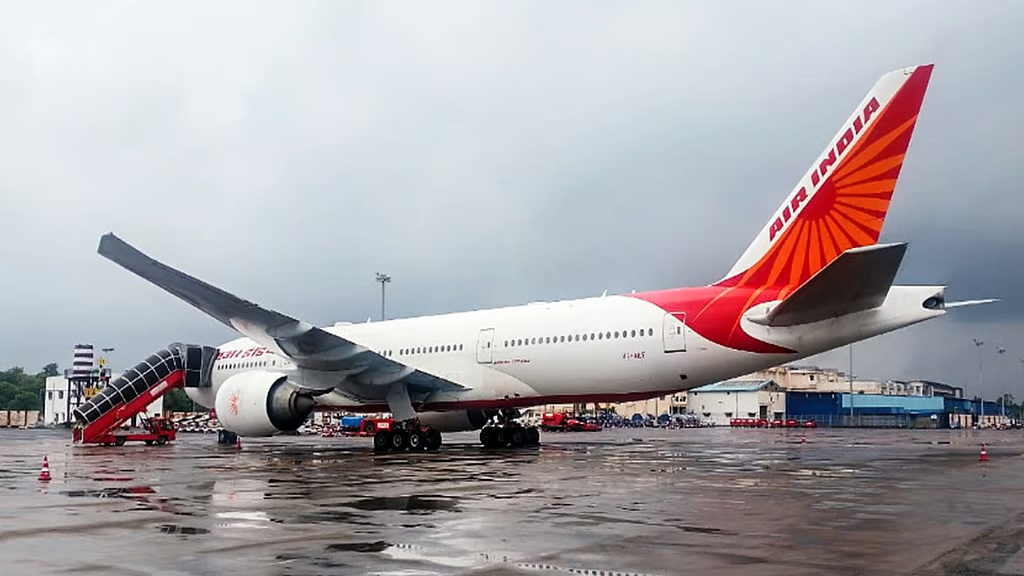
The Jaipur Emergency Landing of an Air India flight from Bhopal to Delhi took place on Sunday, September 13, 2026, after the aircraft developed a technical issue involving one of its engines. The flight, carrying 140 people, was diverted to Jaipur and landed safely at Jaipur International Airport. All passengers and crew members were reported safe, while the aircraft was grounded for detailed technical checks.
The Jaipur Emergency Landing involved Air India flight AI1886, which was operating from Bhopal to New Delhi. According to flight-tracking information cited in the report, the aircraft departed Bhopal’s Raja Bhoj Airport at around 8:26 am and reached Jaipur at approximately 9:40 am after the crew requested an emergency landing. The aircraft landed safely and passengers subsequently disembarked.
The Jaipur Emergency Landing was initiated after one of the pilots contacted air traffic control at Jaipur Airport and requested permission to land because of an issue on board. Airport authorities immediately activated emergency procedures and prepared the necessary safety arrangements before the aircraft arrived. The emergency was declared at the airport at around 9:10 am and remained in place for approximately half an hour.
The Jaipur Emergency Landing prompted Jaipur Airport authorities to place emergency response teams on standby. Security personnel, ambulances and firefighting vehicles were positioned to respond if required. The aircraft, however, landed smoothly on the runway without any reported complications, allowing passengers to leave the plane safely after landing.
The Jaipur Emergency Landing was reportedly linked to an engine-related problem, although the precise technical cause had not been established at the time of the initial reports. The cockpit crew made the decision to divert the aircraft to Jaipur as a safety precaution rather than continue toward Delhi. Such decisions are part of standard aviation safety procedures when pilots identify a technical concern during flight.
The Jaipur Emergency Landing also led to the aircraft being grounded after arrival. Keeping the aircraft on the ground allows airline engineers and technical teams to conduct the required inspections before the aircraft can return to commercial service. Air India confirmed that the aircraft was undergoing checks in accordance with its safety procedures.
The Jaipur Emergency Landing did not result in injuries among the passengers or crew, according to the available information. The safe outcome was aided by the crew’s decision to request an emergency diversion and the preparedness of Jaipur Airport’s emergency services. Once the aircraft landed, passengers were able to disembark and ground staff began assisting them with the next steps of their journey.
The Jaipur Emergency Landing created a temporary disruption for passengers who were travelling to Delhi. Since the aircraft had been grounded for inspection, Air India said its ground team at Jaipur was providing assistance and working to arrange onward travel for the passengers as quickly as possible. The airline also apologised for the inconvenience caused by the unexpected diversion.
The Jaipur Emergency Landing highlights the importance of emergency preparedness at airports. When a pilot reports a possible technical problem, airport authorities typically activate emergency services so that the aircraft can land with additional support available. Fire and rescue vehicles, medical teams and security personnel can then respond immediately if an incident occurs during landing or after touchdown.
The Jaipur Emergency Landing also demonstrates the role of pilots in managing unexpected technical problems. Rather than continuing toward the original destination, the cockpit crew assessed the situation and coordinated with air traffic control to divert the aircraft. Choosing an airport where emergency services could be prepared provided an additional safety margin for everyone on board.
The Jaipur Emergency Landing occurred during a period when several domestic flights have reportedly experienced technical or operational issues. The latest incident is therefore likely to attract attention from aviation authorities and passengers, particularly as airlines continue to face pressure to maintain high standards of aircraft safety and technical reliability.
The Jaipur Emergency Landing also shows why aircraft are subjected to detailed technical inspections after suspected engine problems. Engines are among the most critical components of a commercial aircraft, and even when an aircraft lands safely, engineers need to establish whether the problem was minor or requires repair or replacement of a component. The aircraft involved in this incident will remain grounded until the required checks are completed.
The Jaipur Emergency Landing was handled without reported disruption to the wider airport operation beyond the emergency response period. Emergency arrangements were activated before the aircraft arrived, and the plane subsequently landed safely. The airport’s preparedness ensured that necessary personnel and equipment were available throughout the landing process.
The Jaipur Emergency Landing is also significant for passengers because flight diversions can create uncertainty about onward travel. Travellers may have connecting flights, hotel reservations or other commitments at their destination. In this case, Air India said its ground team was assisting passengers at Jaipur and making efforts to transport them to Delhi at the earliest opportunity.
The Jaipur Emergency Landing further reinforces the importance of airline communication during unexpected disruptions. When an aircraft is diverted for technical reasons, passengers need timely information about why the flight has changed course, what will happen to their luggage and when onward travel will be arranged. Air India’s statement indicated that assistance was being provided to passengers after they disembarked at Jaipur.
The Jaipur Emergency Landing should not be interpreted as evidence of a wider safety failure without further investigation. A technical issue can occur for a variety of reasons, and the decision to divert an aircraft is itself an established safety measure. The available report does not establish the precise nature of the engine problem or identify a specific mechanical failure.
The Jaipur Emergency Landing also illustrates how aviation safety procedures are designed to prevent technical issues from developing into more serious incidents. Pilots are trained to identify abnormal indications, communicate with air traffic controllers and select suitable airports for diversion when necessary. Airport emergency teams then support the aircraft during its arrival.
The Jaipur Emergency Landing involved an aircraft that had originated in Bhopal and was scheduled to travel to Delhi. The diversion meant that Jaipur became the temporary destination for the flight. According to the report, the aircraft had 140 people on board, and all passengers were able to disembark safely after landing.
The Jaipur Emergency Landing also brought attention to Jaipur’s role as an important aviation hub in northern India. The airport regularly handles domestic and international flights and can serve as an alternative landing location for aircraft operating in the region when unexpected situations arise. Its emergency response infrastructure played a role in ensuring that the diverted flight could land safely.
The Jaipur Emergency Landing was followed by a technical inspection of the aircraft. Air India stated that the aircraft was undergoing checks in accordance with its safety standards. The airline also said that the safety of passengers and crew remains its top priority, emphasising that the diversion was carried out according to established procedures.
The Jaipur Emergency Landing may also lead to further information once the airline’s engineering team completes its assessment. If the inspection identifies a specific engine component or technical system responsible for the issue, additional details could help explain why the aircraft required diversion. Until those checks are complete, the available information remains limited to the reported technical problem and the safe landing.
The Jaipur Emergency Landing is a reminder that commercial aviation involves multiple layers of precaution. Even when a flight develops a technical problem, pilots, air traffic controllers, airport emergency teams and airline engineers work together to manage the situation. The successful landing in Jaipur demonstrates how these procedures can operate when an aircraft requires an unscheduled diversion.
The Jaipur Emergency Landing also highlights the importance of maintaining aircraft before and after every flight. Airlines conduct scheduled maintenance and inspections to identify potential technical problems, but aircraft systems can still experience unexpected issues during operations. Grounding the aircraft after an incident ensures that it is not returned to service until engineers have completed the necessary checks.
The Jaipur Emergency Landing was therefore a precautionary response to a technical concern rather than an accident. The aircraft reached Jaipur safely, emergency services were available and passengers were able to leave the plane without reported injuries. The subsequent grounding of the aircraft will allow Air India’s technical team to determine whether repairs are necessary before the aircraft resumes operations.
The Jaipur Emergency Landing also adds to a series of recent aviation incidents involving technical or operational problems on domestic flights. While individual incidents do not necessarily indicate a systemic problem, each event provides an opportunity for airlines and aviation authorities to review procedures and ensure that safety standards remain effective.
The Jaipur Emergency Landing has also demonstrated the importance of having suitable alternative airports available during flight operations. When a technical issue occurs, pilots may need to choose a nearby airport where runway facilities, emergency services and maintenance support are available. Jaipur provided the necessary infrastructure for the Bhopal-Delhi flight to land safely.
The Jaipur Emergency Landing ultimately ended without casualties, which remains the most important outcome of the incident. The 140 people on board reached the ground safely, and the aircraft was secured for inspection. The focus now shifts toward the technical evaluation and arranging onward travel for the affected passengers.
The Jaipur Emergency Landing will likely remain under attention until Air India completes its technical checks and provides any additional information about the engine issue. For passengers and their families, the immediate concern has been resolved with the safe landing and disembarkation. For the airline, the priority is determining the cause of the technical problem and ensuring that the aircraft meets all safety requirements before it is operated again.
The Jaipur Emergency Landing serves as another example of how aviation safety procedures are designed to respond to unexpected situations. Although the incident caused inconvenience and disrupted the passengers’ journey to Delhi, the decision to divert the aircraft allowed the crew to deal with the reported technical concern in a controlled environment. The safe arrival of all passengers and crew at Jaipur remains the key outcome of the incident.