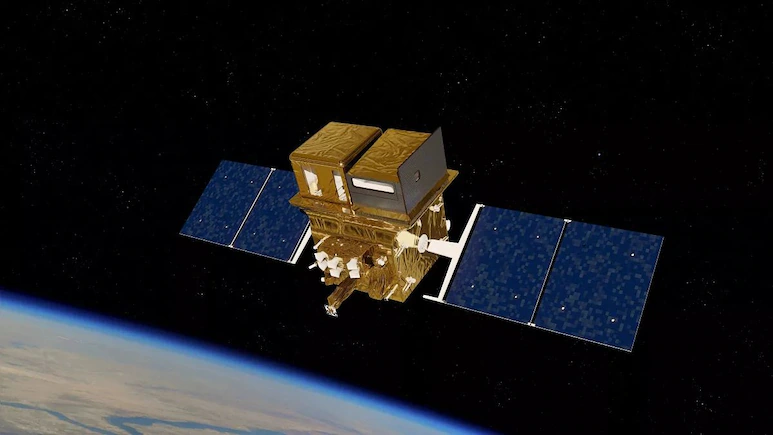
The India France TRISHNA Satellite Mission is set to enter a new phase as India and France prepare to launch the joint Earth-observation satellite from Sriharikota in 2027. The mission, developed by the Indian Space Research Organisation (ISRO) and France’s space agency CNES, will focus on monitoring Earth’s water cycle, surface temperatures, vegetation stress and water availability with high-resolution thermal infrared observations.
The India France TRISHNA Satellite Mission takes its name from the Sanskrit word “thirst” and is being developed at a time when water availability has become an increasingly important environmental and climate challenge. The satellite is intended to provide detailed information that can help scientists understand evaporation, transpiration, water stress and other processes connected with the movement of water between the land, atmosphere and ecosystems.
TRISHNA stands for Thermal infraRed Imaging Satellite for High-resolution Natural resource Assessment. According to the current mission description, the satellite is designed to provide a spatial resolution better than 60 metres and revisit areas several times a week. This combination is intended to provide more frequent and detailed observations than some existing Earth-observation systems.
The India France TRISHNA Satellite Mission will operate from a Sun-synchronous orbit more than 700 kilometres above Earth, using thermal infrared observations to monitor changes in surface temperature and related environmental conditions. The data is expected to support research into water availability, vegetation health, evaporation, glaciers, forests, coastal regions and urban heat patterns.
A key objective of the India France TRISHNA Satellite Mission is to address a limitation in existing satellite-based Earth observation. Some systems provide highly detailed images but do not revisit locations frequently, while others observe areas more frequently but at comparatively lower resolution. TRISHNA is being designed to combine relatively high spatial detail with frequent observations.
ISRO and CNES are contributing different technologies to the India France TRISHNA Satellite Mission. France is providing the thermal infrared instrument, while ISRO is developing the optical payload. The combination of the two observation capabilities is intended to provide scientists with a more comprehensive picture of land and water-related processes.
The data generated by the India France TRISHNA Satellite Mission could have applications in agriculture and water management. Detailed observations of vegetation stress and evapotranspiration can help researchers assess how much water crops and ecosystems are using. Such information can contribute to studies of irrigation efficiency and changing water requirements, although the satellite itself will not directly manage water resources.
Water-resource agencies could also potentially use TRISHNA observations to improve monitoring of reservoirs, rivers and surrounding ecosystems. Scientists will be able to study how surface conditions change over time and how those changes relate to evaporation, drought and other environmental factors. The mission is therefore expected to generate data useful for both scientific research and resource-management applications.
The India France TRISHNA Satellite Mission builds on a long history of cooperation between the two countries in Earth observation. One of the most important earlier projects was Megha-Tropiques, which was launched in 2011 and focused on tropical weather, rainfall, atmospheric water content and energy exchanges. TRISHNA extends this cooperation towards detailed observation of what happens to water after it reaches Earth’s surface.
India and France have also collaborated through the SARAL/AltiKa satellite, launched in 2013 to study ocean-surface topography. France’s foreign ministry describes TRISHNA as the next major joint India-France Earth-observation mission, with launch planned for 2027. The partnership is part of a broader bilateral space dialogue between the two countries.
The India France TRISHNA Satellite Mission is part of a wider expansion of India-France cooperation in space and science. On September 28, 2026, Union Minister of State for Science and Technology Jitendra Singh met French Minister for Higher Education, Research and Space Philippe Baptiste in New Delhi. Discussions covered space cooperation, the India-France Year of Innovation 2026, human spaceflight, scientific research and opportunities involving India’s growing private space sector.
Jitendra Singh said the India-France space partnership has developed over more than six decades, beginning with sounding-rocket experiments in the 1960s and later expanding into satellite missions, launch-vehicle technologies and human spaceflight. He identified Megha-Tropiques, SARAL and the developing TRISHNA mission as important milestones in the relationship.
The India France TRISHNA Satellite Mission is also connected to India’s broader efforts to expand the use of space technology for environmental and developmental applications. According to the Department of Space, India now has more than 400 space start-ups working across areas such as rockets, satellites and space applications. The government has said future India-France cooperation could increasingly involve private companies and start-ups in addition to government space agencies.
France has similarly expressed interest in expanding cooperation beyond traditional government-to-government space programmes. Philippe Baptiste described TRISHNA as an example of what the two countries can achieve through long-term scientific collaboration and said France wants to deepen cooperation in human spaceflight, astronaut health, microgravity research and parabolic-flight experiments.
Another area under discussion is cooperation between Indian and European launch systems. Baptiste highlighted India’s LVM-3 and Europe’s Ariane 6 as major launchers and suggested that the two sides could explore greater interoperability and flexibility in launch opportunities. Such cooperation could allow launch customers to have additional options when missions face scheduling or technical constraints, although any such arrangement would depend on future agreements.
The India France TRISHNA Satellite Mission is also linked to climate-change research. Thermal infrared observations can reveal changes in land-surface temperature and vegetation conditions that are relevant to drought monitoring and ecosystem studies. By collecting observations repeatedly, scientists can examine how environmental conditions evolve rather than relying only on isolated measurements.
TRISHNA could therefore provide information relevant to regions experiencing increasing water stress. However, satellite observations alone cannot solve water shortages. The value of the mission will depend on how scientists, governments, researchers and other institutions process the data and incorporate it into water planning, agricultural studies, climate research and environmental monitoring.
The India France TRISHNA Satellite Mission is also expected to contribute to the understanding of glaciers and other water-related environments. Monitoring surface temperature and environmental conditions across different landscapes can help scientists study changes occurring over time. Such observations can complement information collected through ground-based measurements and other satellite missions.
India’s human-spaceflight programme is another area where the partnership is expanding. France is supporting India’s Gaganyaan programme, including astronaut-related training and medical cooperation. The two countries have also begun discussions on microgravity research and parabolic flights, according to India’s Department of Space.
The India France TRISHNA Satellite Mission comes during the India-France Year of Innovation 2026, which the Indian government says is intended to create additional opportunities for cooperation in science, technology and emerging fields. Space cooperation is being discussed alongside biotechnology, digital technologies, ocean sciences and other areas of scientific research.
India and France are also looking at cooperation in the Blue Economy and ocean sciences. Jitendra Singh has highlighted India’s Deep Ocean Mission and the potential for wider scientific collaboration in ocean research. This creates an additional connection between the countries’ space-based Earth observation capabilities and broader environmental research programmes.
The India France TRISHNA Satellite Mission is expected to launch in 2027, but the precise launch date has not been announced in the current official material. France’s foreign ministry lists 2027 as the planned launch year, while India’s Department of Space has said the realisation of the third joint satellite is progressing well.
For India, the mission will add another advanced Earth-observation capability to its space programme. For France, it represents continued cooperation with one of its major space partners and contributes to the use of satellite technology for climate and environmental monitoring. The project also demonstrates how space programmes can be directed towards issues on Earth, particularly water availability and environmental change.
The India France TRISHNA Satellite Mission therefore represents more than another joint satellite launch. Its primary focus is understanding the Earth’s water cycle and environmental conditions at a level of detail that can support research and resource management. With ISRO and CNES combining their respective technologies, the mission is expected to become an important part of the two countries’ long-running space partnership.
As preparations continue, scientists and space agencies will focus on completing the spacecraft and associated instruments ahead of the planned 2027 launch. Once operational, TRISHNA’s repeated observations could provide valuable datasets for studying water stress, evaporation, vegetation, glaciers and other environmental processes. The mission’s findings could ultimately support better scientific understanding of how Earth’s water resources are changing in a warming climate.
The India France TRISHNA Satellite Mission thus marks another step in a relationship that has evolved from sounding-rocket experiments in the 1960s to sophisticated satellite missions and human-spaceflight cooperation. With the satellite scheduled for launch from Sriharikota in 2027, India and France are preparing to use space-based technology to study one of Earth’s most important resources: water.