
Hyundai Motor India is preparing to introduce a new SUV to its Indian portfolio, and the company has now officially revealed its name: Hyundai BAYON.
The upcoming SUV is being positioned around Hyundai’s “Intelligence ON” philosophy, with the company focusing on technology, urban practicality, distinctive styling and a more connected driving experience. Hyundai says the Bayon has been developed as a global product while being crafted for the requirements of an evolving Indian market.
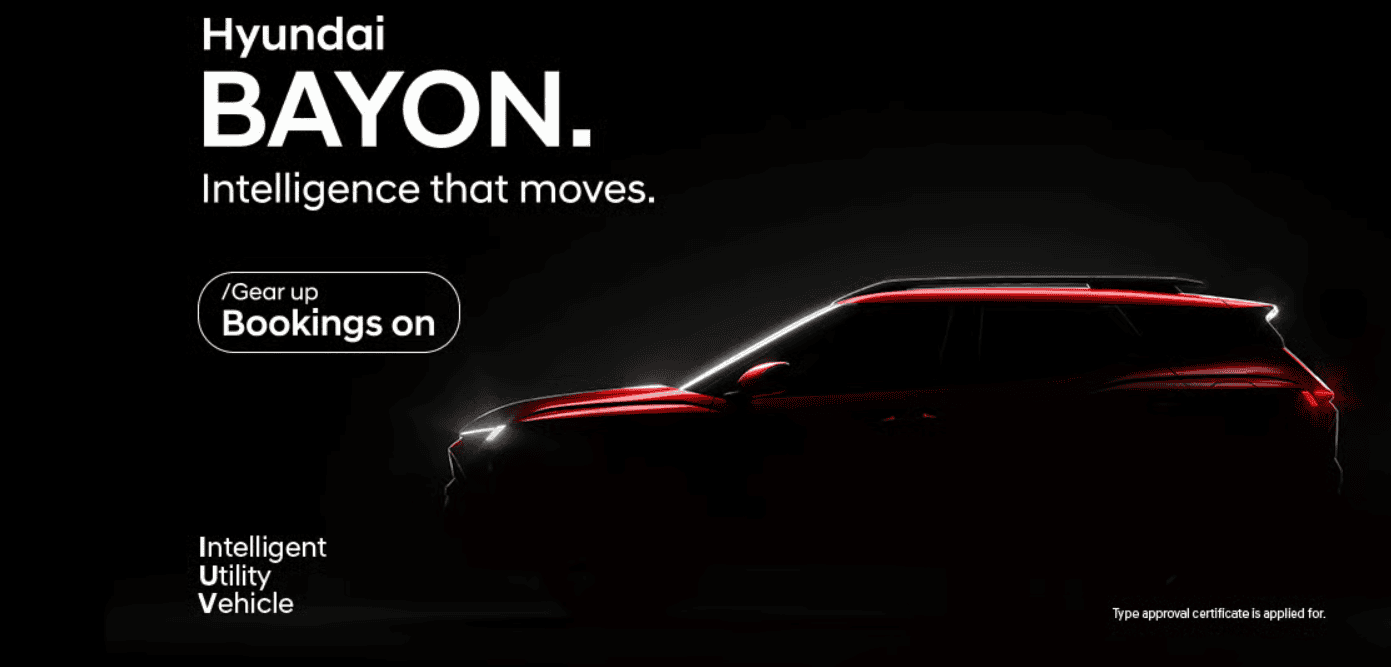
The name announcement is only the beginning. Hyundai has already released the first official design sketches, providing a much clearer indication of how the India-bound SUV will look. The company says more details will be revealed in the coming weeks.
With the Bayon expected to sit in the space between Hyundai’s smaller and larger SUVs, the new model could become an important addition to the company’s growing Indian SUV range.
Hyundai Bayon Name Revealed for India
Hyundai officially announced the BAYON name on September 14, 2026.
According to Hyundai, the name takes inspiration from Bayonne, a city in France’s Basque region. The company says the name reflects characteristics such as individuality, adventure and dynamic energy while giving the new SUV a distinct global identity.
The name is also significant because Hyundai is presenting the vehicle as more than another conventional SUV. The company describes Bayon as an Intelligent Utility Vehicle, combining technology and design with everyday usability.
Hyundai’s official announcement does not yet disclose the complete technical specifications, exact engine lineup, price or final variant structure.
First Hyundai Bayon Design Sketches Revealed
Hyundai released the first design sketches of the Bayon on September 16, giving buyers the first official look at the upcoming SUV.
The sketches show a more upright and muscular SUV stance, with sharp character lines and a distinctive front-end treatment.
Hyundai says the design follows its evolving “Art of Steel” design language, which uses architectural forms, pronounced surfaces and strong proportions to create a more expressive appearance.
The exterior is expected to feature:
- A sculpted bonnet
- Bold front fender volumes
- Distinctive H-Edge lighting
- Split-style lighting elements
- A prominent SUV-inspired front design
- Strong character lines
- A more upright and robust overall stance
The sketches are not necessarily a complete representation of every production detail, but they provide a strong indication of Hyundai’s design direction.
What Is the Hyundai Bayon’s “Intelligence ON” Philosophy?
One of the central themes surrounding the new SUV is Hyundai’s “Intelligence ON” philosophy.
Rather than treating technology as a collection of individual features, Hyundai says it wants technology to work naturally around the occupants.
The idea is that digital systems should simplify everyday driving rather than make the vehicle unnecessarily complicated.
According to Hyundai, this philosophy focuses on intuitive interactions, human-centric technology and seamless integration.
In practical terms, this could translate into a combination of connected-car functions, smart infotainment, driver-assistance technologies and digital convenience features.
However, Hyundai has not yet published the complete feature list, so specific technology such as ADAS functions, display sizes or connected features should not be treated as confirmed specifications at this stage.
Hyundai Bayon Designed for India’s Changing SUV Market
India’s SUV market has expanded significantly, particularly in the compact and crossover segments.
Buyers increasingly expect a combination of SUV styling, manageable dimensions, strong features, connectivity and practical urban usability.
Hyundai says the Bayon has been developed with these changing expectations in mind.
The company describes the vehicle as combining its global design philosophy with functional versatility and technology suited to modern Indian lifestyles.
This positioning could make the Bayon particularly relevant for buyers who want an SUV-like vehicle for daily city use but don’t necessarily need the size of a Creta or Alcazar.
Where Will the Hyundai Bayon Sit in India’s Lineup?
The exact positioning has not yet been fully explained by Hyundai, but industry reports indicate that the India-specific Bayon-based SUV is expected to sit between the Venue and Creta in Hyundai’s portfolio.
This would give Hyundai another product in a highly competitive part of the Indian market.
Autocar India reports that the India-bound SUV is being developed under the BC4i codename and is expected to compete with models such as the Maruti Suzuki Fronx, Toyota Taisor, Tata Nexon, Renault Kiger and Nissan Magnite.
The final dimensions and pricing will determine exactly where the Bayon fits.
Hyundai Bayon Could Share Its Underpinnings With the i20
The international Hyundai Bayon is closely related to the i20, and earlier industry reports have indicated that the India-bound model will use an architecture derived from the newer i20 platform.
That kind of component sharing could allow Hyundai to control manufacturing costs while creating a vehicle with a distinctly different SUV identity.
It would also allow Hyundai to benefit from an existing engineering ecosystem rather than developing an entirely separate platform from scratch.
The result could be a crossover that combines hatchback-like urban dimensions with a more upright SUV body.
Expected Engine Options for Hyundai Bayon
Hyundai has not officially announced the Bayon’s Indian powertrain lineup yet.
However, industry reports have pointed toward a new locally developed 1.2-litre turbo-petrol engine for the India-bound SUV. Autocar India previously reported that this four-cylinder turbo-petrol engine is being developed for India and is intended to be hybrid-ready.
A 1.0-litre turbo-petrol engine has also been reported as a possible option, potentially shared with existing Hyundai products. Autocar India has reported that the 1.0-litre turbo in related Hyundai applications produces around 120hp and 172Nm, although its exact specification and availability in the Bayon should be confirmed by Hyundai.
Possible Hybrid Technology
The 1.2-litre turbo engine is particularly interesting because reports have suggested that it is being developed with hybridisation in mind.
If Hyundai eventually offers a hybrid Bayon, it could give the company another electrified option in India’s rapidly evolving SUV market.
However, Hyundai has not officially confirmed a hybrid Bayon for India, so this should currently be treated as a reported possibility rather than a launch specification.
Transmission Options Could Include Automatic Choices
The final transmission lineup is also yet to be confirmed.
Industry reports have suggested that the Bayon-based SUV could use combinations including a manual gearbox, dual-clutch transmission and potentially an e-CVT for a future hybrid variant.
If Hyundai offers multiple transmission choices, the Bayon could appeal to a broad range of buyers.
A manual gearbox would keep the entry price more accessible, while an automatic option would suit buyers who spend much of their time driving in congested Indian cities.
Hyundai Bayon Interior Expected to Focus on Technology
Hyundai’s official design material describes the Bayon as combining a high-tech interior with a tough exterior.
Although the complete production cabin has not yet been revealed, the interior is expected to place considerable emphasis on digital interfaces and connected technology.
Potential areas of focus include:
- Digital driver information
- Large infotainment display
- Connected-car technology
- Smartphone integration
- Advanced driver assistance
- Voice and digital controls
- Premium cabin materials
The final equipment list will be one of the most important factors in determining where the Bayon sits within Hyundai’s portfolio.
Bold Lighting Could Become a Signature Design Element
One of the most distinctive elements visible in Hyundai’s design sketches is the lighting treatment.
The company specifically highlights its H-Edge lighting and describes the front design as having a strong, recognisable identity.
The lighting signature is likely to become one of the Bayon’s major visual differentiators.
Hyundai has increasingly used distinctive LED signatures across its newer models, and the Bayon appears to continue that strategy.
The design should also help separate the new SUV from the Venue, even though the two vehicles may occupy relatively close positions within the portfolio.
Expected Hyundai Bayon Launch in India
Hyundai has not announced an exact launch date yet.
However, recent reports indicate that the India-bound Bayon is expected to arrive around the 2026 festive season. Times of India reported that Hyundai’s first design reveal comes ahead of an expected festive-season launch, while Autocar India lists late 2026 as the expected timing.
This would put the Bayon into one of the busiest vehicle-buying periods in India.
Hyundai is expected to release additional details about the SUV closer to the launch.
Expected Hyundai Bayon Price
Hyundai has not officially announced the price.
Earlier industry estimates have placed the expected range broadly around ₹7 lakh to ₹15 lakh ex-showroom, although this is not an official Hyundai figure and could change once the company reveals the final specifications and variants.
The final price will depend on several factors, including:
- Engine choices
- Transmission options
- Safety equipment
- Technology features
- Variant structure
- Localisation level
If positioned between the Venue and Creta, Hyundai will need to maintain clear differentiation between the three models.
Hyundai Bayon Expected Rivals
The Bayon’s reported positioning puts it into one of India’s most competitive SUV categories.
Potential rivals include:
| Rival | Segment relevance |
|---|---|
| Maruti Suzuki Fronx | Premium crossover |
| Toyota Urban Cruiser Taisor | Compact crossover |
| Tata Nexon | Compact SUV |
| Renault Kiger | Compact SUV |
| Nissan Magnite | Compact SUV |
| Hyundai Venue | Internal portfolio overlap |
The exact competitive set will become clearer once Hyundai announces the vehicle’s dimensions and pricing.
Hyundai Bayon vs Venue: Why the Difference Matters
The Bayon and Venue are expected to sit relatively close to each other, but Hyundai can differentiate them through styling, dimensions, features and powertrain choices.
The Venue is already established as Hyundai’s compact SUV, while the Bayon is being presented with a more crossover-oriented identity and a fresh design philosophy.
The new model could therefore target buyers who want something different from the conventional compact SUV formula.
The final dimensions will be especially important.
If the Bayon offers noticeably more cabin or luggage space than the Venue, Hyundai could establish a clear reason for buyers to choose the newer model.
What Hyundai Has Confirmed So Far
It is important to separate official information from industry reports.
Confirmed by Hyundai
Hyundai has officially confirmed:
- The SUV’s name is BAYON
- It is being introduced in India
- It is described as an intelligent SUV
- The “Intelligence ON” philosophy is central to the product
- The name is inspired by Bayonne in France’s Basque region
- The first official design sketches have been released
- The vehicle uses Hyundai’s evolving Art of Steel design language
- More information will be revealed in the coming weeks
Not Yet Officially Confirmed
The following details remain subject to official confirmation:
- Final engine specifications
- Exact power and torque
- Transmission lineup
- Hybrid availability
- Dimensions
- Boot capacity
- India price
- Variant structure
- Exact launch date
- Complete ADAS package
- Final infotainment specifications
This distinction is important because several technical details currently circulating originate from earlier industry reports rather than Hyundai’s latest official announcement.
Hyundai Bayon Expected Specifications
| Specification | Current Information |
|---|---|
| Model | Hyundai BAYON |
| Market | India |
| Positioning | New SUV/crossover |
| Design language | Art of Steel |
| Technology philosophy | Intelligence ON |
| Expected launch | Festive season 2026, according to reports |
| Expected price | Around ₹7–15 lakh, industry estimate |
| Platform | Related to i20 architecture, reported |
| 1.2L turbo petrol | Reported |
| 1.0L turbo petrol | Reported possibility |
| Hybrid | Possible in future, not confirmed |
| Main rivals | Fronx, Taisor, Nexon, Kiger, Magnite |
Only information officially announced by Hyundai should be considered confirmed. Reported engine, pricing and launch details remain subject to change.
Why the Hyundai Bayon Could Be Important for India
Hyundai already has a broad SUV portfolio in India, including the Exter, Venue, Creta and Alcazar.
The Bayon would give the company another option for buyers who want SUV styling and technology but don’t necessarily want a larger vehicle.
Its positioning also reflects a broader shift in the Indian market.
Consumers increasingly expect their cars to combine design, connectivity, safety, efficiency and everyday practicality rather than focusing on only one characteristic.
Hyundai’s “Intelligence ON” positioning directly addresses this shift by presenting technology as something that should simplify the driving experience rather than merely increase the number of features on a specification sheet.
What to Expect Next
The September 16 design reveal is only the first major step in Hyundai’s Bayon launch campaign.
The next announcements are likely to focus on the vehicle’s technical specifications, features, powertrain options, safety equipment and pricing.
The most important details to watch will be the final engine lineup and how Hyundai positions the Bayon against the Venue and Creta.
Its price will also be crucial because the SUV will enter a segment where buyers have several established alternatives.
Final Verdict
The Hyundai BAYON is shaping up to be a significant new addition to Hyundai’s Indian SUV lineup, combining a distinctive global identity with a product philosophy specifically aimed at changing urban mobility expectations.
Hyundai has officially confirmed the Bayon name, the “Intelligence ON” philosophy and the first design direction, including its new Art of Steel styling language.
The latest design sketches show a bold SUV with pronounced body surfaces, H-Edge lighting and a technology-focused interior. Industry reports indicate that the India-bound model could use a new 1.2-litre turbo-petrol engine, potentially alongside the existing 1.0-litre turbo-petrol, although these powertrain details are not yet officially confirmed by Hyundai.
With a reported festive-season 2026 launch, the Bayon could soon become another important player in India’s highly competitive compact SUV and crossover market.
For now, the biggest pieces of the puzzle are still missing — price, engine specifications, dimensions, features and final launch date. Hyundai says more details are coming, so the next round of announcements should reveal whether the Bayon can establish a clearly differentiated position between the Venue and Creta.