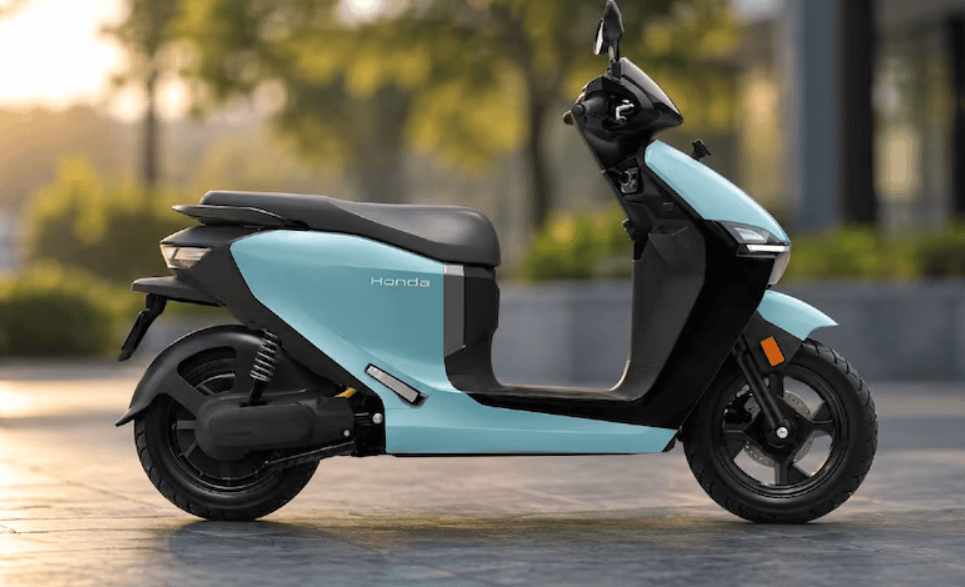
Honda Motorcycle & Scooter India has expanded its electric scooter lineup with the launch of the Honda QC3, a new family-focused electric scooter designed primarily for everyday urban commuting.
Priced at ₹1.35 lakh ex-showroom, New Delhi, the Honda QC3 becomes the company’s third electric scooter in India after the QC1 and Activa e:. It brings a larger 3.0kWh battery, a claimed 145km IDC range, 32 litres of under-seat storage and connected features including a 5-inch TFT display with Honda RoadSync.
The QC3 is initially being introduced in Delhi, Agra, Cuttack, Surat and Kollam through select Honda RedWing dealerships. Bookings are now open with a ₹5,000 booking amount, while Honda says the rollout will expand to additional markets in phases.
Honda QC3 Price in India
The Honda QC3 is priced at ₹1,35,000 ex-showroom in Delhi.
The scooter is being offered as a practical family EV rather than a performance-focused electric scooter. Honda has concentrated on range, storage, connected technology and everyday convenience.
Honda QC3 Price and Key Details
| Feature | Honda QC3 |
|---|---|
| Ex-showroom price | ₹1.35 lakh |
| Battery | 3.0kWh |
| Claimed IDC range | 145km |
| 0–80% charging | About 2 hours 40 minutes |
| Full charging | About 4 hours |
| Under-seat storage | 32 litres |
| Display | 5-inch TFT |
| Connectivity | Honda RoadSync |
| Navigation | Turn-by-turn |
| Key system | Smart Key |
| Initial cities | Delhi, Agra, Cuttack, Surat, Kollam |
The QC3’s pricing puts it directly into a competitive part of India’s electric-scooter market, where models such as the TVS iQube, Bajaj Chetak, Ather and Vida offer similarly positioned products. Autocar India notes that the QC3 is priced at ₹1.35 lakh, compared with ₹1.30 lakh for the TVS iQube 3.1kWh, ₹1.44 lakh for the Bajaj Chetak C3502 and ₹1.03 lakh for the Vida VX2 Plus 3.1, with prices referring to Delhi ex-showroom figures.
Honda QC3 Gets a 3.0kWh Battery
The biggest mechanical feature of the new Honda electric scooter is its 3.0kWh battery pack.
Honda claims a certified 145km IDC range from a full charge. This makes the QC3 the longest-range electric scooter in Honda’s current Indian lineup.
The larger battery is a significant step up from Honda’s entry-level QC1, which uses a 1.5kWh battery and has a considerably lower claimed range.
For urban users, the 145km IDC figure gives the QC3 enough claimed range to handle routine commuting without requiring daily charging for every rider. However, IDC certification figures are standardised test figures, and real-world range can vary depending on riding speed, traffic, rider weight, road conditions and use of electrical systems.
Honda QC3 Charging Time
Honda says the QC3 can charge from 0 to 80 percent in approximately 2 hours and 40 minutes.
A complete charge takes around four hours.
The charging figures are important because the QC3 uses a fixed battery rather than a removable battery system.
For owners with access to a convenient charging point at home or work, the four-hour full-charge time should make overnight or scheduled charging relatively straightforward.
The 0–80 percent figure is particularly useful for users who need to add range during the day without waiting for a complete charge.
32-Litre Storage Is a Major Advantage
Honda has focused heavily on practicality with the QC3.
The electric scooter provides 32 litres of under-seat storage, which Honda describes as the largest storage capacity in its current electric-scooter lineup.
This is an important feature for a family-oriented scooter.
The available space can accommodate everyday items such as bags, rainwear and other personal belongings. It also makes the QC3 more practical for users who want an electric scooter to replace a conventional petrol scooter for daily errands.
Storage has sometimes been compromised on electric scooters because of battery packaging. Honda appears to have made under-seat practicality a key part of the QC3’s design.
5-Inch TFT Display With Honda RoadSync
The QC3 also gets a 5-inch TFT instrument display.
The display supports Honda’s RoadSync connectivity system, along with turn-by-turn navigation.
Instead of relying entirely on a smartphone mounted separately on the handlebar, riders can access navigation information directly through the scooter’s display.
For daily city commuting, this can make navigation more convenient, particularly when travelling through unfamiliar areas.
Honda’s RoadSync platform also adds connected functionality, further positioning the QC3 as a smart electric scooter rather than a basic commuter EV.
Smart Key Adds Everyday Convenience
The Honda QC3 comes equipped with a Smart Key system.
This feature is designed to make everyday use easier by reducing the need to physically insert a conventional key every time the scooter is started or accessed.
For family users who frequently make short trips, this type of convenience feature can make a noticeable difference to the ownership experience.
Honda QC3 Is Designed as a Family Electric Scooter
Honda is clearly positioning the QC3 differently from performance-oriented electric scooters.
The company describes it as a smart, family-focused electric scooter designed around daily urban mobility.
That philosophy is visible in the product’s specifications.
Instead of concentrating on extremely high motor output or aggressive styling, Honda has prioritised:
- Long claimed range
- Large under-seat storage
- Easy charging
- Connected navigation
- Smart Key convenience
- Practical family-oriented design
This approach could appeal to buyers who want their electric scooter primarily as a replacement for a conventional daily-use scooter.
Honda QC3 Design and Colour Options
The QC3 is offered in four colour options:
- Matt Photon Gray Metallic
- Pearl Precious White
- Pearl Shallow Blue
- Pearl Siren Blue
The colour palette gives the scooter a modern appearance without moving too far away from the familiar family-scooter design philosophy.
The QC3 is intended to be approachable for a broad range of riders rather than targeting enthusiasts looking for a sporty electric scooter.
Honda QC3 Motor and Performance
Honda has focused the QC3 specification around practical city riding.
The scooter uses a hub-mounted electric motor and gets a front disc brake.
Honda has not positioned the QC3 around headline-grabbing acceleration figures or a very high top speed.
Instead, the scooter’s core proposition is about providing sufficient everyday performance while delivering useful range and practicality.
For family buyers, this approach can be more relevant than outright performance.
Honda QC3 vs Honda QC1
The QC3 sits above the QC1 in Honda’s electric scooter portfolio.
The QC1 uses a 1.5kWh fixed battery and has an 80km claimed range, while the QC3 doubles the battery capacity to 3.0kWh and raises the certified range to 145km.
The QC3 also provides substantially more storage.
The QC1 has around 26 litres of storage, whereas the QC3 offers 32 litres.
The result is a clear distinction between Honda’s two products: the QC1 focuses on more basic urban electric mobility, while the QC3 is designed as a more complete family scooter.
Honda QC3 vs Activa e:
The QC3 also joins the Activa e: in Honda’s electric lineup.
The Activa e: has a different approach, including a removable battery setup, while the QC3 uses a fixed 3.0kWh battery. The QC3 also claims a longer 145km IDC range compared with the Activa e:’s previously stated 102km IDC range.
This makes the QC3 the more range-focused model within Honda’s current electric scooter portfolio.
The 32-litre storage capacity is another practical difference, particularly because the Activa e:’s removable-battery arrangement affects available under-seat space.
Honda QC3 vs TVS iQube and Bajaj Chetak
The QC3 enters an increasingly competitive electric scooter market.
The TVS iQube, Bajaj Chetak, Vida VX2 and various Ather models are among the products competing for buyers looking for practical electric mobility.
Autocar India places the QC3 at ₹1.35 lakh ex-showroom Delhi, against ₹1.30 lakh for the TVS iQube 3.1kWh and ₹1.44 lakh for the Bajaj Chetak C3502.
This means the QC3’s success will depend on more than its range.
Honda will need its combination of brand familiarity, practical storage, charging convenience, connected features and after-sales network to attract buyers in this competitive price bracket.
Honda QC3 Initial Availability
The QC3 is not immediately being sold across the entire country.
Honda’s initial rollout covers five cities:
Delhi
Delhi is among the first markets to receive the QC3 through select RedWing dealerships.
Agra
Honda is also introducing the scooter in Agra as part of its initial rollout.
Cuttack
Cuttack is one of the first eastern Indian markets to receive the QC3.
Surat
The scooter is also initially available through select dealerships in Surat.
Kollam
Kollam completes the first five-city rollout.
Honda says a wider rollout will follow in phases.
This phased approach allows the company to introduce the scooter through selected dealerships before expanding availability to additional markets.
Honda QC3 Booking Amount
Bookings for the QC3 have opened with a ₹5,000 booking amount.
Customers in the initial markets can book the scooter through Honda’s website or participating authorised Honda RedWing dealerships.
The booking amount should not be confused with the final on-road price.
Buyers will still need to account for applicable registration, insurance, taxes and other charges when calculating the final amount payable.
Who Should Consider the Honda QC3?
The QC3 is particularly relevant for several types of buyers.
Daily City Commuters
The 145km IDC range and four-hour full charging claim make the QC3 suitable for routine urban travel.
Families
The 32-litre storage compartment, Smart Key and connected features make the scooter practical for everyday family use.
Existing Honda Users
People already familiar with Honda’s scooter ecosystem may find the transition to an electric Honda easier.
Riders Looking for More Range
Compared with Honda’s QC1 and Activa e:, the QC3 offers a higher claimed range, making it the more range-oriented Honda EV scooter currently available in India.
What Buyers Should Check Before Purchasing
The 145km IDC range is an official certified figure, but buyers should not assume that the scooter will always deliver exactly 145km in real-world conditions.
Actual range can vary based on:
- Average riding speed
- Traffic conditions
- Rider and passenger weight
- Road gradients
- Riding mode
- Tyre pressure
- Weather
- Battery condition
- Use of connected and electrical features
Potential buyers should also check whether the QC3 is available in their city and whether their preferred Honda dealership has charging, servicing and delivery support for the electric scooter.
Is the Honda QC3 Practical for Daily Use?
On paper, practicality is one of the strongest aspects of the QC3.
The combination of a 3.0kWh battery, 145km IDC range and 32-litre storage compartment addresses three of the most important concerns for family electric-scooter buyers.
The 5-inch TFT display and RoadSync connectivity add another layer of convenience, while the Smart Key makes regular use simpler.
The fixed battery also means owners need access to a suitable charging location, so buyers should consider their home parking and charging arrangement before making a purchase.
Final Thoughts
The Honda QC3 is an important addition to Honda’s growing electric-scooter portfolio in India.
At ₹1.35 lakh ex-showroom Delhi, it arrives with a 3.0kWh battery, a claimed 145km IDC range, approximately four-hour full charging, 32 litres of under-seat storage, a 5-inch TFT display, Honda RoadSync connectivity and turn-by-turn navigation.
Its positioning is clear: this is not primarily a performance-focused electric scooter. Honda has designed the QC3 around family practicality and everyday urban commuting.
The large storage compartment could be one of its most useful features, while the higher claimed range gives it a clear advantage over Honda’s smaller QC1 in terms of everyday travel potential.
The biggest challenge will be competition. Buyers in this price range already have several established electric scooters to choose from, so Honda will need to combine its brand reach, dealership network and product practicality to make the QC3 stand out.
For now, the QC3’s rollout begins in Delhi, Agra, Cuttack, Surat and Kollam, with bookings open for ₹5,000 and wider availability planned in phases.
With Honda now offering three electric scooter options in India, the QC3 represents a significant step toward making the company’s EV lineup more practical for mainstream family and city use.