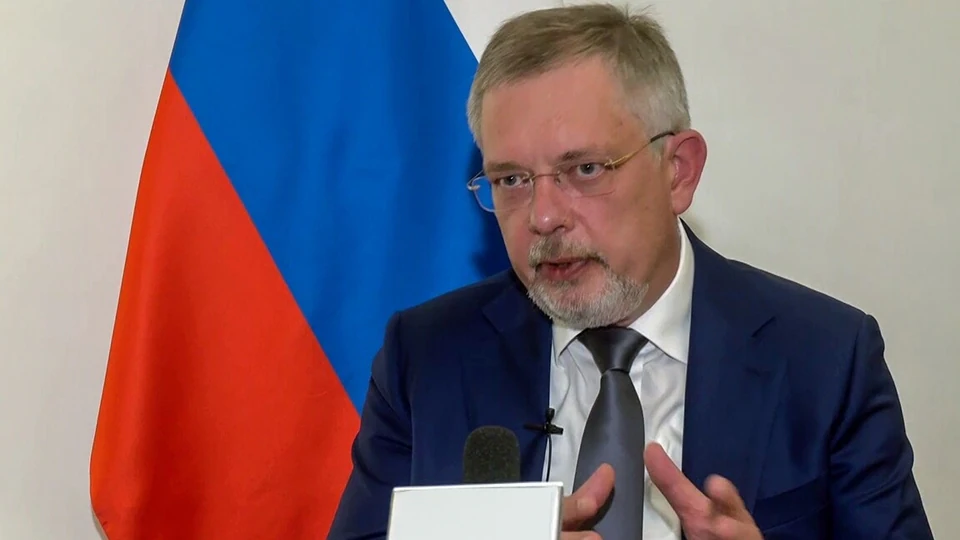
Russian Ambassador to India Denis Alipov has claimed that a senior US official publicly indicated that Washington would not allow India to become another China, describing the alleged remark as a “Freudian slip”. Alipov made the comments on September 27, 2026, while speaking at the NDTV Defence Summit, amid growing discussion over US pressure on India’s purchases of Russian crude oil.
The Denis Alipov remarks were presented as an assessment of US strategic thinking rather than as an official statement from Washington. Alipov said the alleged comment was made during this year’s Raisina Dialogue in New Delhi. He did not identify the US official or provide additional details in the remarks reported by Hindustan Times and NDTV.
According to Denis Alipov, the US official had said that America would not allow India to become the “next China” as a competitor. Alipov described the statement as a “Freudian slip”, using the term to suggest that the comment unintentionally revealed Washington’s underlying concerns about India’s growing economic and geopolitical influence. The claim is Alipov’s and has not been independently established by the available reports.
The Denis Alipov comments came at a time when India-US economic relations are facing pressure over India’s continued purchases of Russian crude oil. The Russian envoy argued that Washington’s actions, including the recently enacted Lindsey O. Graham Sanctioning Russia and Iran Act of 2026, should be viewed in the broader context of US pressure on countries buying Russian energy.
The Graham Act gives the US government authority to impose tariffs of up to 100% on goods from major buyers of Russian oil and gas under specified conditions. Current reporting identifies India and China among countries whose Russian oil purchases could bring them within the scope of the legislation, although the law does not specifically name individual countries as tariff targets.
Speaking about India’s Russian oil purchases, Denis Alipov said New Delhi was buying Russian crude because of its economic interests and energy requirements rather than to support Russia. He argued that Russian oil remained commercially attractive for India and linked the issue to what he described as India’s effort to maintain strategic autonomy in its foreign policy.
India’s government has previously said that it would take necessary measures to protect its trade and economic interests following developments surrounding the US sanctions legislation. The Ministry of External Affairs also said India remained committed to meeting the energy requirements of its population and would continue to diversify energy sources based on market conditions.
The Denis Alipov statement therefore comes against a backdrop of competing strategic interests involving India, Russia and the United States. India has maintained defence and energy ties with Russia while simultaneously expanding defence, technology and economic cooperation with the US and other Western countries. The Russian ambassador’s comments reflect Moscow’s interpretation of these changing geopolitical relationships.
India-Russia relations were another major subject addressed by Denis Alipov during the Defence Summit. He described the relationship between the two countries as based on long-term trust and cooperation and pointed to the continuity of bilateral ties from the Soviet period through the present Russian Federation. He also said the relationship had not been treated by either side as dependent on immediate changes in the international political environment.
According to Denis Alipov, India and Russia have maintained their partnership through significant changes in global politics because neither country has made the relationship dependent on short-term international developments. He described the two countries as reliable partners and said their long-standing cooperation created a foundation for further engagement.
The timing of the remarks is also notable because six US F-35 Lightning II fighter jets and more than 200 American personnel have arrived in India to participate in Exercise Tarang Shakti 2026. This is the first time F-35 aircraft have participated in the Indian Air Force’s multinational exercise. The American deployment is taking place alongside aircraft from several other partner countries.
The Denis Alipov comments also touched indirectly on India’s future fighter aircraft choices. In another session at the NDTV Defence Summit, the Russian ambassador said any decision by India between the American F-35 and Russian Su-57 would ultimately be India’s sovereign decision. He described the F-35 as a capable aircraft but argued that it was expensive, while highlighting Russia’s offer.
India’s defence relationship with Russia remains extensive, involving several generations of military equipment and joint development programmes. At the same time, India has acquired a number of US defence platforms, including transport aircraft and helicopters. The BrahMos programme, jointly developed by India and Russia, remains one of the most prominent examples of bilateral defence cooperation.
The Denis Alipov remarks about US intentions should therefore be understood as statements made by the Russian ambassador rather than as an established description of official US policy. The reports available on September 27 do not include a US government response confirming the alleged Raisina Dialogue comment. Hindustan Times also noted that the Indian government had not issued an official statement on Alipov’s specific remark.
Alipov’s comments nevertheless highlight a broader debate about India’s position between major global powers. New Delhi has continued to pursue what it describes as strategic autonomy, maintaining relationships with Russia while developing closer cooperation with the United States, Europe, Japan, Australia and other partners. This approach allows India to engage with different countries across defence, energy, technology, trade and diplomatic forums.
The Russian ambassador also connected the issue to India’s future global role. Denis Alipov said he expected India to become a stronger global power and argued that increased pressure from the US would accompany that rise. This is his assessment of future geopolitical dynamics rather than an independently verified forecast.
The controversy over Russian oil is likely to remain an important element in India-US relations as the new US sanctions framework develops. For India, energy security and access to competitively priced crude remain important considerations, while Washington has sought to increase economic pressure on countries purchasing Russian energy. The eventual impact will depend on how the US implements the legislation and how India, Russia and other affected countries respond.
For Denis Alipov, the current situation demonstrates why India should continue pursuing an independent foreign policy. His comments placed the Russian position firmly in the context of India’s energy requirements, defence cooperation and broader geopolitical rise. However, the claim that Washington intends to prevent India from becoming another China remains an allegation made by the Russian envoy and should not be treated as a confirmed US policy position without supporting evidence.
The latest remarks also underline the complexity of India’s defence partnerships. The arrival of American F-35s for Tarang Shakti 2026 comes at the same time that Russia is promoting the Su-57 and emphasizing its long-standing defence relationship with India. India’s eventual procurement decisions will involve its own strategic, technological, financial and operational considerations.
As India continues to strengthen its global partnerships, statements from Denis Alipov are likely to remain part of the wider debate over India’s relationship with Russia and the United States. For now, the key development is that the Russian ambassador has publicly interpreted recent US actions as part of a broader effort to limit India’s rise, while the specific US official statement he referenced has not been independently verified in the reports available.
The Denis Alipov remarks thus add another layer to the ongoing discussion around India-US relations, Russian energy supplies and India’s strategic autonomy. With the Graham Act now part of the US policy framework and India continuing to maintain energy and defence links with Russia, the issue is likely to remain significant for New Delhi’s foreign policy and economic calculations in the coming months.