
Back-to-back technical disruptions during major national-level examinations at Jaipur’s Sitapura examination centres have triggered concerns over the reliability of computer-based testing infrastructure in India. Within a short period, candidates appearing for NEET-PG 2026 and the AIIMS Common Recruitment Examination faced power failures, server problems and repeated computer shutdowns, forcing authorities to order fresh examinations for affected candidates.
The controversy intensified after technical problems were reported at the iON Digital Zone centres in Jaipur’s Sitapura area during NEET-PG 2026 on August 30. The examination could not be completed normally for thousands of candidates because of internal power-supply problems at two centres.
NEET-PG is one of India’s most important postgraduate medical entrance examinations. Candidates spend months, and often years, preparing for the test because their scores can determine admission to postgraduate medical courses and influence their future specialisation.
According to the National Board of Examinations in Medical Sciences, the examination could not be completed at two Sitapura test centres because of internal power-supply issues. The affected centres carried test centre numbers 41682 and 41683.
The disruption affected 2,445 candidates, according to the Union Health Ministry’s account of the incident. The Ministry attributed the problem to internal power-supply issues at the test centres and identified TCS Ltd, whose testing operation was conducting the examination, as responsible for the centre-level disruption.
Candidates reported that their computer systems repeatedly shut down during the examination. Some said they would answer only a few questions before the system stopped functioning and they had to wait for it to restart.
The situation created considerable anxiety because NEET-PG is conducted under strict time limits. Any repeated interruption can disturb concentration and make candidates concerned about whether their responses and remaining examination time have been recorded correctly.
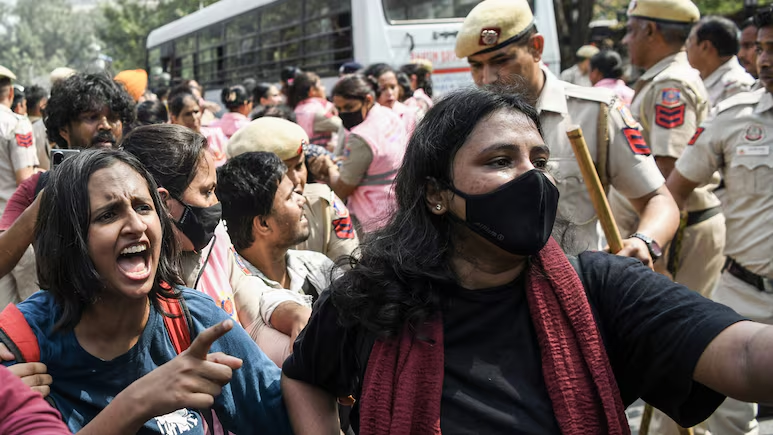
Candidates also alleged that the examination, scheduled to begin at 9 am, was delayed at the affected centres. Protests subsequently broke out outside the examination venue as candidates demanded a fair solution.
NBEMS eventually announced that affected candidates would receive another opportunity to take the examination.
The NEET-PG re-examination for affected Jaipur candidates has been scheduled for September 5, 2026, at 3 pm. Revised admit cards and venue-related information are to be communicated to the candidates concerned.
NBEMS also apologised to candidates for the inconvenience caused by the disruption.
The Jaipur incident becomes more significant when viewed against the overall scale of NEET-PG 2026. The examination was conducted across 1,111 centres nationwide for more than 2.73 lakh registered candidates. Around 2.66 lakh candidates appeared, and the overwhelming majority were able to complete their examination normally.
The problems were therefore concentrated at specific Jaipur centres rather than representing a nationwide failure of the examination.
However, what happened next turned an isolated examination-centre problem into a broader controversy over computer-based testing infrastructure.
A day after the NEET-PG disruption, technical problems again affected another major examination at the iON Digital Zone facilities in Sitapura.
This time, candidates were appearing for the All India Institute of Medical Sciences Common Recruitment Examination, commonly known as AIIMS CRE.
The examination is conducted for recruitment to different Group B and Group C non-faculty positions across participating institutions.
Technical and power-related problems disrupted the examination, eventually forcing authorities to cancel the affected session and arrange another examination for candidates.
The recurrence was particularly troubling because the infrastructure had already experienced serious problems during NEET-PG.
Candidates appearing for the AIIMS examination reportedly faced server crashes and other technical difficulties, leading to delays and protests.
AIIMS has subsequently scheduled the affected CRE-5 examination for September 7, 2026, giving impacted candidates another opportunity to appear.
The two incidents occurring in such quick succession have raised a fundamental question: how thoroughly are computer-based examination centres tested before being approved for high-stakes national examinations?
Computer-based testing has become increasingly common across India.
Medical entrance examinations, recruitment tests, university admissions and several government examinations now rely heavily on digital testing centres.
The model offers several advantages.
Large numbers of candidates can appear for examinations simultaneously, question papers can be distributed digitally and examination authorities can reduce some of the logistical challenges associated with printing and transporting physical papers.
Digital examinations can also provide better monitoring and faster processing of candidate responses.
However, computer-based testing creates a different set of vulnerabilities.
A traditional pen-and-paper examination can generally continue during a temporary computer-network failure.
A computer-based examination cannot.
Every candidate depends on functioning computers, reliable servers, stable electricity, networking equipment and backup systems.
A failure in any one of these areas can affect hundreds or thousands of candidates simultaneously.
That is why redundancy is particularly important at computer-based testing centres.
High-stakes examination venues need reliable backup electricity systems capable of maintaining computers, networking equipment, servers and essential supporting infrastructure during an outage.
Simply having a backup generator may not necessarily be enough.
The system must be capable of switching over quickly and reliably without causing candidates’ computers to repeatedly shut down.
The Jaipur incidents have therefore raised questions about whether sufficient contingency arrangements were available and whether those arrangements functioned as expected.
TCS iON attributed the NEET-PG disruption to internal power failures connected with what it described as unknown local electrical issues at the Sitapura examination facility.
Whatever the precise technical cause, the impact on candidates was substantial.
For NEET-PG aspirants, appearing for a re-examination is not a minor inconvenience.
Candidates often travel considerable distances to examination centres. Some book hotels, arrange transportation and take leave from work or medical duties.
They also prepare psychologically for a particular examination date.
When the examination is cancelled or rendered invalid because of infrastructure problems, candidates must repeat that entire process.
There is also the question of fairness.
Candidates appearing for a re-examination on a different date will necessarily receive a different question paper.
Examination authorities therefore have to ensure that differences in question difficulty do not create an unfair advantage or disadvantage.
For competitive examinations in which small differences in scores can significantly affect rankings, candidates naturally expect the examination authority to maintain comparable standards.
The NEET-PG controversy also follows another computer-based examination disruption in Jaipur.
On August 22, a power outage affected candidates appearing for the All India AYUSH Post Graduate Entrance Test. A re-test was ordered for affected candidates after some were unable to complete that examination.
This means concerns about examination-centre infrastructure did not begin with NEET-PG.
Multiple incidents within a short period have intensified demands for stronger technical audits and accountability.
Candidates have questioned why centres experiencing serious power-related problems continued to be used for important national examinations.
The issue is larger than one examination vendor or one Jaipur facility.
India’s increasing dependence on computer-based examinations means the reliability of testing infrastructure has become directly connected with the credibility of the examination system itself.
Candidates must be confident that their performance will be measured by their knowledge and preparation rather than by the quality of the computer terminal assigned to them.
Even apparently small technical problems can have significant consequences during a timed examination.
If one candidate’s computer works normally while another candidate experiences repeated shutdowns, the two candidates are not competing under identical conditions.
Examination software can sometimes preserve responses and pause timers during technical interruptions, but that does not completely eliminate the psychological impact.
Repeated shutdowns can break concentration, increase anxiety and disrupt a candidate’s strategy for completing different sections of an examination.
The Jaipur candidates have highlighted precisely these concerns.
The incidents have also raised questions about communication during technical failures.
When a computer-based examination experiences a serious outage, candidates need immediate and consistent information.
They need to know whether their responses have been saved, whether the timer has stopped, whether additional time will be provided and whether the examination will continue.
Confusion inside an examination hall can make an already stressful technical problem significantly worse.
Clear emergency protocols are therefore as important as technical backup systems.
Invigilators should know exactly what procedures to follow when systems fail.
Testing agencies should also have the ability to communicate quickly with examination centres and candidates.
Another issue is the process used to select examination centres.
A computer laboratory capable of conducting ordinary training sessions is not automatically suitable for a high-stakes national examination involving hundreds of candidates.
Centres need adequate electricity capacity, backup power, network redundancy, functional computers, security systems and trained technical personnel.
Infrastructure should ideally be tested under realistic examination conditions before candidates arrive.
A system may work properly when only a few computers are active but experience problems when hundreds of terminals operate simultaneously.
Stress testing can therefore become an important part of examination preparation.
Authorities may also need to review the previous performance history of testing centres.
If a centre repeatedly experiences serious technical problems, continuing to allocate major examinations to the same facility can undermine confidence among candidates.
The latest incidents have therefore strengthened arguments for a centre-level reliability record.
Such a system could track power failures, server disruptions, candidate complaints, cancellations and other significant problems.
Centres with repeated failures could then face additional audits or temporary suspension until their infrastructure is demonstrated to be reliable.
Accountability is another major concern.
When an examination fails because of infrastructure problems, responsibility can become divided between the examination authority, testing agency, centre operator and local infrastructure provider.
For candidates, however, those contractual distinctions offer little comfort.
They registered for an examination organised by a recognised national institution and expect the complete examination ecosystem to function properly.
Authorities therefore need contracts that clearly define responsibility for technical failures and establish consequences when required service standards are not met.
Financial penalties alone may not always be sufficient.
Repeated failures can affect candidates’ careers and public confidence in national examinations.
Quality assurance must therefore focus on preventing disruption rather than merely compensating for it afterward.
The Jaipur incidents have also shown why backup planning should include alternative examination centres.
In a major city, examination authorities could potentially identify standby infrastructure capable of accommodating candidates if a primary centre suffers a serious failure before the examination begins.
Moving hundreds of candidates at short notice would be difficult, but advance contingency planning could provide more options than simply cancelling the examination.
For examinations conducted nationwide, regional emergency teams could also be established to respond quickly to serious centre-level failures.
Technical monitoring could provide another layer of protection.
Central examination control rooms can monitor server connectivity and system performance at individual centres.
If unusual shutdown patterns or connectivity problems appear, technical teams could intervene before the problem becomes widespread.
Power systems could similarly be monitored during the examination.
Computer-based testing also needs carefully designed recovery systems.
Candidate responses should be saved continuously rather than only periodically.
If a computer terminal fails, candidates should ideally be able to move to another terminal and resume from exactly where they stopped without losing responses or examination time.
Such systems can significantly reduce the impact of isolated computer failures.
But large-scale power failures remain more difficult because they can simultaneously affect multiple terminals and supporting infrastructure.
That is why reliable power redundancy remains essential.
The Jaipur incidents have attracted political criticism as well.
Opposition leaders questioned the management of national examinations and demanded accountability for repeated disruptions affecting students.
However, beyond the political debate, the immediate issue for candidates is straightforward.
They want examinations to be conducted under predictable and equal conditions.
A candidate appearing for a national examination should not have to worry about whether the centre’s electricity supply or computer network will survive the duration of the test.
Technology is supposed to make examinations more efficient.
If poorly implemented, it can instead introduce new forms of uncertainty.
The repeated disruptions in Jaipur demonstrate the importance of treating digital examination infrastructure as mission-critical technology.
For a high-stakes national examination, the required reliability should be closer to that expected from essential digital infrastructure than from an ordinary computer laboratory.
That means redundant electricity, tested backup systems, reliable networking, continuous response saving, trained technical staff and clearly defined emergency procedures.
Candidates should also receive transparent information after an incident.
Authorities need to explain what went wrong, how many candidates were affected, what corrective measures are being taken and how fairness will be protected during any re-examination.
Transparency becomes particularly important when multiple incidents occur at the same location.
The latest sequence in Jaipur has understandably made candidates question whether enough was done after the first warning signs appeared.
The NEET-PG disruption alone would have warranted an examination of the centre’s technical infrastructure.
When another major examination then experienced problems at the same Sitapura facilities, those concerns became much harder to dismiss as an isolated malfunction.
AIIMS’ decision to provide another examination opportunity on September 7 addresses the immediate problem for affected CRE candidates.
Similarly, the September 5 NEET-PG re-examination provides affected medical aspirants with another opportunity to complete their test.
But re-examinations solve only the immediate consequence.
They do not answer the broader question of how such failures can be prevented.
For candidates, repeating an examination means additional preparation, travel, stress and uncertainty.
For examination authorities, it creates additional logistical and security requirements.
For the broader education system, repeated cancellations risk reducing confidence in computer-based testing.
The solution is therefore not to abandon digital examinations.
Computer-based testing can remain an effective method for conducting large-scale examinations when the supporting infrastructure is reliable.
Instead, the Jaipur incidents underline the need for stronger technical standards.
Examination centres should undergo rigorous certification before being used.
Backup systems should be tested under full load.
Previous failures should be recorded and considered before centres receive future allocations.
Testing vendors should face clearly defined performance requirements.
Candidates should have access to rapid grievance mechanisms when disruptions occur.
Most importantly, examination authorities should treat infrastructure reliability as part of examination fairness.
A technically functioning examination environment is not an optional convenience.
It is a basic requirement for ensuring that every candidate receives an equal opportunity to perform.
The back-to-back problems at Jaipur’s Sitapura centres have therefore become more than a local technical controversy.
They have opened a wider debate about whether India’s rapidly expanding computer-based examination system has sufficient safeguards to match its growing importance.
Millions of candidates now depend on digital examination systems for admission to universities, professional courses and government employment.
Even a very small percentage of technical failures can consequently affect thousands of careers.
The Jaipur incidents demonstrate how quickly confidence can be damaged when failures occur repeatedly at the same location.
For the affected NEET-PG candidates, attention will now turn to the September 5 re-examination.
For candidates affected by the AIIMS CRE disruption, the next important date is September 7.
Authorities will be under particular pressure to ensure that both examinations proceed without another technical problem.
The larger challenge will continue after those examinations are completed.
Examination bodies and technology providers will need to determine exactly what caused the repeated failures and whether infrastructure standards need to be strengthened nationally.
Computer-based testing has become too important to India’s education and recruitment system for repeated power or server failures to be treated simply as unavoidable inconvenience.
Candidates prepare for these examinations expecting their knowledge, accuracy and time management to determine their results.
They should not have to compete against malfunctioning computers or unreliable electricity.
The events in Jaipur have made that expectation clearer than ever and placed the reliability of India’s computer-based examination infrastructure firmly under scrutiny.