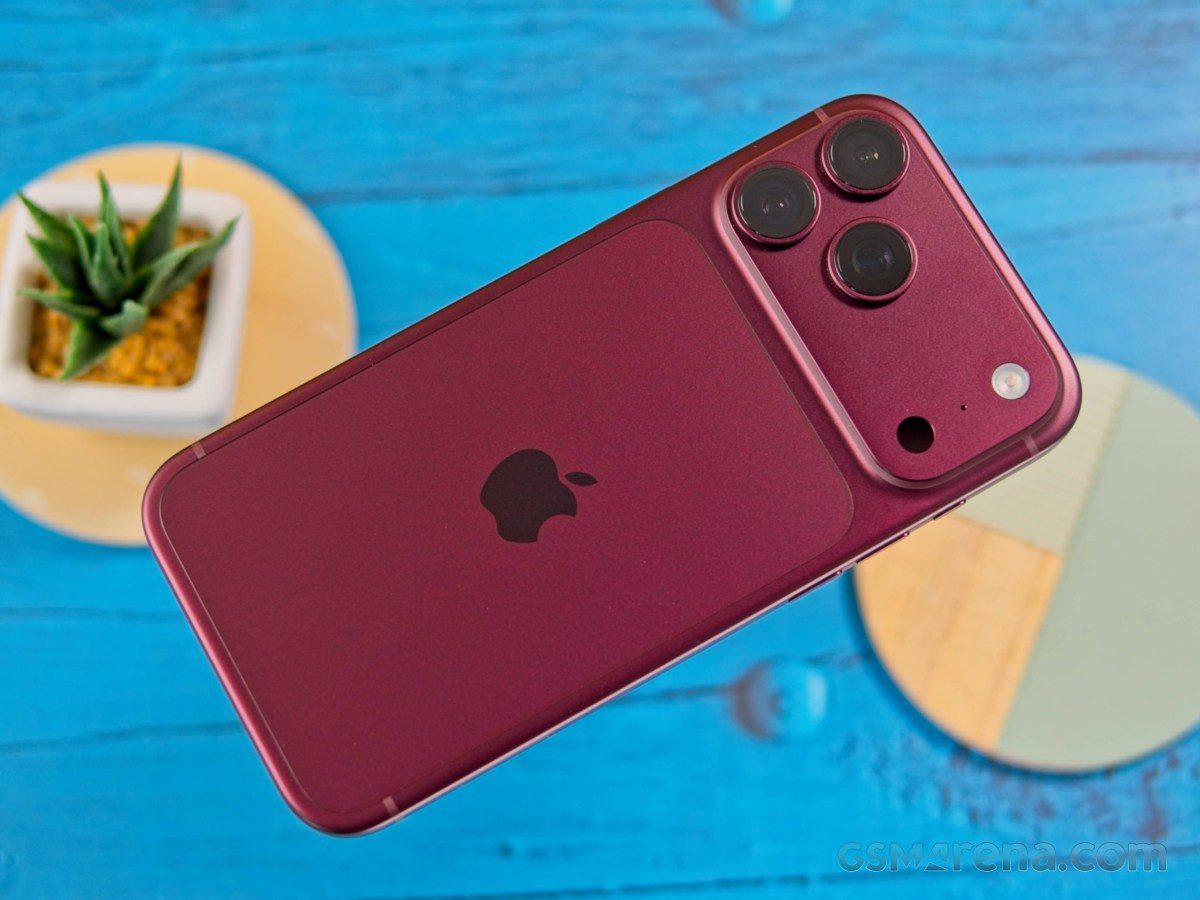

Apple has officially entered the foldable smartphone market with the launch of the iPhone Duo, its first-ever foldable iPhone. Unveiled on September 9, 2026, the new device combines a compact 5.4-inch outer display with a much larger 7.6-inch inner screen, bringing a completely new form factor to Apple’s iPhone lineup.
The company describes iPhone Duo as the biggest transformation to the iPhone since the original model. Apple has combined the foldable hardware with a redesigned version of iOS 27, new multitasking features, Apple Intelligence, Siri AI and a dual-battery architecture.
When folded, iPhone Duo has a 5.4-inch outer Super Retina XDR display and is designed to remain compact enough for everyday pocket use. When opened, the device reveals a 7.6-inch inner Super Retina XDR display, which Apple says is 50 percent larger than the display on the iPhone 18 Pro Max.
Both screens support ProMotion, Always-On functionality and up to 3,000 nits of peak outdoor brightness. Apple has also used a special nano-texture finish on the inner display to reduce glare and reflections while making the crease less noticeable.
The two displays have the same aspect ratio, allowing content to scale proportionally as users move between the folded and unfolded configurations.
Apple has designed the inner display with a hidden FaceTime camera that remains out of sight when it is not being used. The approach allows the company to maintain a more uninterrupted viewing area on the large folding screen.
Another major change is the authentication system. Instead of relying on Face ID, iPhone Duo incorporates Touch ID into the side button, allowing users to unlock the phone regardless of whether it is open or closed.
The device also includes Camera Control, which provides quick access to the camera and supports a new Siri Camera mode. With this feature, Siri can understand what the camera is seeing and respond to questions or take actions based on the visual information.
Durability has been one of Apple’s major priorities with its first foldable iPhone. iPhone Duo uses grade 5 titanium with a mirror-polished finish, while the hinge includes a 3D-printed cover with a contrasting micro-blasted finish.
The outer display is protected by Ceramic Shield 2, which Apple says offers three times better scratch resistance than the previous generation. The back of the device also uses Ceramic Shield protection.
The foldable iPhone carries an IP68 rating for splash, water and dust resistance. Apple says the precision hinge contains more than 100 components and has been engineered to control the opening and closing movement while supporting the centre of the display.
The inner display also receives additional protection through a scratch-resistant coating and a nano-textured cover layer. High-strength glass is positioned around the folding display panel, while custom adhesives help the different layers move relative to one another as the phone folds.
Apple has also redesigned the internal structure with support ribs and ceramic-fibre antenna inserts to improve rigidity.
Photography is another major focus of iPhone Duo. The device features a 48MP Fusion Main camera capable of capturing images at up to 48MP resolution, along with an integrated optical-quality 2x Telephoto capability.
The main camera uses a large sensor, a fast aperture and sensor-shift optical image stabilisation to improve low-light photography. Apple has also developed a new computational photography pipeline to enhance detail and image quality.
A 48MP Fusion Ultra Wide camera is included as well. It can capture wider scenes and supports macro photography.
For selfies and video calls, iPhone Duo features a Center Stage front camera that can automatically expand its field of view and adjust the orientation of the frame. This means users can capture landscape selfies without manually rotating the phone.
The folding design also creates new photography possibilities that are not available on conventional iPhones.
For example, users can take selfies using the higher-resolution rear cameras while viewing the composition on the outer display. Another feature called Duo Preview allows people being photographed to see the live camera preview on the external screen and adjust their pose or framing.
Apple has also introduced Smart Take, which uses on-device AI running on the A20 Pro chip to analyse a scene and automatically capture photographs when subjects are ready.
For families, Kid Cue can display Peanuts animations on the outer screen to encourage children to look toward the camera.
The dual-screen design can also be used for FaceTime. Duo FaceTime allows another person to participate using the outer display and camera, while Dual Capture can share front and rear camera feeds simultaneously.
For video creators, iPhone Duo supports 4K recording at 120 frames per second in Dolby Vision using the 48MP Fusion Main camera. This allows users to create high-quality slow-motion footage.
Cinematic effects can also be applied after recording at up to 60 frames per second. Apple has upgraded Audio Mix with algorithms designed to improve voice quality and isolate music.
The large foldable screen also changes how iOS works.
Apple has specifically redesigned iOS 27 for iPhone Duo so that the interface can adapt as the device folds, unfolds and changes orientation. Controls and navigation elements have been repositioned to make better use of the available screen space.
When the phone is open, users can see two Home Screen pages along with Today View widgets. The Dynamic Island has also been redesigned for the foldable form factor and can expand vertically along the side of the displays.
One of the biggest software additions is Split View multitasking. For the first time on an iPhone, users can run two apps side by side on the same screen.
This could make the device particularly useful for productivity. Someone could browse the web while taking notes, watch a video while messaging, or compare information across two apps without constantly switching between them.
Users can also open two windows of the same application, such as Safari, which could be useful for comparison shopping or research.
Apple has also made it possible to save pairs of apps and return to them later, making the large inner screen more useful for people who regularly multitask.
StandBy has received a significant upgrade as well. iPhone Duo can enter StandBy mode even when it is not charging, using either the inner or outer display as a photo frame, clock, widget hub or information screen.
Apple is also putting its latest artificial intelligence capabilities at the centre of the new device.
iPhone Duo supports the next-generation Siri AI, which is rolling out as a beta with iOS 27. The updated Siri is designed to understand personal context and provide more conversational assistance.
Siri AI can use information from messages, emails and photos to help users find information. It can also understand what is displayed on the screen and take actions related to that content.
The new Siri experience can also be used for writing tasks simply by describing what the user wants.
Apple has further integrated AI into photography and other applications. Features including Spatial Reframing, Extend and an upgraded Clean Up tool are designed to give users more control over images.
Image Playground now supports photorealistic imagery, while Safari’s Notify Me feature can monitor webpages for changes such as product restocks and price drops.
Apple says these AI capabilities are designed with privacy in mind, using a combination of on-device processing and Private Cloud Compute for more demanding tasks.
Performance comes from Apple’s new A20 Pro chip, the same processor used in the iPhone 18 Pro models.
The A20 Pro uses a 2-nanometre manufacturing process and includes a six-core CPU, seven-core GPU and a dual 16-core Neural Engine. Apple says the CPU is up to 20 percent faster than the A19 Pro, while the GPU is up to 40 percent faster and more power efficient.
The Neural Engine provides twice the compute power for on-device AI models, while memory bandwidth has increased by 50 percent.
Apple has also developed a custom thermal-management system for the foldable device. The A20 Pro package is connected directly to a custom vapor chamber, helping the phone maintain performance during gaming, multitasking and intensive AI workloads.
According to Apple, iPhone Duo can deliver up to 35 percent better sustained performance than the iPhone 17 Pro.
Battery life has been addressed through a dual-battery architecture. One battery is placed on each side of the foldable design, allowing Apple to use the internal space more efficiently.
Apple claims iPhone Duo can provide up to 31 hours of video playback using the inner display and up to 44 hours using the outer display. When both displays are used equally, the company estimates up to 24 hours of usage per charge.
Fast charging can bring the device to 50 percent in around 20 minutes, while wireless charging can reach 50 percent in around 30 minutes with a compatible MagSafe or Qi2 charger.
Connectivity is handled by Apple’s N1 wireless networking chip and C2 cellular modem system. The N1 supports Wi-Fi 7, Bluetooth 6 and Thread, while C2 adds improvements to cellular performance and reliability.
iPhone Duo is also an eSIM-only smartphone worldwide. Apple says removing the physical SIM card slot creates additional internal space that can be used for other components, including battery capacity.
The device will be offered in two finishes: star white and night sky. It will be available with 256GB, 512GB, 1TB and 2TB storage options.
In the United States, iPhone Duo starts at $1,999 for the 256GB model. Apple has confirmed that India is among the more than 70 countries and regions included in the initial rollout. Pre-orders begin on October 16, 2026, with availability starting October 23.
Apple will also sell dedicated accessories for the foldable phone, including an iPhone Duo Case and an iPhone Duo Folio with Kickstand.
The company has also highlighted the environmental design of the new smartphone. iPhone Duo contains 35 percent recycled material overall, including recycled cobalt in the battery and recycled titanium in its 3D-printed hinge cover.
Apple says the device is manufactured using 60 percent renewable energy across its supply chain, while its packaging is entirely fibre-based.
The launch of iPhone Duo marks an important change in Apple’s smartphone strategy. The company has stayed out of the foldable phone market while rivals have released multiple generations of foldable devices, but it is now entering the category with a design focused heavily on durability, multitasking, cameras and integration between hardware and software.
Rather than simply turning the iPhone into a smaller tablet, Apple is attempting to make the foldable format part of the everyday iPhone experience. The 5.4-inch external screen is designed for conventional phone use, while the 7.6-inch internal display provides a much larger workspace when users need it.
The combination of Split View, Apple Pencil support, StandBy, AI-powered Siri and the redesigned iOS interface could make the larger screen particularly useful for work, entertainment and content creation.
With a starting price of $1,999 in the United States, however, iPhone Duo sits firmly in the premium segment. Its success will ultimately depend on whether consumers believe the combination of Apple’s ecosystem, foldable design and software experience justifies the significant price premium.
For Apple, the iPhone Duo represents far more than another new iPhone model. It is the company’s first major step into foldable smartphones and introduces a new form factor that combines the portability of an iPhone with a much larger display.
Pre-orders begin October 16, with the first units arriving on October 23. If Apple’s claims about durability, battery life, performance and software integration hold up in real-world use, iPhone Duo could become one of the most significant additions to the iPhone family in years.