The Punjab government has announced a major proposed increase in Dearness Allowance for around 85,000 government employees recruited after July 17, 2020. Their DA is set to rise from the existing 42 percent to 60 percent, bringing it in line with the rate applicable under the Central pay structure.
The announcement was made by Punjab Industries and Commerce Minister Aman Arora on September 4, 2026. The decision comes at a time when government employees across the state have been protesting over pending Dearness Allowance instalments, arrears and other service-related demands.
The proposed hike represents an increase of 18 percentage points in DA. However, it is important to note that the recommendation still requires final approval from Chief Minister Bhagwant Mann before it can formally take effect.
The decision was recommended by a three-member Cabinet Sub-Committee formed to examine the grievances and pay-related concerns of government employees. The committee includes Finance Minister Harpal Singh Cheema, Industries and Commerce Minister Aman Arora and Social Security Minister Baljit Kaur.
According to the government, the proposed revision is aimed at addressing a pay disparity affecting employees recruited after July 17, 2020. These employees were brought under a pay structure based on the Central government’s Seventh Pay Commission, but their DA continued to be calculated at Punjab’s lower rate of 42 percent.
Employees recruited before July 2020 generally continue to be governed by Punjab-specific pay scales under the state’s pay structure. These scales have historically provided a higher basic salary than the Central pay structure in several categories.
The post-2020 employees, however, were placed on the Central pay pattern for their basic pay. At the same time, they continued to receive DA according to the Punjab rate, creating a difference between their pay structure and the DA rate applicable to Central government employees.
Aman Arora said the situation of these employees was different from that of older employees because they did not receive the higher Punjab entry-level basic pay. As a result, the argument that a lower DA rate was compensated for by a higher basic salary did not apply to them to the same extent.
The proposed 60 percent DA would therefore bring the allowance rate of these employees on par with the Central government pattern.
Around 85,000 employees are expected to benefit from the decision. Government figures indicate that approximately 71,000 of them were recruited under the current Aam Aadmi Party government, while around 14,000 were recruited during the previous Congress government.
The beneficiaries are spread across several departments and occupations. They include teachers, police personnel, clerks, nurses, health workers, medical officers, patwaris and junior engineers, among others.
The government has described the decision as a step towards removing the disparity created by two different pay structures in the state. Arora referred to the proposed increase as a “Janmashtami gift” for the affected employees.
The financial impact of the decision is expected to be significant. According to government estimates reported in connection with the announcement, increasing the DA for this group could add around Rs 900 crore to the state’s annual financial burden.
The proposed revision, however, does not cover all Punjab government employees.
Around 3.15 lakh employees recruited before July 2020 are not included in this particular DA decision. Many of these employees have been demanding the release of pending DA instalments and arrears, meaning the latest announcement is unlikely to end the wider dispute between the government and its employees.
The larger controversy involves demands for an outstanding 18 percent DA and associated arrears. Employee organisations have argued that the government should release the pending dues for the wider workforce instead of providing relief only to a specific group.
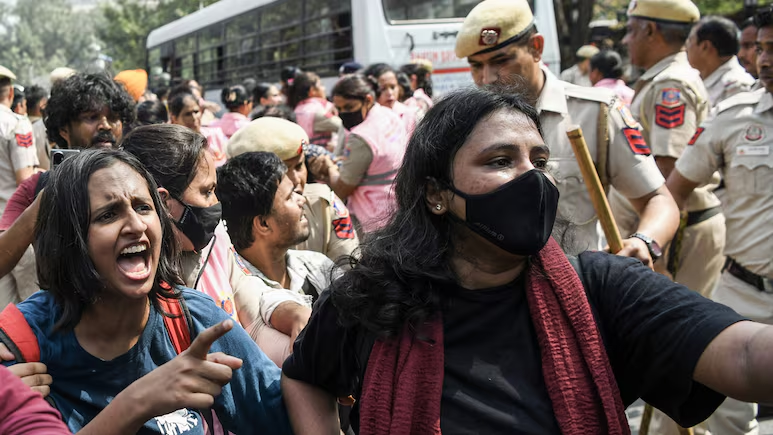
The timing of the announcement is significant because employee unions have already announced plans for further agitation. Government employees have threatened to observe mass casual leave on September 8 if the state does not withdraw disciplinary action linked to the statewide strike held on August 27.
Employees had participated in the August 27 action to press for their demands, including the release of pending DA instalments. Following the strike, departments were asked to issue notices to employees who were absent from duty.
Employee organisations have strongly objected to the disciplinary action. They have given the government a deadline to withdraw the notices and have warned of further protests if their demands are not addressed.
The latest DA proposal could therefore provide relief to one section of employees while leaving the broader agitation unresolved.
Employee unions have also criticised the move as an attempt to divide the workforce by addressing the concerns of post-2020 recruits separately. Representatives of employee organisations have said that their wider demands, including pending DA and arrears, remain unresolved.
The government, on the other hand, has maintained that it is trying to address genuine pay anomalies. Officials have argued that employees recruited after July 2020 are in a different position because their basic salaries are linked to the Central pay structure.
The distinction between the two categories of employees is at the heart of the dispute.
Before July 2020, employees were recruited under Punjab’s existing pay arrangements. After the change, new recruits were brought under a Central government-aligned pay matrix. While this reduced their entry-level basic pay compared with some employees under the older Punjab structure, their DA did not immediately move to the corresponding Central rate.
The proposed revision would change that situation by increasing the DA from 42 percent to 60 percent.
For an employee, DA is calculated as a percentage of basic pay. Therefore, an 18-percentage-point increase does not mean that every employee will receive the same amount of additional money. The actual increase in monthly salary will depend on the individual’s basic pay and applicable salary components.
For example, if an eligible employee has a basic pay of Rs 25,500, DA at 42 percent amounts to Rs 10,710. At 60 percent, the DA would be Rs 15,300, resulting in an increase of Rs 4,590 in the DA component before considering other salary-related calculations.
Similarly, an employee with a basic pay of Rs 35,400 would receive Rs 14,868 as DA at 42 percent. At 60 percent, the DA would become Rs 21,240, representing an increase of Rs 6,372 in the DA component.
The exact impact on take-home salary can differ because deductions, taxes and other allowances also affect the final amount credited to an employee’s account.
The government has also argued that Punjab’s traditional pay scales are higher than Central pay scales in several major cadres. According to Aman Arora, employees under the state’s older pay structure can receive substantially higher basic salaries than their Central counterparts.
However, he said this comparison was less relevant for employees recruited after July 17, 2020 because those employees were themselves placed on the Central pay pattern.
The issue has also become part of a wider legal and political dispute.
The Punjab government recently approached the Supreme Court after the Punjab and Haryana High Court directed the state to clear pending DA and dearness relief arrears. The government has argued that paying the entire outstanding amount immediately would place a substantial financial burden on the state.
The pending arrears have become a major issue for government employees and pensioners. Employee organisations have continued to demand a settlement rather than a selective revision of DA for a particular category.
Punjab has a large government workforce, making the dispute politically important as well as financially significant. The state is also heading towards its next Assembly election in 2027, increasing the political attention around employee and pensioner demands.
The government has recently tried to encourage employee organisations to return to negotiations rather than continue confrontation. Ministers have indicated that discussions could be used to find a solution to the broader dispute.
Employee representatives, however, have maintained that they want action on disciplinary notices and their outstanding financial demands before returning to negotiations.
The proposed DA hike could nevertheless provide immediate financial relief to thousands of newer employees if it receives final approval from the Chief Minister.
The decision is also significant because it effectively recognises that the post-2020 recruitment policy created a separate category of employees with a different basic pay structure but without a corresponding DA rate.
By moving their DA from 42 percent to 60 percent, the government intends to reduce at least part of that disparity.
However, the proposal does not resolve the question of pending DA arrears for the larger workforce. Employees recruited before July 2020 remain outside the latest announcement, despite continuing to demand payment of outstanding instalments.
The government will therefore face pressure from both groups. Post-2020 employees are likely to watch for formal implementation of the 60 percent DA decision, while older employees and their unions are expected to continue pressing for their pending dues.
For the affected 85,000 employees, the most important next step is final approval from Chief Minister Bhagwant Mann. Until that approval and the subsequent formal government order are issued, the announcement should be understood as a proposed revision rather than a fully implemented salary change.
If approved, the new DA rate would provide an 18-percentage-point increase for employees recruited after July 17, 2020 and working under the applicable Central pay structure.
The move could also influence the ongoing employee agitation. Whether it leads to a reduction in protests will depend largely on how unions respond and whether the government addresses the remaining demands concerning arrears, pending DA instalments and disciplinary notices.
For now, Punjab’s decision represents a significant development in the state’s long-running pay dispute. Around 85,000 employees could see their DA increase from 42 percent to 60 percent, potentially bringing their allowance rate in line with the Central pay pattern.
But the larger issue involving more than three lakh other employees remains unresolved. The coming days, particularly the government’s final approval and the employee unions’ response ahead of the proposed September 8 mass casual leave, will determine whether the latest announcement becomes a broader breakthrough or remains limited to one category of Punjab government employees.